


Japanese Prime Minister Junichiro Koizumi appears ready to risk sending troops to Iraq in the face of widespread public opposition and declining popularity for reasons which go beyond Iraqi reconstruction for its own sake, according to diplomats here.
"There is a new generation which wants Japan to be a `normal' country. Iraq is its chance," a western diplomatic source said.
While his government prevaricates over the timing and other substantive details of the promised dispatch, Koizumi repeats at every opportunity that Japan's "basic plan" to send troops to provide humanitarian assistance has not changed.
"Everything is ready, all it needs is the political green light. It's the timing that matters," the source said.
Koizumi has also repeatedly said Japan must not give in to terrorists -- a simplistic argument but one which, taken up by the conservative press, could win over public opinion, especially in the wake of the killing of two Japanese diplomats in northern Iraq last weekend.
But behind all the noble pledges to assist in rebuilding a devastated nation and steadfastness in the face of international terrorism lies the national interest, as the government has readily acknowledged.
"The reconstruction of Iraq is ... directly linked to national interests of our country, which depends on the Middle East region for nearly 90 percent of its oil resources [needs]," the government said in pledging US$5 billion in October to help rebuild the country.
There are also signs of the emergence of a new realpolitik which could dispense with the pacifist taboos of the postwar era.
"Iraq is one more step on the road toward a more normal Japan in the international arena, it's an important landmark," said a diplomat who asked not to be identified.
Yet the debate is skewed since Japan's military contribution to the US-led coalition is largely symbolic. There has never been any suggestion of it doing anything except sending a limited number of non-combatant troops, expected to total 1,000 at most.
Privately, Japanese diplomats admit their principal concern is the nuclear threat posed by North Korea, and that to "back off" from Iraq would proclaim Japan's weakness to the Pyongyang regime.
Koizumi's unstinting support for US President George W. Bush's administration derives from Japan's recourse to the security "umbrella" provided by the US in a security crisis involving North Korea.
But beyond the close and somewhat burdensome -- in terms of hosting tens of thousands of US troops -- alliance with Washington, Japan has aspirations toward greater multilateral ties -- all the more urgent given neighboring China's increasing might.
Increasingly, the "Yoshida doctrine" that guided Japan during the Cold War is seen as having had its day. Named after Japan's most influential postwar prime minister, Shigeru Yoshida, it assigned Japan to be master of its economic destiny while leaving defense issues to the Americans.
But a shift away from that doctrine presupposes amending Japan's postwar pacifist Constitution which, since 1946, has prevented Japan from taking an active part in collective security by renouncing war as a sovereign right or the threat or use of force to settle international disputes.
While clearly flouted by the existence of the so-called Self Defense Forces, Article Nine of the Constitution also states that land, sea and air forces "will never be maintained."
Koizumi has said he wants to revise the constitution from 2005 "to enable [the military] to play an active role in peacekeeping on the international stage."
But the prime minister's ambition of allowing Japan to play what he sees as its proper role in the international community is not without political risk.
As well as paying the price for Japanese blood spilt on Iraqi soil, Koizumi is confronted by deep-rooted pacifism on the part of his coalition partner, the Buddhist-backed New Komei Party.
The centrist party's support is crucial in the upper house of parliament, where Koizumi's Liberal Democratic Party does not have a majority, and for which elections will be held next July.
"Japan is in a period of transition. It's anyone's game," one diplomat said.

Republican US lawmakers on Friday criticized US President Joe Biden’s administration after sanctioned Chinese telecoms equipment giant Huawei unveiled a laptop this week powered by an Intel artificial intelligence (AI) chip. The US placed Huawei on a trade restriction list in 2019 for contravening Iran sanctions, part of a broader effort to hobble Beijing’s technological advances. Placement on the list means the company’s suppliers have to seek a special, difficult-to-obtain license before shipping to it. One such license, issued by then-US president Donald Trump’s administration, has allowed Intel to ship central processors to Huawei for use in laptops since 2020. China hardliners
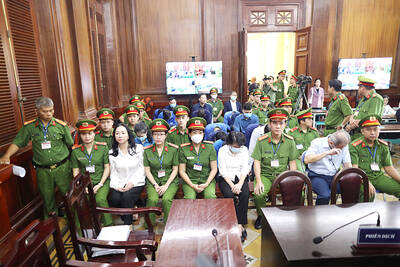
A top Vietnamese property tycoon was on Thursday sentenced to death in one of the biggest corruption cases in history, with an estimated US$27 billion in damages. A panel of three hand-picked jurors and two judges rejected all defense arguments by Truong My Lan, chair of major developer Van Thinh Phat, who was found guilty of swindling cash from Saigon Commercial Bank (SCB) over a decade. “The defendant’s actions ... eroded people’s trust in the leadership of the [Communist] Party and state,” read the verdict at the trial in Ho Chi Minh City. After the five-week trial, 85 others were also sentenced on

‘DELUSIONAL’: Targeting the families of Hamas’ leaders would not push the group to change its position or to give up its demands for Palestinians, Ismail Haniyeh said Israeli aircraft on Wednesday killed three sons of Hamas’ top political leader in the Gaza Strip, striking high-stakes targets at a time when Israel is holding delicate ceasefire negotiations with the militant group. Hamas said four of the leader’s grandchildren were also killed. Ismail Haniyeh’s sons are among the highest-profile figures to be killed in the war so far. Israel said they were Hamas operatives, and Haniyeh accused Israel of acting in “the spirit of revenge and murder.” The deaths threatened to strain the internationally mediated ceasefire talks, which appeared to gain steam in recent days even as the sides remain far
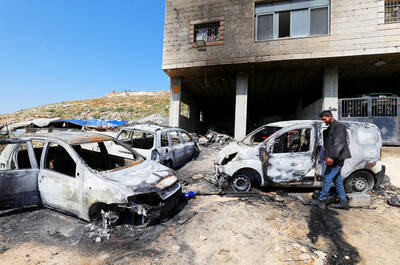
RAMPAGE: A Palestinian man was left dead after dozens of Israeli settlers searching for a missing 14-year-old boy stormed a village in the Israeli-occupied West Bank US President Joe Biden on Friday said he expected Iran to attack Israel “sooner, rather than later” and warned Tehran not to proceed. Asked by reporters about his message to Iran, Biden simply said: “Don’t,” underscoring Washington’s commitment to defend Israel. “We are devoted to the defense of Israel. We will support Israel. We will help defend Israel and Iran will not succeed,” he said. Biden said he would not divulge secure information, but said his expectation was that an attack could come “sooner, rather than later.” Israel braced on Friday for an attack by Iran or its proxies as warnings grew of


 RSS
RSS