


Confronted by a plethora of peace plans and US pressure, Israeli Prime Minister Ariel Sharon is trying to regain the initiative from his opponents and give the impression he is making every effort to end the impasse with the Palestinians.
After earlier floating the idea of launching "unilateral steps," Sharon warned in a press conference last week that Israel can not avoid "painful compromises" in the quest for peace and confirmed that he was ready to order evacuations from certain areas in the Palestinian territories.
While his still vague words have yet to be translated into any firm action, it represents a change in policy by Sharon who until now has ruled out such unilateral measures.
Sharon has felt under pressure to act after recent criticism from his US allies and Israel's top brass over his policies in the Palestinian territories.
And the launch of an alternative peace plan in Geneva on Monday has also served to underline the lack of progress in the peace process under his stewardship.
According to Dan Schueftan, a professor at the University of Haifa and a long-time champion of unilateral Israeli disengagement in the territories, such a strategy should enable Sharon to retake the initiative by helping determine the borders of any future two-state settlement to his advantage.
Schueftan ruled out a formal annexation of areas of the West Bank for the moment, "because if you annex territories, you have a confrontation with the United States."
Instead Sharon would "simply incorportate them de facto without exchanging their position de jure," Schueftan added.
In a major speech last December in Herzliya, near Tel Aviv, Sharon said he was ready to accept the creation of a Palestinian state encompassing the zones transferred to the control of the Palestinian Authority under the terms of the 1993 Oslo accords, consisting of around 42 percent of the West Bank and more than two-thirds of Gaza.
In contrast, the Geneva Initiative envisages the Palestinians taking control of some 97.5 percent of the West Bank and the entire Gaza Strip.
"The Palestinians and [Yossi] Beilin [chief Israeli backer of the Geneva plan] want to mobilize the demographic argument for 100 percent withdrawal, but you can get rid of Israeli control of most of the Palestinians without giving them what they want. And this is where Sharon is heading," Schueftan said.
Apart from the Geneva plan, the opposition Labor party has detailed its own vision for peace in recent days, while Jewish settlers -- who have long regarded Sharon as their ultimate champion -- have also come up with a blueprint which firmly rejects the principle of exchanging land for peace.
Sharon's talk about the need for concessions is also designed to demonstrate to Israeli public opinion, and the US, that he has no intention of allowing the current impasse with the Palestinians to drag on indefinitely.
According to Joseph Alpher, a former advisor to Sharon's predecessor as premier, Labor's Ehud Barak, Sharon is acutely aware of the pressure building up on him.
"My sense is he is saying these things because there are all kinds of pressures on him, because he understands he is losing public support," Alpher said.
"There are American pressures, but more than anything, he is concerned about the Israeli public. This is his response. He is very careful not to say anything that really commits him."
Alpher said that Sharon had shown signs of trying to prepare the Israeli public for major changes, citing a speech last summer when he spoke of "an occupation ... [which] can't go on."
But Alpher said that Sharon still had little intention of dismantling a single settlement, and was expecting another major Palestinian attack to ease the pressure on him to give ground and instead shift the focus back on to security.
"I think at the end of the day, he is probably saying to himself: `There will be some terrorist monstrosity and it will let me off the hook, and I won't have to do anything.'"

Republican US lawmakers on Friday criticized US President Joe Biden’s administration after sanctioned Chinese telecoms equipment giant Huawei unveiled a laptop this week powered by an Intel artificial intelligence (AI) chip. The US placed Huawei on a trade restriction list in 2019 for contravening Iran sanctions, part of a broader effort to hobble Beijing’s technological advances. Placement on the list means the company’s suppliers have to seek a special, difficult-to-obtain license before shipping to it. One such license, issued by then-US president Donald Trump’s administration, has allowed Intel to ship central processors to Huawei for use in laptops since 2020. China hardliners
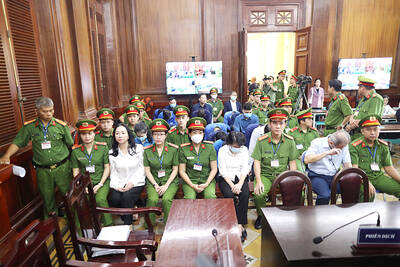
A top Vietnamese property tycoon was on Thursday sentenced to death in one of the biggest corruption cases in history, with an estimated US$27 billion in damages. A panel of three hand-picked jurors and two judges rejected all defense arguments by Truong My Lan, chair of major developer Van Thinh Phat, who was found guilty of swindling cash from Saigon Commercial Bank (SCB) over a decade. “The defendant’s actions ... eroded people’s trust in the leadership of the [Communist] Party and state,” read the verdict at the trial in Ho Chi Minh City. After the five-week trial, 85 others were also sentenced on

‘DELUSIONAL’: Targeting the families of Hamas’ leaders would not push the group to change its position or to give up its demands for Palestinians, Ismail Haniyeh said Israeli aircraft on Wednesday killed three sons of Hamas’ top political leader in the Gaza Strip, striking high-stakes targets at a time when Israel is holding delicate ceasefire negotiations with the militant group. Hamas said four of the leader’s grandchildren were also killed. Ismail Haniyeh’s sons are among the highest-profile figures to be killed in the war so far. Israel said they were Hamas operatives, and Haniyeh accused Israel of acting in “the spirit of revenge and murder.” The deaths threatened to strain the internationally mediated ceasefire talks, which appeared to gain steam in recent days even as the sides remain far
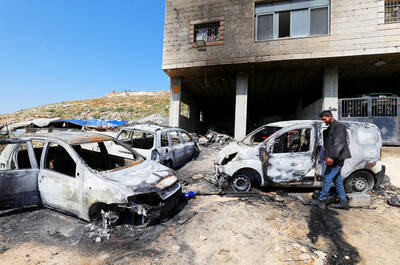
RAMPAGE: A Palestinian man was left dead after dozens of Israeli settlers searching for a missing 14-year-old boy stormed a village in the Israeli-occupied West Bank US President Joe Biden on Friday said he expected Iran to attack Israel “sooner, rather than later” and warned Tehran not to proceed. Asked by reporters about his message to Iran, Biden simply said: “Don’t,” underscoring Washington’s commitment to defend Israel. “We are devoted to the defense of Israel. We will support Israel. We will help defend Israel and Iran will not succeed,” he said. Biden said he would not divulge secure information, but said his expectation was that an attack could come “sooner, rather than later.” Israel braced on Friday for an attack by Iran or its proxies as warnings grew of


 RSS
RSS