


Iraqi scientists never revived their long-dead nuclear bomb program, and in fact lied to Saddam Hussein about how much progress they were making before US-led attacks shut the operation down for good in 1991, Iraqi physicists say.
Before that first Gulf War, the chief of the weapons program resorted to "blatant exaggeration" in telling Iraq's president how much bomb material was being produced, key scientist Imad Khadduri writes in a new book.
Other leading physicists, in Baghdad interviews, said the hope for an Iraqi atomic bomb was never realistic. "It was all like building sand castles," said Abdel Mehdi Talib, Baghdad University's dean of sciences.
Seven months after a US-British invasion toppled Saddam's Baath Party government, Iraqi scientists have grown more vocal in countering Bush administration claims, used to justify the war, that Baghdad had "reconstituted" nuclear weapons development, and that it once was a mere six months from making a bomb.
At best, Khadduri writes, it would have taken Iraq several years to build a nuclear weapon if the 1991 war and subsequent UN inspections had not intervened.
His self-published Iraq's Nuclear Mirage, a chronicle of years of secret weapons work and of a final escape into exile, is part of this senior scientist's emergence from a low profile in Canada -- intended to refute what he calls a "massive deception" in Washington that led the US into war.
Months of searching by hundreds of US experts have found no trace of nuclear, chemical or biological wea-pons in Iraq, just as UN inspectors found none before the war. No Iraqi scientists have confirmed the programs were revived in recent years.
Khadduri, a US- and British-educated physicist, writes that he did theoretical work on nuclear wea-pons as long ago as the mid-1970s, after joining Iraq's Atomic Energy Commission. By the late 1980s, as the secret bomb program accelerated, he was in a pivotal position as coordinator of all its scientific and engineering information.
The UN inspectors of the International Atomic Energy Agency, who dismantled the bomb program after Iraq's defeat in the 1991 war, saw Khadduri as a key source and conducted an all-day interview with him earlier this year in Toronto, where he has resided since 1998.
Iraq's Nuclear Mirage, available via online booksellers, dismisses the US contention that the atom-bomb establishment was somehow resurrected after the IAEA demolished it, UN inspectors were stationed in Iraq and Iraqi specialists were scattered.
"Where is the scientific and engineering staff required for such an enormous effort?" he asks. "Where are the buildings and infrastruc-ture?"
The continuing US weapons hunt amounts to no more than "investigating mirages," he says.
An ex-bombmaker still in Iraq is just as dismissive of the unsubstantiated US allegations.
"There was no point in trying to revive this program. There was no material, no equipment, no scientists," former bomb designer Sabah Abdul Noor said in a recent interview at Baghdad's Technology University.
"Scientists were scattered and under the eyes of inspectors, totally scattered. To do a project, you have to be together."
Talib, the newly elected university dean, was an anti-Baathist who didn't participate in the bomb program, but was close to many who did. They vastly oversold their accomplishments before 1991, the physicist said.
"They put a lot of lies on Saddam Hussein," he said in a Baghdad interview. "They took a lot of money out of him through what you call, in English, bluffing." When their installations were finally demolished, it "saved their necks" by burying their mistakes, he said. "They could tell Saddam: `There's nothing left.'"
Khadduri, in his core position in the program, could attest to the overselling.
He writes that when he transferred top-secret documents of bomb program chief Jafar Dhia Jafar to an optical disc in 1991, he found the "blatant exaggeration" in a 1990 report to Saddam.
Khadduri and others said the design and actual production of a bomb would have been an extremely difficult task.
It was an impossible quest, "all futility," said one of Baghdad's senior nuclear physicists, Hamed M. al-Bahili.
Al-Bahili, who joined the Atomic Energy Commission in 1968 but remained outside the weapons program, said his colleagues inside "all knew they wouldn't achieve results." As for whether the program was later revived, he said, "these American inspectors are wasting their time."

Republican US lawmakers on Friday criticized US President Joe Biden’s administration after sanctioned Chinese telecoms equipment giant Huawei unveiled a laptop this week powered by an Intel artificial intelligence (AI) chip. The US placed Huawei on a trade restriction list in 2019 for contravening Iran sanctions, part of a broader effort to hobble Beijing’s technological advances. Placement on the list means the company’s suppliers have to seek a special, difficult-to-obtain license before shipping to it. One such license, issued by then-US president Donald Trump’s administration, has allowed Intel to ship central processors to Huawei for use in laptops since 2020. China hardliners

Conjoined twins Lori and George Schappell, who pursued separate careers, interests and relationships during lives that defied medical expectations, died this month in Pennsylvania, funeral home officials said. They were 62. The twins, listed by Guinness World Records as the oldest living conjoined twins, died on April 7 at the Hospital of the University of Pennsylvania, obituaries posted by Leibensperger Funeral Homes of Hamburg said. The cause of death was not detailed. “When we were born, the doctors didn’t think we’d make 30, but we proved them wrong,” Lori said in an interview when they turned 50, the Philadelphia Inquirer reported. The
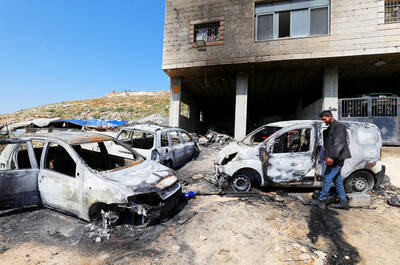
RAMPAGE: A Palestinian man was left dead after dozens of Israeli settlers searching for a missing 14-year-old boy stormed a village in the Israeli-occupied West Bank US President Joe Biden on Friday said he expected Iran to attack Israel “sooner, rather than later” and warned Tehran not to proceed. Asked by reporters about his message to Iran, Biden simply said: “Don’t,” underscoring Washington’s commitment to defend Israel. “We are devoted to the defense of Israel. We will support Israel. We will help defend Israel and Iran will not succeed,” he said. Biden said he would not divulge secure information, but said his expectation was that an attack could come “sooner, rather than later.” Israel braced on Friday for an attack by Iran or its proxies as warnings grew of

A prominent Christian leader has allegedly been stabbed at the altar during a Mass yesterday in southwest Sydney. Bishop Mar Mari Emmanuel was saying Mass at Christ The Good Shepherd Church in Wakeley just after 7pm when a man approached him at the altar and allegedly stabbed toward his head multiple times. A live stream of the Mass shows the congregation swarm forward toward Emmanuel before it was cut off. The church leader gained prominence during the COVID-19 pandemic, amassing a large online following, Officers attached to Fairfield City police area command attended a location on Welcome Street, Wakeley following reports a number


 RSS
RSS