


They are the vanguard of democracy in Iraq, and they like to say they are a most unhappy lot.
"I resent my work; it's very frustrating," said Imad Salih, shaking his head, "I hate it."
Salih is among more than 800 men and women who were elected, or selected, to serve on 88 Baghdad neighborhood councils, nine district councils and one city council, at the encouragement of the US occupation authorities.
They have no authority, no budget, no real power. And for many Iraqis, that is demeaning, if not insulting.
The national Governing Council ignores them. Government ministers will not see them. The City Council members do not merit much respect even at City Hall. A few days ago the lobby receptionist told the City Council chairman he did not recognize him and at first refused to let him in the building.
On top of those problems, some local council members have become targets for anti-American guerrillas. One member of the Mansour regional council reported during a meeting last week that he had found a hand grenade in his house along with a note ordering him to stop working for the council.
Now the council members, and others like them chosen by the Americans in cities and towns across Iraq, are part of the acrimonious debate over the future of the US plan to speed up the transition to self-rule.
Under the US plan, these council members are to play a role in choosing the "transitional assembly" that is to select the next interim government, though some of the council members hope to remain on the ensuing councils.
Hardly anyone, however, seems to think this role in the transition is a good idea.
"These people who have been appointed, we can't say all of them are loyal to the new Iraq," said Jalal Talabani, who is the current head of the Governing Council.
"Some of them are former Baathists," said Mowaffak al-Rubaie, another council member, referring to the party of Saddam Hussein.
No one anticipated this. When they set up the local councils, the Americans appeared to have believed they were performing an important civic function for the Iraqi people. It is the Americans who pay them: City Council members get US$296 a month; those on the District Council receive US$176; and the Neighborhood Council members are paid US$104.
Even with their frustrations, many of the Iraqis chosen to serve say they have been proud to be part of the experiment, several said in interviews. What is more, many of these council members' friends and neighbors are clamoring to be on the councils, too. And even those council members who clench their fists as they complain about their lack of any real power will begrudgingly admit that they appreciate the opportunity.
"Most Iraqis don't know the meaning of democracy," said Yaquob Yousiff al-Bakhatti, who is on the Baghdad City Advisory Council. "So this is a good thing. It is above good."
The US military, in concert with civilian occupation authorities, created the city's elaborate council system last summer out of need -- and civic ambition.
"The purpose was to lay the foundation for local democratic governance, but at the same time, the military needed people to communicate with," said Lieutenant-Colonel Joe Rice, a former mayor of Glendale, Colorado, who helped create the councils and continues to work with them.
Whatever their role in the self-government plan, a look at the councils' work may provide a glimpse of what democracy in Iraq will look like.
At a Baghdad City Council meeting last week, 27 council members -- 23 men and four women -- were ranged around a large rectangular table in a formal meeting hall at City Hall. The council chairman, Adnan Abdul Sahid, sat at a raised dais. To his right, at the short end of the rectangle, sat a group of US military and civilian officers, including Rice, each with a translator whispering in his ear. As the meeting plodded along, none of the Americans said a word.
Late in the morning the council plunged headlong into a discussion of national healthcare financing. In capsule form they articulated problems that, in the US, have consumed millions of hours of study and debate over the past decade. The Iraqis disposed of them quickly.
"We have been trying to finance the system from our own revenues," one councilman explained. "But it isn't working. The prices are too high for the citizens, but they aren't enough for the hospitals. The minister of health has ordered prices reduced by 50 percent. But we should cancel this whole system of self-financing. We need a system that makes sure everyone gets complete medical care."
Without dispute, the council agreed to send a letter to the Health Ministry calling for the abolition of free-market healthcare financing. And that, some Americans say, is the chief weakness of the infant councils.
"They jump to big conclusions without enough critical thinking or study," said one American adviser. "It's almost an emotional thing. It's getting better, but it will take time."
At the same time, the council members are being given rude lessons in government bureaucracy. Later during the meeting, midway through a discussion of problems many Iraqis have acquiring a reliable supply of propane canisters for cooking, a council member blurted out in somewhat surprised frustration: "Whenever I try to investigate the problem, everyone gives me 6,000 excuses. I can't find the truth!"
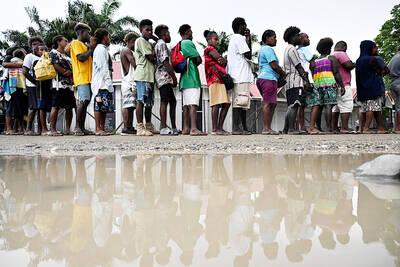
SEEKING CHANGE: A hospital worker said she did not vote in previous elections, but ‘now I can see that maybe my vote can change the system and the country’ Voting closed yesterday across the Solomon Islands in the south Pacific nation’s first general election since the government switched diplomatic allegiance from Taiwan to Beijing and struck a secret security pact that has raised fears of the Chinese navy gaining a foothold in the region. The Solomon Islands’ closer relationship with China and a troubled domestic economy weighed on voters’ minds as they cast their ballots. As many as 420,000 registered voters had their say across 50 national seats. For the first time, the national vote also coincided with elections for eight of the 10 local governments. Esther Maeluma cast her vote in the
Nearly half of China’s major cities are suffering “moderate to severe” levels of subsidence, putting millions of people at risk of flooding, especially as sea levels rise, according to a study of nationwide satellite data released yesterday. The authors of the paper, published by the journal Science, found that 45 percent of China’s urban land was sinking faster than 3mm per year, with 16 percent at more than 10mm per year, driven not only by declining water tables, but also the sheer weight of the built environment. With China’s urban population already in excess of 900 million people, “even a small portion

UNSETTLING IMAGES: The scene took place in front of TV crews covering the Trump trial, with a CNN anchor calling it an ‘emotional and unbelievably disturbing moment’ A man who doused himself in an accelerant and set himself on fire outside the courthouse where former US president Donald Trump is on trial has died, police said yesterday. The New York City Police Department (NYPD) said the man was declared dead by staff at an area hospital. The man was in Collect Pond Park at about 1:30pm on Friday when he took out pamphlets espousing conspiracy theories, tossed them around, then doused himself in an accelerant and set himself on fire, officials and witnesses said. A large number of police officers were nearby when it happened. Some officers and bystanders rushed

HYPOCRISY? The Chinese Ministry of Foreign Affairs yesterday asked whether Biden was talking about China or the US when he used the word ‘xenophobic’ US President Joe Biden on Wednesday called for a hike in steel tariffs on China, accusing Beijing of cheating as he spoke at a campaign event in Pennsylvania. Biden accused China of xenophobia, too, in a speech to union members in Pittsburgh. “They’re not competing, they’re cheating. They’re cheating and we’ve seen the damage here in America,” Biden said. Chinese steel companies “don’t need to worry about making a profit because the Chinese government is subsidizing them so heavily,” he said. Biden said he had called for the US Trade Representative to triple the tariff rates for Chinese steel and aluminum if Beijing was


 RSS
RSS