


India's two main political parties may be fielding three female candidates for the top jobs in states holding polls next week, but analysts say the number of women in Indian politics is still abysmally low.
The ruling Hindu nationalist Bharatiya Janata Party (BJP) is putting up former royal Vasundhra Raje Scindia in the western state of Rajasthan and Hindu nun and former federal minister Uma Bharati in central Madhya Pradesh for the chief ministers' posts.
Both are challenging male incumbents from India's main opposition Congress party headed by Sonia Gandhi, the Italian-born widow of former prime minister Rajiv Gandhi.
In Delhi state, the Congress's incumbent chief minister Sheila Dixit is warding off a determined challenge from the BJP.
Both parties -- which say they want one-third of the seats in the national parliament and state legislatures reserved for women -- have said their nomination of women for top jobs is aimed at giving women a higher profile in politics.
BJP spokesman Prakash Jadavekar said the party's nomination of two women for chief ministership is a first for the party in 50 years.
"This shows we are for the upliftment of women and we want more of them in politics," said Jadavekar.
But Zoya Hassan, a professor of political studies from Delhi's Jawaharlal Nehru University, dismissed the actions as tokenism.
"It is important that these candidates are women, but in my view it is a symbolic thing. Even when they win, they do not take up women's issues like violence against women, unemployment, women's education opportunities, etc."
In all, the BJP has fielded 56 women in the four states where state assembly polls will be held on Dec. 1 -- Rajasthan, Madhya Pradesh, neighboring Chattisgarh and the national capital Delhi.
Jadvekar admits women make up just nine percent of the BJP's total candidature.
The Congress has done little better. "We have 18 women candidates in Rajasthan, 35 in Madhya Pradesh and about 12 in Delhi. In Chattisgarh, we could not find suitable candidates," said a Congress leader, Renuka Chowdhury.
Political parties say the "winnability" factor of a candidate -- whether male or female -- overrides most other considerations.
But Jadavekar of the BJP admitted: "If the bill proposing the reservation of one-third of its seats in parliament and legislatures is made into a law, then we can do better."
The argument that men have greater "winnability" than women has been negated by a study by the Centre for Scientific Research, a New Delhi-based women's organization.
The study found that results from state polls in Delhi in 1998 showed that just eight percent of male candidates nominated by various political parties won their seats, while the winning percentage for women was 15.78.
In previous elections too, women candidates fared better than men, the study said.
In some constituencies, women have been fielded by the Congress and the BJP as part of strategy.
India has had just a handful of women as chief ministers and one woman prime minister, Indira Gandhi.
Nearly half of China’s major cities are suffering “moderate to severe” levels of subsidence, putting millions of people at risk of flooding, especially as sea levels rise, according to a study of nationwide satellite data released yesterday. The authors of the paper, published by the journal Science, found that 45 percent of China’s urban land was sinking faster than 3mm per year, with 16 percent at more than 10mm per year, driven not only by declining water tables, but also the sheer weight of the built environment. With China’s urban population already in excess of 900 million people, “even a small portion

UNSETTLING IMAGES: The scene took place in front of TV crews covering the Trump trial, with a CNN anchor calling it an ‘emotional and unbelievably disturbing moment’ A man who doused himself in an accelerant and set himself on fire outside the courthouse where former US president Donald Trump is on trial has died, police said yesterday. The New York City Police Department (NYPD) said the man was declared dead by staff at an area hospital. The man was in Collect Pond Park at about 1:30pm on Friday when he took out pamphlets espousing conspiracy theories, tossed them around, then doused himself in an accelerant and set himself on fire, officials and witnesses said. A large number of police officers were nearby when it happened. Some officers and bystanders rushed

HYPOCRISY? The Chinese Ministry of Foreign Affairs yesterday asked whether Biden was talking about China or the US when he used the word ‘xenophobic’ US President Joe Biden on Wednesday called for a hike in steel tariffs on China, accusing Beijing of cheating as he spoke at a campaign event in Pennsylvania. Biden accused China of xenophobia, too, in a speech to union members in Pittsburgh. “They’re not competing, they’re cheating. They’re cheating and we’ve seen the damage here in America,” Biden said. Chinese steel companies “don’t need to worry about making a profit because the Chinese government is subsidizing them so heavily,” he said. Biden said he had called for the US Trade Representative to triple the tariff rates for Chinese steel and aluminum if Beijing was
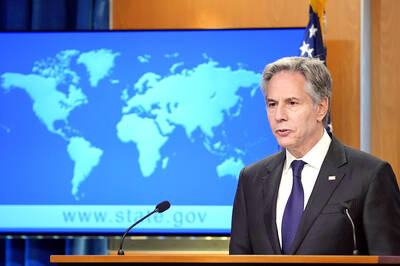
Beijing is continuing to commit genocide and crimes against humanity against Uyghurs and other Muslim minorities in its western Xinjiang province, U.S. Secretary of State Antony Blinken said in a report published on Monday, ahead of his planned visit to China this week. The State Department’s annual human rights report, which documents abuses recorded all over the world during the previous calendar year, repeated language from previous years on the treatment of Muslims in Xinjiang, but the publication raises the issue ahead of delicate talks, including on the war in Ukraine and global trade, between the top U.S. diplomat and Chinese


 RSS
RSS