


The isolation, poverty and discrimination suffered by the 3 million Roma or gypsies of eastern and central Europe is about to land on the doorstep of the EU as it takes in new members. Experts say those problems stem from the lack of education, or the poor quality of education available to the Roma.
They have only a minute chance of entering higher education because of segregation from an early age, inferior schooling, absenteeism and, above all, their high drop-out rate. In Bulgaria, for example, Roma make up 20 percent of the children entering school at seven, but only two percent of students aged between 15 and 19 in secondary schools.
"The education of the Roma is the key problem from which all their difficulties stem," said Mikhail Ivanov of the Bulgarian national council for ethnic and demographic questions.
Segregation is a problem in all the countries, but the problems are particularly acute in Romania, which has a gypsy population of 1.5 million, of whom one in three are illiterate.
"In many establishments I have visited recently, Roma children are made to study in separate classrooms that are often insalubrious," said Costel Bercus, of the Romani Criss association in Bucharest.
"The decision to separate the Roma children from their Romanian comrades is taken by the school principals in violation of the law," he said. "They assign the children to classes according to the color of their skin."
Bercus said a child constrained to study in one of the classrooms for Roma has "practically no chance of evolving and integrating into society."
In the Czech republic, the Nova Skola (new school) association estimates 75 percent of Roma children are sent to special classes for problem children. In Bulgaria, Roma are sometimes sent to schools for the mentally retarded because they cannot speak the Bulgarian language, and about 70 percent are sent to inferior schools that have seen little improvement since Communist days.
Under pressure from the EU to end such discrimination, countries claim to be making some effort to deal with the problem.
The Romanian secretary of state for education, Gheorghe Sarau, says his country is one that offers Roma literature in schools, although there was no indication of how many students are taking the subject.
The Hungarian government has promised to eliminate Roma-only classes by 2008. Bulgaria has promised to step up integration by creating mixed schools where Roma will form up to one third of the student body. The Czech republic is making scholarships available to Roma children who want to continue through high school.
Here in Kosice, on the eastern fringe of what will be the enlarged EU next year, a couple of schools are trying to overcome the neglect and discrimination that surrounds the Roma by emphasizing their culture and teaching their language.
"It is an experiment, since studies in the Roma language are still not accredited by the ministry of education," said Anna Koptova, principal of a private Roma school that opened in September, which seeks to help the Roma community break out of its isolation.
"It is a standard school where Roma is studied as a foreign language," she added. "All the other subjects are taught in the Slovakian language."
Koptova said the Roma community, which is expending at a rate far faster than the rest of the population, needs intellectuals, and the school here is a step in that direction. But so far, it has only 22 pupils.
In Kosice, however, Roma make up about 70 percent of the 350-member student body at a secondary school specializing in the arts. The school emphasizes two strong points of the Roma people, music and dance.
The principal, Gejza Adam, described the place as a "school of tolerance where the majority cohabits with minorities." All the students, including those who are not gypsies, must learn the Roma language and study the culture and history of the community.
Adam said the ethnic tensions so much in evidence in Slovakia are absent at the school. The misty-eyed couples from different ethnic backgrounds who drift along the corridors in the breaks between classes seem to make the point for him.

Republican US lawmakers on Friday criticized US President Joe Biden’s administration after sanctioned Chinese telecoms equipment giant Huawei unveiled a laptop this week powered by an Intel artificial intelligence (AI) chip. The US placed Huawei on a trade restriction list in 2019 for contravening Iran sanctions, part of a broader effort to hobble Beijing’s technological advances. Placement on the list means the company’s suppliers have to seek a special, difficult-to-obtain license before shipping to it. One such license, issued by then-US president Donald Trump’s administration, has allowed Intel to ship central processors to Huawei for use in laptops since 2020. China hardliners
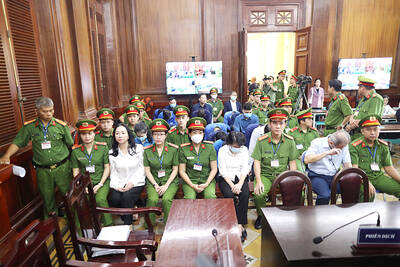
A top Vietnamese property tycoon was on Thursday sentenced to death in one of the biggest corruption cases in history, with an estimated US$27 billion in damages. A panel of three hand-picked jurors and two judges rejected all defense arguments by Truong My Lan, chair of major developer Van Thinh Phat, who was found guilty of swindling cash from Saigon Commercial Bank (SCB) over a decade. “The defendant’s actions ... eroded people’s trust in the leadership of the [Communist] Party and state,” read the verdict at the trial in Ho Chi Minh City. After the five-week trial, 85 others were also sentenced on

‘DELUSIONAL’: Targeting the families of Hamas’ leaders would not push the group to change its position or to give up its demands for Palestinians, Ismail Haniyeh said Israeli aircraft on Wednesday killed three sons of Hamas’ top political leader in the Gaza Strip, striking high-stakes targets at a time when Israel is holding delicate ceasefire negotiations with the militant group. Hamas said four of the leader’s grandchildren were also killed. Ismail Haniyeh’s sons are among the highest-profile figures to be killed in the war so far. Israel said they were Hamas operatives, and Haniyeh accused Israel of acting in “the spirit of revenge and murder.” The deaths threatened to strain the internationally mediated ceasefire talks, which appeared to gain steam in recent days even as the sides remain far
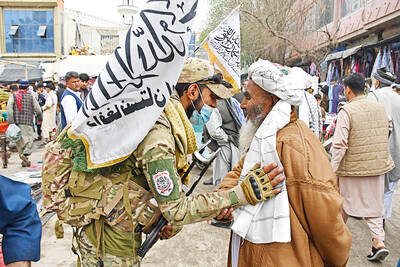
The Taliban’s reclusive supreme leader made a rare public appearance yesterday, an Afghan government spokesman said, leading thousands of worshipers in prayers marking Eid al-Fitr. Hibatullah Akhundzada has made only a handful of public appearances since inheriting the leadership of the Taliban in 2016 and leading the movement back to power with the withdrawal of US forces in 2021. Taliban government spokesman Zabihullah Mujahid said prayer in the largest mosque in Kandahar was “performed under the leadership of the supreme leader.” In a statement on X, he said the early-morning service “was attended by thousands of compatriots” in the southern province considered the


 RSS
RSS