


Angry young people scattered throughout a crowd of mourners in Instanbul on Saturday, carrying placards that amplified their belief that Turkey was paying with its blood for American sins.
Some were rude, others merely said that Turkey's relations with the US should be abolished.

PHOTO: AFP
But as more than 1,000 Turks gathered to express their anger and sorrow over the deadly bombings in this city, the more commonly expressed feeling was Turkey's determination not to be cowed by the bombers.
Although an apparent aim of the recent bombings here was to drive a broad and deep wedge between the US and Turkey, it is not at all clear that they have succeeded in doing so.
Nor is there any indication that Britain and Italy, two other American allies that recently suffered losses in connection to terrorism and the US-led war in Iraq, are re-examining their commitments to the US.
The Turkish, British and Italian governments have all more or less pledged continued allegiance, and they have not cast the damage inflicted on their countries as a direct, negotiable cost of helping the US.
When British Foreign Minister Jack Straw was asked by a British radio station if the bombing of the British consulate in Istanbul was payback for Britain's role in the war, he called that notion "utter and palpable nonsense."
That is perhaps to be expected: a matter of political self-preservation. But less predictably, those governments do not yet seem to be facing new opposition to their partnerships with the US, although the opposition that existed has been emboldened.
"I don't see any hostility or sort of alienation of Turkey from the Western world," said Ozdem Sanberk, the director of the Turkish Economic and Social Studies Foundation.
"The message is going in a totally different way," he said.
The losses suffered by Turkey, Britain and Italy could, however, force those governments and the US to make adjustments as President George W. Bush prosecutes his declared campaign against terrorism.
Late last week, opposition politicians in Italy began to insist more urgently and pointedly on an enhanced role for the UN in Iraq and the swifter installment of an Iraqi government.
"The conditions for our presence there cannot remain the same," said Lapo Pistelli, a center-left member of the Italian parliament, referring to Italian armed forces.
After the fall of the government of former Iraqi president Saddam Hussein, Italy authorized the dispatch of 3,000 police officers, soldiers and civilians to Iraq, and 19 of them were killed in a suicide bombing there a week and a half ago.
It was the most deadly single attack on Italian military forces since World War II, and it prompted a heart-wrenching, tear-filled week of memorial services that hundreds of thousands of Italians attended.
But it did not prompt an outcry that the troops be brought home, even though a majority of Italians opposed the American-led invasion of Iraq. There was more public commentary devoted to the tactics of terrorists inside and outside Iraq and to the importance of not being intimidated by them.
"The 19 dead have maybe strengthened this resolve," said Roberto d'Alimonte, a political scientist in Florence.
"I think that they have been for us, with all due deference, and I ask for apologies, what Sept. 11 was for Americans," he said.
He was suggesting that, in response to being the targets of an attack, both outrage at the bombers and national pride had kicked in, and that those reactions prevented any other, more critical ones.

Republican US lawmakers on Friday criticized US President Joe Biden’s administration after sanctioned Chinese telecoms equipment giant Huawei unveiled a laptop this week powered by an Intel artificial intelligence (AI) chip. The US placed Huawei on a trade restriction list in 2019 for contravening Iran sanctions, part of a broader effort to hobble Beijing’s technological advances. Placement on the list means the company’s suppliers have to seek a special, difficult-to-obtain license before shipping to it. One such license, issued by then-US president Donald Trump’s administration, has allowed Intel to ship central processors to Huawei for use in laptops since 2020. China hardliners
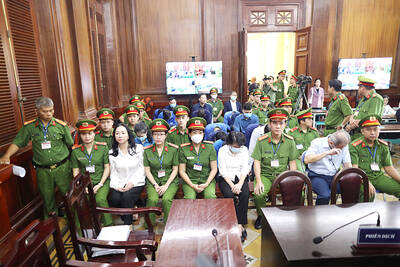
A top Vietnamese property tycoon was on Thursday sentenced to death in one of the biggest corruption cases in history, with an estimated US$27 billion in damages. A panel of three hand-picked jurors and two judges rejected all defense arguments by Truong My Lan, chair of major developer Van Thinh Phat, who was found guilty of swindling cash from Saigon Commercial Bank (SCB) over a decade. “The defendant’s actions ... eroded people’s trust in the leadership of the [Communist] Party and state,” read the verdict at the trial in Ho Chi Minh City. After the five-week trial, 85 others were also sentenced on

‘DELUSIONAL’: Targeting the families of Hamas’ leaders would not push the group to change its position or to give up its demands for Palestinians, Ismail Haniyeh said Israeli aircraft on Wednesday killed three sons of Hamas’ top political leader in the Gaza Strip, striking high-stakes targets at a time when Israel is holding delicate ceasefire negotiations with the militant group. Hamas said four of the leader’s grandchildren were also killed. Ismail Haniyeh’s sons are among the highest-profile figures to be killed in the war so far. Israel said they were Hamas operatives, and Haniyeh accused Israel of acting in “the spirit of revenge and murder.” The deaths threatened to strain the internationally mediated ceasefire talks, which appeared to gain steam in recent days even as the sides remain far
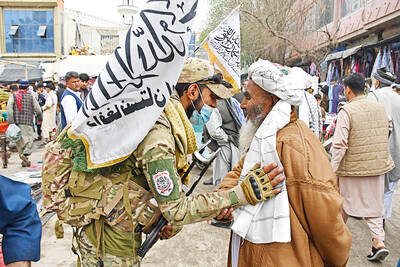
The Taliban’s reclusive supreme leader made a rare public appearance yesterday, an Afghan government spokesman said, leading thousands of worshipers in prayers marking Eid al-Fitr. Hibatullah Akhundzada has made only a handful of public appearances since inheriting the leadership of the Taliban in 2016 and leading the movement back to power with the withdrawal of US forces in 2021. Taliban government spokesman Zabihullah Mujahid said prayer in the largest mosque in Kandahar was “performed under the leadership of the supreme leader.” In a statement on X, he said the early-morning service “was attended by thousands of compatriots” in the southern province considered the


 RSS
RSS