


If you thought soaps were just about sultry sex and incredible plot twists, then think again.
In parts of the developing world, TV soap operas are saving lives, promoting social change and leading the fight against AIDS -- and mostly without even peeping into the bedroom.
In India, Detective Vijay tackles issues ranging from wife-beating, the education of girls, female empowerment and HIV-AIDS in a soap opera aimed at rural males that has became one of the country's top 10 programs.
In South Africa, the seven-year-old soap Soul City is watched by two-thirds of the population and has ventured into everything from AIDS and alcoholism to diarrhoea and depression.
"One shantytown near Pretoria has renamed itself Soul City because of the influence of the program," executive producer Agnes Shabalala told an international "soap summit" in Los Angeles last week for people involved in the industry.
In China, the daily drama Ordinary People has raised issues such as the traditional Chinese preference for sons, the mistreatment of women and the ostracizing of those with HIV-AIDS.
"We like to create a good story with a social message. Of the 1.3 billion population in China, 800 million watch our show every day," said Ordinary People producer Yan Jiande.
US soaps have incorporated social issues into popular entertainment for years, often exporting their series around the world.
But speakers at the "soap summit" are benefiting from an innovative program devised by the US-based non-profit agency Population Communications International (PCI).
PCI works with governments, non-governmental organizations and individual radio and TV stations worldwide to fund and create locally produced soaps to inspire and motivate social change in nations as diverse as Peru and Pakistan.
Sonny Fox, senior vice president for PCI's US arm, said that entertainment was the "magic weapon" in educating and changing entrenched attitudes in those countries where mass television is a relatively recent phenomenon.
"Soap summit" participants said some of their biggest challenges were the cultural, and sometimes political, sensibilities of their target audiences, particularly in the fight against HIV-AIDS where infection has reached pandemic proportions in some countries.
Speakers at the meeting said an estimated 5.3 million people in South Africa now have the HIV infection, and about 4.5 million in India.
Yan said that while the Chinese authorities were very supportive of Ordinary People, "they have said we could show AIDS as something contracted through drugs or blood transfusions, but not through a sexual relationship.
"The depiction of sexual relations is not acceptable either to rural societies, or to the government. Ten years ago, even a scene involving kissing would be cut," Yan said.
Devika Bahl, creative director of the Indian soap Detective Vijay, said it was still taboo in India to discuss homosexuality and the show's writers have yet to explain to viewers how their hero became HIV-positive.
"That is a challenge for us. We can't really show kissing on screen. The maximum acceptable is a peck on the shoulder. So the sexual route is not going to be acceptable.
"We need to find ways of saying things that are culturally acceptable, otherwise the message is just not going to get through," Bahl said.
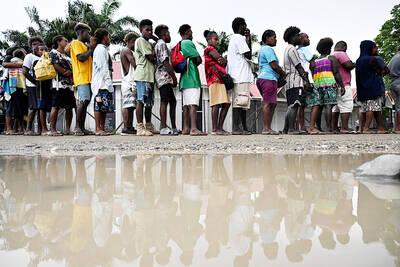
SEEKING CHANGE: A hospital worker said she did not vote in previous elections, but ‘now I can see that maybe my vote can change the system and the country’ Voting closed yesterday across the Solomon Islands in the south Pacific nation’s first general election since the government switched diplomatic allegiance from Taiwan to Beijing and struck a secret security pact that has raised fears of the Chinese navy gaining a foothold in the region. The Solomon Islands’ closer relationship with China and a troubled domestic economy weighed on voters’ minds as they cast their ballots. As many as 420,000 registered voters had their say across 50 national seats. For the first time, the national vote also coincided with elections for eight of the 10 local governments. Esther Maeluma cast her vote in the
Nearly half of China’s major cities are suffering “moderate to severe” levels of subsidence, putting millions of people at risk of flooding, especially as sea levels rise, according to a study of nationwide satellite data released yesterday. The authors of the paper, published by the journal Science, found that 45 percent of China’s urban land was sinking faster than 3mm per year, with 16 percent at more than 10mm per year, driven not only by declining water tables, but also the sheer weight of the built environment. With China’s urban population already in excess of 900 million people, “even a small portion

UNSETTLING IMAGES: The scene took place in front of TV crews covering the Trump trial, with a CNN anchor calling it an ‘emotional and unbelievably disturbing moment’ A man who doused himself in an accelerant and set himself on fire outside the courthouse where former US president Donald Trump is on trial has died, police said yesterday. The New York City Police Department (NYPD) said the man was declared dead by staff at an area hospital. The man was in Collect Pond Park at about 1:30pm on Friday when he took out pamphlets espousing conspiracy theories, tossed them around, then doused himself in an accelerant and set himself on fire, officials and witnesses said. A large number of police officers were nearby when it happened. Some officers and bystanders rushed

HYPOCRISY? The Chinese Ministry of Foreign Affairs yesterday asked whether Biden was talking about China or the US when he used the word ‘xenophobic’ US President Joe Biden on Wednesday called for a hike in steel tariffs on China, accusing Beijing of cheating as he spoke at a campaign event in Pennsylvania. Biden accused China of xenophobia, too, in a speech to union members in Pittsburgh. “They’re not competing, they’re cheating. They’re cheating and we’ve seen the damage here in America,” Biden said. Chinese steel companies “don’t need to worry about making a profit because the Chinese government is subsidizing them so heavily,” he said. Biden said he had called for the US Trade Representative to triple the tariff rates for Chinese steel and aluminum if Beijing was


 RSS
RSS