


Sri Lanka's power struggle deepened yesterday as parliament reopened after a forced two-week shutdown and declared that its suspension by a hostile president was undemocratic and illegal.
Speaker Joseph Michael Perera said the legislature could disregard President Chandrika Kumaratunga if she ordered another suspension to paralyze the work of Prime Minister Ranil Wickremesinghe's government.
Perera read out his five-page ruling amid angry protests from members of parliament (MPs) of Kumaratunga's party, which is the main opposition, and the president's emerging Marxist ally, the JVP, or People's Liberation Front.
Kumaratunga suspended parliament after sacking three ministers on Nov. 4. At the same time her office said a state of emergency was also imposed but denied it three days later.
Her action led Norway to suspend its mediation role to end Sri Lanka's three-decade ethnic war until there was "clarity" on who was in charge in Colombo.
"The sudden prorogation done ... without the support of any valid reason and against the wishes of the parliament can only be described as an act to deliberately prevent due functioning of parliament," Perera said, adding he hoped it would not "set an unhealthy precedent for the future."
Perera is from Wickremesinghe's United National Party, but the office of the speaker is officially neutral. His rulings are binding on the legislature and cannot be challenged in court.
He cited precedents in fellow Commonwealth nations Australia, Britain, India and New Zealand and said no parliament in the world had been suspended by an executive without the agreement of the prime minister. He noted that under the French system, the president could summon parliament, but not prorogue it without the consent of the prime minister.
Kumaratunga's action also went against democracy, he said, and warned that a lack of cooperation between the president and parliament could lead to a crippling of the entire government.
"When different parties hold power in these two branches it is essential, if the expectations of the people are to be fulfilled, for both these branches of government to act in cooperation," he said.
There was no immediate reaction from the president to the challenge to her authority, but Kumaratunga's party said it would move to bring a no-trust vote against the speaker.
"What the speaker has done is unconstitutional," opposition legislator Nimal Siripala de Silva told reporters.

Republican US lawmakers on Friday criticized US President Joe Biden’s administration after sanctioned Chinese telecoms equipment giant Huawei unveiled a laptop this week powered by an Intel artificial intelligence (AI) chip. The US placed Huawei on a trade restriction list in 2019 for contravening Iran sanctions, part of a broader effort to hobble Beijing’s technological advances. Placement on the list means the company’s suppliers have to seek a special, difficult-to-obtain license before shipping to it. One such license, issued by then-US president Donald Trump’s administration, has allowed Intel to ship central processors to Huawei for use in laptops since 2020. China hardliners

Conjoined twins Lori and George Schappell, who pursued separate careers, interests and relationships during lives that defied medical expectations, died this month in Pennsylvania, funeral home officials said. They were 62. The twins, listed by Guinness World Records as the oldest living conjoined twins, died on April 7 at the Hospital of the University of Pennsylvania, obituaries posted by Leibensperger Funeral Homes of Hamburg said. The cause of death was not detailed. “When we were born, the doctors didn’t think we’d make 30, but we proved them wrong,” Lori said in an interview when they turned 50, the Philadelphia Inquirer reported. The
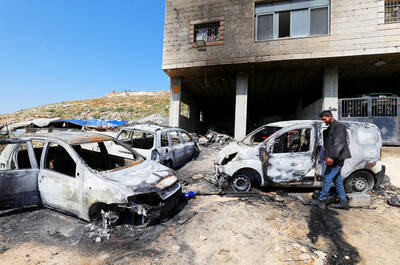
RAMPAGE: A Palestinian man was left dead after dozens of Israeli settlers searching for a missing 14-year-old boy stormed a village in the Israeli-occupied West Bank US President Joe Biden on Friday said he expected Iran to attack Israel “sooner, rather than later” and warned Tehran not to proceed. Asked by reporters about his message to Iran, Biden simply said: “Don’t,” underscoring Washington’s commitment to defend Israel. “We are devoted to the defense of Israel. We will support Israel. We will help defend Israel and Iran will not succeed,” he said. Biden said he would not divulge secure information, but said his expectation was that an attack could come “sooner, rather than later.” Israel braced on Friday for an attack by Iran or its proxies as warnings grew of

A prominent Christian leader has allegedly been stabbed at the altar during a Mass yesterday in southwest Sydney. Bishop Mar Mari Emmanuel was saying Mass at Christ The Good Shepherd Church in Wakeley just after 7pm when a man approached him at the altar and allegedly stabbed toward his head multiple times. A live stream of the Mass shows the congregation swarm forward toward Emmanuel before it was cut off. The church leader gained prominence during the COVID-19 pandemic, amassing a large online following, Officers attached to Fairfield City police area command attended a location on Welcome Street, Wakeley following reports a number


 RSS
RSS