


Just a month ago, Palestinian President Yasser Arafat appeared to be losing his grip on power, looking weak as rumors swirled that he was near death. His new prime minister was challenging him and an Israeli threat to "remove" him hung over his head.
Now, the ultimate political survivor is back on top, looking healthy after putting his prime minister in his place, keeping a firm hold over the Palestinian government and rebuffing US and Israeli efforts to push him aside.
The Palestinian's leader's rapid resurgence will likely frustrate efforts to resuscitate the US-backed "road map" peace plan, which envisioned an end to violence and the creation of a Palestinian state by 2005, but stalled amid bloodshed and political maneuvering.
Both sides failed to meet their obligations -- Palestinian action against militants and an Israeli set-tlement freeze.
Arafat has consistently avoided confrontation with armed groups, said Dore Gold, an adviser to Israeli Prime Minister Ariel Sharon.
"To expect all of a sudden that Yasser Arafat will join the war on terrorism is to expect a conversion that nobody believes is going to occur," Gold said. "This just represents a major roadblock to the road map."
Hassan Khreishe, a Palestinian legislator, worried that Israel and the US would shun the Palestinian Cabinet, which was hand-picked by Arafat in a show of power. The Cabinet was announced Sunday and is to face a parliamentary vote of confidence tomorrow.
"This is Yasser Arafat's government," said Khreishe, a frequent critic of the Palestinian leader. "He chose it just to send a message to the world that Yasser Arafat is the decision maker here."
However, Israel stopped short of declaring a boycott. Israel will judge the new Palestinian government on its performance, Gold said.
The US and Israel, accusing Arafat of promoting terror attacks and refusing to deal with them, had pressured the Palestinians to create the office of prime minister. The intent was to shave off some of Arafat's power and eventually force him out of the picture.
The first prime minister, Mahmoud Abbas, resigned in September after just four months in office after tussling with Arafat over control of the Palestinian security forces.
His successor, Ahmed Qureia, was drawn into the same struggle, apparently realizing that he would have little success on the job without command of security. He sought to consolidate the eight branches of the security forces under General Nasser Yousef, his candidate for interior minister.
Resisting efforts to weaken him, Arafat played for time. Yousef handed Arafat an excuse to reject him when he refused to take part in a swearing-in ceremony -- conducted by Arafat -- of an emergency Cabinet. Yousef said the temporary Cabinet, appointed by Arafat decree, was invalid. Arafat turned his opposition to Yousef, who had surprised him by seeking broad powers, into something personal, now insisting that the general not serve in a new government.
Arafat's fortunes changed dra-matically just within a month. Last month, he had appeared ill and dazed in public, his eyes rheumy and his skin pale and clammy. Rumors circulated he had stomach cancer or suffered a mild heart attack.
However, he recovered from what his aides said was just a bad case of stomach flu. Israel's threats in September to "remove" him -- suggesting either expulsion or assassination -- boosted his sagging popularity at home, with one recent poll showing 50 percent of Palestinians supported him, up from 35 percent in June.
And Sharon suggested Israel would leave Arafat alone. "If the Palestinians want to keep Arafat as a symbol -- though I don't know what specifically he embodies -- it's the business of the Palestinians," he said last week during a trip to Russia.
On Sunday, Arafat won a re-sounding victory over Qureia with the naming of a new Cabinet, tightening his grip over the security services and punishing Yousef's snub by naming a different interior minister.
Qureia had a stark choice, said Palestinian political analyst Hani Masri. He could have continued to fight and appear to be doing the bidding of Sharon and US President George W. Bush, or he could give in and appear to be working with Arafat.
"He's chosen Arafat, because if he didn't, he would have been sent home," Masri said.
Kadoura Fares, one of the few newcomers named to the Cabinet, derided US and Israeli efforts to bypass Arafat.
"It's not helpful, not for peace, not for anything," he said. "Yasser Arafat is the only one on the Palestinian side who can put his signature on a final [peace] agreement."

Republican US lawmakers on Friday criticized US President Joe Biden’s administration after sanctioned Chinese telecoms equipment giant Huawei unveiled a laptop this week powered by an Intel artificial intelligence (AI) chip. The US placed Huawei on a trade restriction list in 2019 for contravening Iran sanctions, part of a broader effort to hobble Beijing’s technological advances. Placement on the list means the company’s suppliers have to seek a special, difficult-to-obtain license before shipping to it. One such license, issued by then-US president Donald Trump’s administration, has allowed Intel to ship central processors to Huawei for use in laptops since 2020. China hardliners

A top Vietnamese property tycoon was on Thursday sentenced to death in one of the biggest corruption cases in history, with an estimated US$27 billion in damages. A panel of three hand-picked jurors and two judges rejected all defense arguments by Truong My Lan, chair of major developer Van Thinh Phat, who was found guilty of swindling cash from Saigon Commercial Bank (SCB) over a decade. “The defendant’s actions ... eroded people’s trust in the leadership of the [Communist] Party and state,” read the verdict at the trial in Ho Chi Minh City. After the five-week trial, 85 others were also sentenced on

Conjoined twins Lori and George Schappell, who pursued separate careers, interests and relationships during lives that defied medical expectations, died this month in Pennsylvania, funeral home officials said. They were 62. The twins, listed by Guinness World Records as the oldest living conjoined twins, died on April 7 at the Hospital of the University of Pennsylvania, obituaries posted by Leibensperger Funeral Homes of Hamburg said. The cause of death was not detailed. “When we were born, the doctors didn’t think we’d make 30, but we proved them wrong,” Lori said in an interview when they turned 50, the Philadelphia Inquirer reported. The
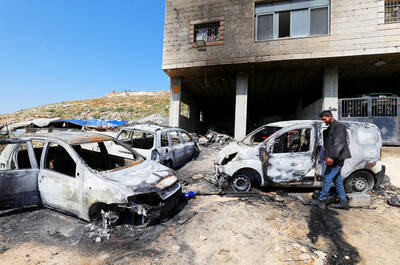
RAMPAGE: A Palestinian man was left dead after dozens of Israeli settlers searching for a missing 14-year-old boy stormed a village in the Israeli-occupied West Bank US President Joe Biden on Friday said he expected Iran to attack Israel “sooner, rather than later” and warned Tehran not to proceed. Asked by reporters about his message to Iran, Biden simply said: “Don’t,” underscoring Washington’s commitment to defend Israel. “We are devoted to the defense of Israel. We will support Israel. We will help defend Israel and Iran will not succeed,” he said. Biden said he would not divulge secure information, but said his expectation was that an attack could come “sooner, rather than later.” Israel braced on Friday for an attack by Iran or its proxies as warnings grew of


 RSS
RSS