


Guatemala, still struggling to overcome 36 years of civil war, has endured months of election-related violence and faces the possibility of more as voters decide this weekend whether to give a former dictator accused of human rights abuses another chance to run the country.
General Efrain Rios Montt is a distant third in the polls, but many fear he and his supporters will refuse to accept defeat in today's presidential vote. Thousands of people attacked police and businesses in July, when it appeared court officials were prepared to block Rios Montt's candidacy because he seized power in a 1982 coup.
Amnesty International released a report Friday warning of violent uprisings today.

PHOTO: AP
"The violence could seriously distort the electoral process and the legitimacy of its outcome," the report said. It cited at least 21 election-related killings and 46 threats against journalists.
Guatemala's 1985 constitution forbids coup leaders from seeking the presidency, but the Supreme Court, packed with Rios Montt's supporters, cleared the way for the 77-year-old to run.
It is unlikely today's vote will determine the next leader. One candidate must receive more than 50 percent of the vote to win the election outright, or a runoff will be held Dec. 28 between the top two vote-getters.
Former Guatemala City Mayor Oscar Berger and center-left candidate Alvaro Colom of the National Union of Hope party are running in a dead heat, with roughly a third of the votes each, according to recent polls.
Rios Montt is far behind, with 11.3 percent, according to a newspaper poll published Wednesday that had a margin of error of 5 percentage points.
President Alfonso Portillo, a member of Rios Montt's Guatemalan Republican Front party, is barred from seeking re-election because Guatemala's 1985 constitution only allows presidents to serve one four-year term.
In an interview Friday with journalists, Berger said he was looking for alliances that would help him win a second round, but he refused to give details. His candidacy already is supported by an alliance of three parties.
Backed by his former paramilitary fighters, accused of helping soldiers burn down villages and kill civilians during the country's 1960-1996 civil war, Rios Montt is making a final attempt at the presidency. Many see his candidacy as a setback to Guatemala's fragile, seven-year recovery from the war.
The idea of a former dictator trying his hand at democracy is nothing new in Latin America. Daniel Ortega toppled Nicaraguan dictator Anastasio Somoza and ruled for 11 years but then lost three election bids. Hugo Banzer of Bolivia ran the government as a military dictator in the 1970s, then was democratically elected president in 1997.
The US, which backed Rios Montt during his dictatorship, has expressed concern about his candidacy.
"In light of Mr. Rios Montt's background, it would be difficult for the United States to have the kind of relationship with Guatemala that we would ideally prefer if he were in charge," State Department spokesman Richard Boucher said Friday in Washington.
Rios Montt has shown no signs of backing down, saying pre-election polls are wrong and a tool of business leaders.
More than 2,000 electoral observers will be stationed throughout the South American country of 11.2 million people to prevent violence and ensure fair voting.
Ballots have been encrypted with a special code to keep them from being swapped, and the vehicles carrying them to the polls have been outfitted with satellite tracking systems to make sure no unscheduled stops are made along the way.
Still, many worry there will be mass protests if Rios Montt loses. Former paramilitary fighters already have blocked highways and kidnapped journalists to push the government to pay them for their help during the war.
The army has ordered soldiers to help keep the peace today.
"We are really afraid because of everything that has happened," said Amelia Villela, a 32-year-old school teacher attending a Colom rally on Thursday.
The main issues facing voters, who also will choose lawmakers, local officials and members of Central America's Parliament, are rampant crime, corruption, human rights abuses and a sluggish economy.
Human rights groups in Guatemala and Spain have accused Rios Montt's former government of carrying out massacres and killing civilians, including the 1981 arson of the Spanish Embassy in Guatemala City in which 37 people died. Officials in both countries are investigating the charges.
Rios Montt makes no apologies for his past leadership. A presidential win would extend his immunity from prosecution, which will expire when his term as senator and president of Congress ends in January.
Yet the former evangelical minister often preaches love and understanding during his political rallies.
"We don't want confrontation, only peace and harmony," he said Friday.

Republican US lawmakers on Friday criticized US President Joe Biden’s administration after sanctioned Chinese telecoms equipment giant Huawei unveiled a laptop this week powered by an Intel artificial intelligence (AI) chip. The US placed Huawei on a trade restriction list in 2019 for contravening Iran sanctions, part of a broader effort to hobble Beijing’s technological advances. Placement on the list means the company’s suppliers have to seek a special, difficult-to-obtain license before shipping to it. One such license, issued by then-US president Donald Trump’s administration, has allowed Intel to ship central processors to Huawei for use in laptops since 2020. China hardliners
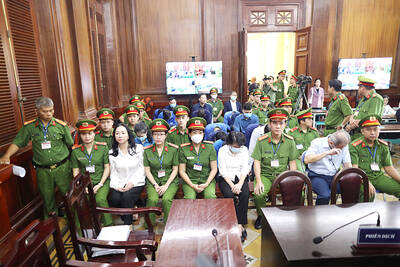
A top Vietnamese property tycoon was on Thursday sentenced to death in one of the biggest corruption cases in history, with an estimated US$27 billion in damages. A panel of three hand-picked jurors and two judges rejected all defense arguments by Truong My Lan, chair of major developer Van Thinh Phat, who was found guilty of swindling cash from Saigon Commercial Bank (SCB) over a decade. “The defendant’s actions ... eroded people’s trust in the leadership of the [Communist] Party and state,” read the verdict at the trial in Ho Chi Minh City. After the five-week trial, 85 others were also sentenced on

Conjoined twins Lori and George Schappell, who pursued separate careers, interests and relationships during lives that defied medical expectations, died this month in Pennsylvania, funeral home officials said. They were 62. The twins, listed by Guinness World Records as the oldest living conjoined twins, died on April 7 at the Hospital of the University of Pennsylvania, obituaries posted by Leibensperger Funeral Homes of Hamburg said. The cause of death was not detailed. “When we were born, the doctors didn’t think we’d make 30, but we proved them wrong,” Lori said in an interview when they turned 50, the Philadelphia Inquirer reported. The
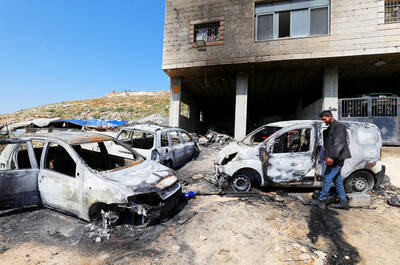
RAMPAGE: A Palestinian man was left dead after dozens of Israeli settlers searching for a missing 14-year-old boy stormed a village in the Israeli-occupied West Bank US President Joe Biden on Friday said he expected Iran to attack Israel “sooner, rather than later” and warned Tehran not to proceed. Asked by reporters about his message to Iran, Biden simply said: “Don’t,” underscoring Washington’s commitment to defend Israel. “We are devoted to the defense of Israel. We will support Israel. We will help defend Israel and Iran will not succeed,” he said. Biden said he would not divulge secure information, but said his expectation was that an attack could come “sooner, rather than later.” Israel braced on Friday for an attack by Iran or its proxies as warnings grew of


 RSS
RSS