


As protesters denounced him, US President George W. Bush on Wednesday signed a ban on a type of late-term abortion and promised to defend it in court despite an initial legal setback.
The so-called ban on "partial birth" abortion was a long-sought victory for the Christian right and abortion opponents in the run-up to the 2004 election.
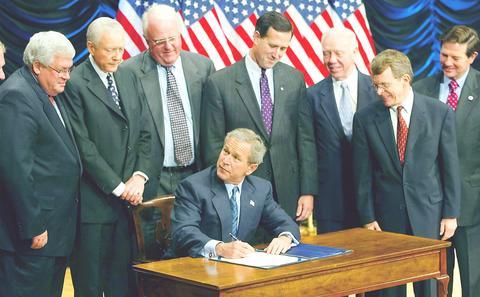
PHOTO: AP
But within minutes of the signing ceremony, a federal judge in Nebraska issued a temporary restraining order barring US Attorney General John Ashcroft and the Justice Department from enforcing the new law against four doctors who practice in more than a dozen states.
A district judge in New York took a similar legal challenge under advisement after a three-hour hearing. Abortion rights groups have also asked a California court to block and ultimately overturn the new law.
Bush, an evangelical Christian, cast the ban in stark terms: as the government coming to the defense of the "innocent child" against "a terrible form of violence."
"Today, at last, the American people and our government have confronted the violence," Bush said.
Abortion rights groups countered the ban would sacrifice women's health and rights for Bush's political gain, and promised a court fight that could drag on for months if not years.
Bush vowed his administration would "vigorously defend this law against any who would try to challenge it in the courts."
He took the unusual step of signing the ban into law at a building named after Ronald Reagan, the former Republican president who opposed abortion, instead of at the White House.
Outside, dozens of protesters denounced him with signs that read: "Keep abortion legal" and "We trust our doctors more than we trust Bush." The American Civil Liberties Union called it "a deceptive and dangerous" measure.
In a statement, Democratic presidential candidate Howard Dean, a doctor, called it a "dark day for American women" and warned the ban would "chill the practice of medicine and endanger the health of countless women."
White House spokesman Scott McClellan said the ban was a "practical" step to reduce US abortions and Bush would support additional efforts to end abortions, including measures to promote adoption and sexual abstinence.
If it withstands the legal challenges, the "partial birth" abortion ban would constitute the first federal limit on a type of abortion since the 1973 Roe versus Wade Supreme Court ruling backing abortion rights.
Bush said last week that the US was not ready for a total abortion ban.
Critics say the measure will ban many abortion techniques, not one particular procedure, and that it is effectively no different from a Nebraska law invalidated by the US Supreme Court three years ago.
That was what the ACLU argued on Wednesday in federal court in New York, trying to block enforcement of the law before it is scheduled to take effect at 12:01am on Nov. 6.
"The Supreme Court has spoken," Talcott Camp, deputy director of the ACLU's Reproductive Freedom Project, argued in court.
Sponsors of the ban said they took prior court objections into account and believed it would be upheld.
The US Congress has held emotional debates on the partial birth abortion for years, and former President Bill Clinton twice vetoed similar legislation because it did not contain an exception to protect the health of a woman.
Congress determined such an exception was not necessary for health reasons, but did include a narrow one to save a woman's life.
Under the bill, a doctor could face up to two years in prison as well as civil lawsuits for performing a "partial birth" abortion, defined as intentionally killing a fetus that has been partially delivered.

Republican US lawmakers on Friday criticized US President Joe Biden’s administration after sanctioned Chinese telecoms equipment giant Huawei unveiled a laptop this week powered by an Intel artificial intelligence (AI) chip. The US placed Huawei on a trade restriction list in 2019 for contravening Iran sanctions, part of a broader effort to hobble Beijing’s technological advances. Placement on the list means the company’s suppliers have to seek a special, difficult-to-obtain license before shipping to it. One such license, issued by then-US president Donald Trump’s administration, has allowed Intel to ship central processors to Huawei for use in laptops since 2020. China hardliners
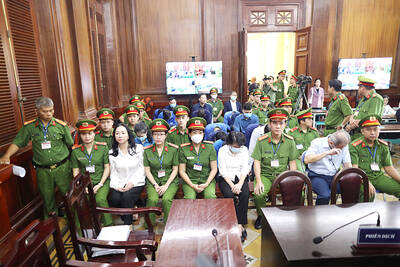
A top Vietnamese property tycoon was on Thursday sentenced to death in one of the biggest corruption cases in history, with an estimated US$27 billion in damages. A panel of three hand-picked jurors and two judges rejected all defense arguments by Truong My Lan, chair of major developer Van Thinh Phat, who was found guilty of swindling cash from Saigon Commercial Bank (SCB) over a decade. “The defendant’s actions ... eroded people’s trust in the leadership of the [Communist] Party and state,” read the verdict at the trial in Ho Chi Minh City. After the five-week trial, 85 others were also sentenced on

Conjoined twins Lori and George Schappell, who pursued separate careers, interests and relationships during lives that defied medical expectations, died this month in Pennsylvania, funeral home officials said. They were 62. The twins, listed by Guinness World Records as the oldest living conjoined twins, died on April 7 at the Hospital of the University of Pennsylvania, obituaries posted by Leibensperger Funeral Homes of Hamburg said. The cause of death was not detailed. “When we were born, the doctors didn’t think we’d make 30, but we proved them wrong,” Lori said in an interview when they turned 50, the Philadelphia Inquirer reported. The

RAMPAGE: A Palestinian man was left dead after dozens of Israeli settlers searching for a missing 14-year-old boy stormed a village in the Israeli-occupied West Bank US President Joe Biden on Friday said he expected Iran to attack Israel “sooner, rather than later” and warned Tehran not to proceed. Asked by reporters about his message to Iran, Biden simply said: “Don’t,” underscoring Washington’s commitment to defend Israel. “We are devoted to the defense of Israel. We will support Israel. We will help defend Israel and Iran will not succeed,” he said. Biden said he would not divulge secure information, but said his expectation was that an attack could come “sooner, rather than later.” Israel braced on Friday for an attack by Iran or its proxies as warnings grew of


 RSS
RSS