


Questioning past US policy in the Middle East, US President George W. Bush is arguing that supporting undemocratic governments in the name of regional stability has produced only "frustration and pent-up emotions" there.
In a speech to the National Endowment for Democracy yesterday, Bush was to champion democratic gains around the globe but focus especially on the still-roiled Middle East, national security adviser Condoleezza Rice said Wednesday.
The speech was scheduled on the same day Bush signs an US$87.5 billion package he requested for military and reconstruction operations in Iraq and Afghanistan.
"After 60 years of trying to find stability through regimes that were not devoted to political liberty for their people, what we found is that we did not buy security and stability, but rather frustration and pent-up emotions in a region that has fallen behind in terms of prosperity, and in fact continues to produce ideologies of hatred," Rice said.
Bush will tell those suspicious of US motives in countries like Iraq that the political and economic freedoms America wants to see in the region are not synonymous with Westernization, she said.
"If you look at democratic development in the world, it makes its peace with local traditions and local and religious and ideological views," she said. "It's not a one-size-fits-all approach."
Those comments could be Bush's rebuttal to anti-Western sentiment brewing in the Middle East. Rice said, however, the intent is to associate the US with people who seek freedom, and to say he believes it's possible they can achieve it.
"This is not the United States doing something to this region," she said. "This is a region in which the stirrings are really quite clear."
The speech, announced only on Wednesday, would outline democracy's march during the past several years and work that remains to be done, especially in the Middle East, Rice said.
"At a time when people are struggling to be able to achieve this and to make progress in places like Iraq and Afghanistan, I think he thinks it's important to put this in a large, regional context," she said.
Rice said Bush would discuss how he believes that America's liberty, freedom and security are "inextricably linked."
"He'll talk about challenges that democracy still faces in places like Burma and North Korea and places like even China where economic liberty gives an opportunity for the march of political liberty, but where there needs to be a commitment to making that link," she said.
The president will express his support for positive developments occurring in places like Bahrain, Jordan and Saudi Arabia "where you're beginning to get some stirrings of the need for a political voice for the people," Rice said.
Saudi Arabia decided last month to hold its first local elections, at a time when the Saudi royal family is under pressure to bring democratic reform. Saudi Arabia, an absolute monarchy, has an unelected national advisory body, known as the Shura Council, and no parliament.

Republican US lawmakers on Friday criticized US President Joe Biden’s administration after sanctioned Chinese telecoms equipment giant Huawei unveiled a laptop this week powered by an Intel artificial intelligence (AI) chip. The US placed Huawei on a trade restriction list in 2019 for contravening Iran sanctions, part of a broader effort to hobble Beijing’s technological advances. Placement on the list means the company’s suppliers have to seek a special, difficult-to-obtain license before shipping to it. One such license, issued by then-US president Donald Trump’s administration, has allowed Intel to ship central processors to Huawei for use in laptops since 2020. China hardliners

Conjoined twins Lori and George Schappell, who pursued separate careers, interests and relationships during lives that defied medical expectations, died this month in Pennsylvania, funeral home officials said. They were 62. The twins, listed by Guinness World Records as the oldest living conjoined twins, died on April 7 at the Hospital of the University of Pennsylvania, obituaries posted by Leibensperger Funeral Homes of Hamburg said. The cause of death was not detailed. “When we were born, the doctors didn’t think we’d make 30, but we proved them wrong,” Lori said in an interview when they turned 50, the Philadelphia Inquirer reported. The
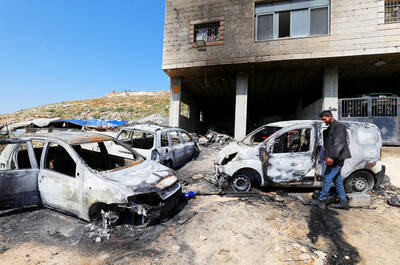
RAMPAGE: A Palestinian man was left dead after dozens of Israeli settlers searching for a missing 14-year-old boy stormed a village in the Israeli-occupied West Bank US President Joe Biden on Friday said he expected Iran to attack Israel “sooner, rather than later” and warned Tehran not to proceed. Asked by reporters about his message to Iran, Biden simply said: “Don’t,” underscoring Washington’s commitment to defend Israel. “We are devoted to the defense of Israel. We will support Israel. We will help defend Israel and Iran will not succeed,” he said. Biden said he would not divulge secure information, but said his expectation was that an attack could come “sooner, rather than later.” Israel braced on Friday for an attack by Iran or its proxies as warnings grew of
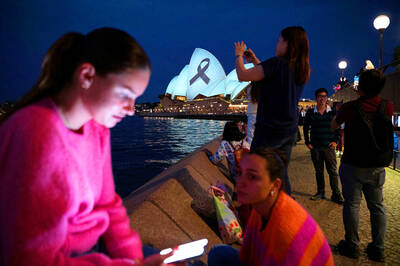
A prominent Christian leader has allegedly been stabbed at the altar during a Mass yesterday in southwest Sydney. Bishop Mar Mari Emmanuel was saying Mass at Christ The Good Shepherd Church in Wakeley just after 7pm when a man approached him at the altar and allegedly stabbed toward his head multiple times. A live stream of the Mass shows the congregation swarm forward toward Emmanuel before it was cut off. The church leader gained prominence during the COVID-19 pandemic, amassing a large online following, Officers attached to Fairfield City police area command attended a location on Welcome Street, Wakeley following reports a number


 RSS
RSS