


Pakistani President Pervez Musharraf, visiting South Korea, dismissed reports that his country has helped North Korea proliferate missiles or build nuclear weapons.
In interviews with South Korean media published yesterday, Musharraf said Pakistan had in the past had military cooperation with North Korea and had bought missiles from the communist state at the center of a nuclear proliferation crisis in Northeast Asia, but that had stopped.
"The reality is that during the four years that I have been president I can say with full guarantee that no proliferation has ever taken place. There has been no defense collaboration with North Korea," he told the English-language Korea Times.
"We have had relations and defense cooperation with North Korea and we have bought surface-to-air missiles in the past because of a threat to us. But now we produce ourselves," he said.
Pakistan, which conducted its first nuclear tests in 1998, has repeatedly denied reports of any nuclear or missile-related cooperation with North Korea. A Pakistani firm was slapped with US sanctions last March for allegedly arranging the transfer of nuclear-capable missiles from North Korea to Pakistan.
In an interview with the Korea Herald, Musharraf voiced support for six-party talks involving the two Koreas, the US, China, Russia and Japan aimed at halting North Korea's nuclear arms programs.
"We are extremely concerned about the escalation of nuclear tension on the Korean Peninsula," he told the Herald.
Musharraf arrived in Seoul on Wednesday for a three-day state visit to mark the 20th anniversary of diplomatic ties between South Korea and Pakistan.
He was to meet President Roh Moo-hyun yesterday.
Pakistan, which has about 5,000 guest workers in South Korea, also hoped to draw more South Korean investment in the oil, gas and telecommunications sectors, he said.
South Korea has invested just US$15.8 million in the South Asian country.
Musharraf flew to Seoul from China, where he agreed a half-billion-dollar loan and won commitments to boost trade but did not sign an expected deal on nuclear power plant cooperation.

Republican US lawmakers on Friday criticized US President Joe Biden’s administration after sanctioned Chinese telecoms equipment giant Huawei unveiled a laptop this week powered by an Intel artificial intelligence (AI) chip. The US placed Huawei on a trade restriction list in 2019 for contravening Iran sanctions, part of a broader effort to hobble Beijing’s technological advances. Placement on the list means the company’s suppliers have to seek a special, difficult-to-obtain license before shipping to it. One such license, issued by then-US president Donald Trump’s administration, has allowed Intel to ship central processors to Huawei for use in laptops since 2020. China hardliners
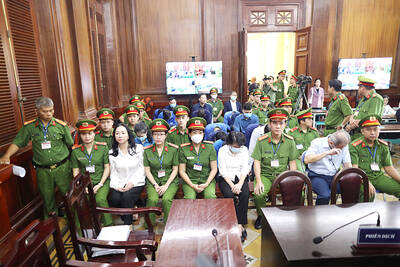
A top Vietnamese property tycoon was on Thursday sentenced to death in one of the biggest corruption cases in history, with an estimated US$27 billion in damages. A panel of three hand-picked jurors and two judges rejected all defense arguments by Truong My Lan, chair of major developer Van Thinh Phat, who was found guilty of swindling cash from Saigon Commercial Bank (SCB) over a decade. “The defendant’s actions ... eroded people’s trust in the leadership of the [Communist] Party and state,” read the verdict at the trial in Ho Chi Minh City. After the five-week trial, 85 others were also sentenced on

‘DELUSIONAL’: Targeting the families of Hamas’ leaders would not push the group to change its position or to give up its demands for Palestinians, Ismail Haniyeh said Israeli aircraft on Wednesday killed three sons of Hamas’ top political leader in the Gaza Strip, striking high-stakes targets at a time when Israel is holding delicate ceasefire negotiations with the militant group. Hamas said four of the leader’s grandchildren were also killed. Ismail Haniyeh’s sons are among the highest-profile figures to be killed in the war so far. Israel said they were Hamas operatives, and Haniyeh accused Israel of acting in “the spirit of revenge and murder.” The deaths threatened to strain the internationally mediated ceasefire talks, which appeared to gain steam in recent days even as the sides remain far
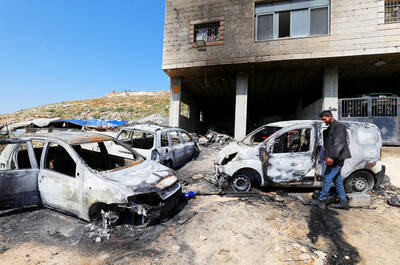
RAMPAGE: A Palestinian man was left dead after dozens of Israeli settlers searching for a missing 14-year-old boy stormed a village in the Israeli-occupied West Bank US President Joe Biden on Friday said he expected Iran to attack Israel “sooner, rather than later” and warned Tehran not to proceed. Asked by reporters about his message to Iran, Biden simply said: “Don’t,” underscoring Washington’s commitment to defend Israel. “We are devoted to the defense of Israel. We will support Israel. We will help defend Israel and Iran will not succeed,” he said. Biden said he would not divulge secure information, but said his expectation was that an attack could come “sooner, rather than later.” Israel braced on Friday for an attack by Iran or its proxies as warnings grew of


 RSS
RSS