


"Manifesto" is the buzzword of Japan's political season. Each party must have one. Newspaper headlines squeeze it in.
Policies and ideas, the lofty sounding foreign word implies, will now determine the outcome of elections, instead of pork-barrel politics.
But in this corner of rural Japan, where public works and the heavily protected konnyaku yam are the main motors of the economy, the manifesto is as alien a concept as its promise of political transformation.
"The word manifesto has already been used around here for a long time," said Toru Ikehara, 70, the president of a construction company bearing his name and that of a construction association. He took a form out of a drawer. "Here," he said, "this is the manifesto for construction scrap disposal. You pull down a house, state in detail what waste went where, so as to take responsibility for the disposal."
As Japan prepares to hold a general election on Sunday, there is breathless talk here of moving toward an American-style two-party system. The main opposition Democratic Party, strengthened by its recent merger with another party, is expected to continue making gains in the cities, where voters are younger and work in the private sector.
But the Liberal Democratic Party of Prime Minister Junichiro Koizumi, which has governed almost uninterrupted since 1955, still dominates rural Japan. Its grip on the area around Nakanojo, as well as on other aging rural areas dependent on the government, suggests that there may not be a change in government this time around, and perhaps not for a few more years.
Postwar Japan has been essentially a one-party state, in part because the Liberal Democratic Party, which is actually conservative, has always enjoyed rock-solid rural support.
To ensure that, the party funneled money from the cities into the countryside, which it pampered with lavish public works projects and agricultural subsidies. Moreover, electoral laws gave more weight to rural votes. The cities remained uninterested in politics as long as Japan's economy kept growing.
For rural areas like Nakanojo, the spigot from Tokyo has tightened in recent years, because of Japan's long economic slump and Koizumi's drive to slash public spending.
But backing the opposition, which promises even steeper cuts, would be committing suicide. So places like Nakanojo continue to back the Liberal Democratic Party, if only because there is no alternative.
Here in this town in the 5th Election District of Gumma province, some 120km north of Tokyo, the main opposition is not even bothering to field a candidate for the lower house of parliament. The Liberal Democratic Party incumbent, Yuko Obuchi, 29, won the seat after its previous occupant -- Keizo Obuchi, a former prime minister who also happened to be her father -- died in 2000.
Obuchi's campaign manager, Kentaro Iwai, felt comfortable enough to say that her re-election on Sunday was assured, though there are candidates from minor parties.
"The point is how many votes she can get," said Iwai, 61, who is also vice chairman of the Liberal Democratic Party's provincial chapter.
That money is no longer flowing down here as it used to is easily visible in Nakanojo, a town of 18,000 inhabitants. There are few young people to be seen; most have left for the cities.
The main street is referred to as Shuttered Street because of the number of closed shops. On weekdays the train pulls up at the small station packed almost exclusively with elderly tourists on their way to nearby hot springs.
Public works spending, which provides jobs and money to local construction companies, has been slashed. In five years the spending for the county that includes Nakanojo has been cut by half, from US$96 million in 1998 to US$47 million last year.
Ikehara, the construction company president, said that because of the fall in public works spending, construction companies around here had gone bankrupt or had imposed pay cuts.
Nevertheless, public works still account for half of his company's projects. He could not imagine backing the Democratic Party, led by Naoto Kan, which has pledged in its manifesto to reduce public works by 30 percent over three years.
"The state collects taxes and distributes it," he said. "If it stops coming here, what are the people around here to do? There still aren't political parties that could replace the ruling LDP."
Gumma province's other main industry is growing the konnyaku, or devil's tongue, yam, accounting for more than 80 percent of the national market. The industry survives because of the 990 percent tariff imposed on imports of the vegetable.
The Liberal Democratic Party also remains entrenched in rural areas because of the strength of the support groups like town associations and the construction industry, which line up behind one candidate.
Even in this one-party redoubt, though, there is a growing sense that the country is moving inevitably toward a two-party system.
"There are many young people in urban areas, and they feel like changing political parties," said Iwai, Obuchi's campaign manager. "They think they can make a real comparison for the first time by a change in power. They want to try it, and if it doesn't work they can take it back."
Kamei of the agricultural association said that a two-party system would be good for Japan by making politicians more accountable, but that personally he feared such a change.
"We've never experienced the two-party system," he said. "Apart from whether it is good or bad, I feel anxious."

Republican US lawmakers on Friday criticized US President Joe Biden’s administration after sanctioned Chinese telecoms equipment giant Huawei unveiled a laptop this week powered by an Intel artificial intelligence (AI) chip. The US placed Huawei on a trade restriction list in 2019 for contravening Iran sanctions, part of a broader effort to hobble Beijing’s technological advances. Placement on the list means the company’s suppliers have to seek a special, difficult-to-obtain license before shipping to it. One such license, issued by then-US president Donald Trump’s administration, has allowed Intel to ship central processors to Huawei for use in laptops since 2020. China hardliners
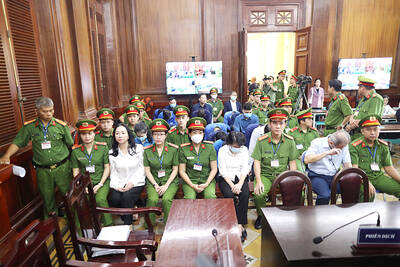
A top Vietnamese property tycoon was on Thursday sentenced to death in one of the biggest corruption cases in history, with an estimated US$27 billion in damages. A panel of three hand-picked jurors and two judges rejected all defense arguments by Truong My Lan, chair of major developer Van Thinh Phat, who was found guilty of swindling cash from Saigon Commercial Bank (SCB) over a decade. “The defendant’s actions ... eroded people’s trust in the leadership of the [Communist] Party and state,” read the verdict at the trial in Ho Chi Minh City. After the five-week trial, 85 others were also sentenced on

Conjoined twins Lori and George Schappell, who pursued separate careers, interests and relationships during lives that defied medical expectations, died this month in Pennsylvania, funeral home officials said. They were 62. The twins, listed by Guinness World Records as the oldest living conjoined twins, died on April 7 at the Hospital of the University of Pennsylvania, obituaries posted by Leibensperger Funeral Homes of Hamburg said. The cause of death was not detailed. “When we were born, the doctors didn’t think we’d make 30, but we proved them wrong,” Lori said in an interview when they turned 50, the Philadelphia Inquirer reported. The

RAMPAGE: A Palestinian man was left dead after dozens of Israeli settlers searching for a missing 14-year-old boy stormed a village in the Israeli-occupied West Bank US President Joe Biden on Friday said he expected Iran to attack Israel “sooner, rather than later” and warned Tehran not to proceed. Asked by reporters about his message to Iran, Biden simply said: “Don’t,” underscoring Washington’s commitment to defend Israel. “We are devoted to the defense of Israel. We will support Israel. We will help defend Israel and Iran will not succeed,” he said. Biden said he would not divulge secure information, but said his expectation was that an attack could come “sooner, rather than later.” Israel braced on Friday for an attack by Iran or its proxies as warnings grew of


 RSS
RSS