


Backers of Germany's much-delayed national Holocaust memorial have moved to exclude from the project a chemical firm that was to supply an anti-graffiti coating, citing objections to the fact it once owned a share in the producer of the deadly Zyklon-B gas, a key supporter said Saturday.
It wasn't immediately clear how much the move would delay construction, which was declared open for the third time in April. Designed by US architect Peter Eisenman, the memorial to the more than 6 million Jews who perished at the Nazis' hands will feature 2,700 concrete slabs on a plot the size of two football fields, close to Berlin's signature Brandenburg Gate.
The move to seek an alternative supplier to Duesseldorf-based Degussa AG for the slabs' protective coating was made at a meeting this week of a panel overseeing the project -- a decision that writer Lea Rosh, who first proposed the memorial in 1988, said was "not easy."
The company once owned a 42.2 percent share in Degesch GmbH, which delivered to the Nazis the Zyklon-B cyanide tablets used to gas concentration camp inmates. IG Farben, a chemical company dissolved after World War II, held another 42.2 percent.
"We asked ourselves where the limit is and how far can we go in saying `we won't forgive,'" Rosh told RBB television.
"We said that if a survivor from, let's say, Budapest comes to this memorial and says, `I want to mourn my grandparents,' then it isn't right that a firm that back then delivered the Zyklon-B to gas people supplies the anti-graffiti coating now."
The daily Frankfurter Allgemeine reported that some members of the panel opposed the move, arguing that the memorial was meant to be about Germany's efforts to acknowledge its past and that Degussa had, for example, contributed to a fund set up by government and industry to compensate Nazi-era slave laborers.
In a terse statement, Degussa said Parliament President Wolfgang Thierse, the project's top political backer, had informed it of the panel's decision.
"Degussa will reply to this letter in writing and will issue a response at an appropriate time," the statement said.
German politicians rallied behind the project in the late 1990s after decades of debate over how Germany should remember Holocaust victims, but wrangling over details persisted even after the final design was approved in 1999.
Latest plans call for completion by May 8, 2005 -- 60 years after Nazi Germany's defeat.
Rosh said that, despite the row over the slabs' coating, work on building the memorial's foundation and on producing the slabs would continue.

Republican US lawmakers on Friday criticized US President Joe Biden’s administration after sanctioned Chinese telecoms equipment giant Huawei unveiled a laptop this week powered by an Intel artificial intelligence (AI) chip. The US placed Huawei on a trade restriction list in 2019 for contravening Iran sanctions, part of a broader effort to hobble Beijing’s technological advances. Placement on the list means the company’s suppliers have to seek a special, difficult-to-obtain license before shipping to it. One such license, issued by then-US president Donald Trump’s administration, has allowed Intel to ship central processors to Huawei for use in laptops since 2020. China hardliners

Conjoined twins Lori and George Schappell, who pursued separate careers, interests and relationships during lives that defied medical expectations, died this month in Pennsylvania, funeral home officials said. They were 62. The twins, listed by Guinness World Records as the oldest living conjoined twins, died on April 7 at the Hospital of the University of Pennsylvania, obituaries posted by Leibensperger Funeral Homes of Hamburg said. The cause of death was not detailed. “When we were born, the doctors didn’t think we’d make 30, but we proved them wrong,” Lori said in an interview when they turned 50, the Philadelphia Inquirer reported. The
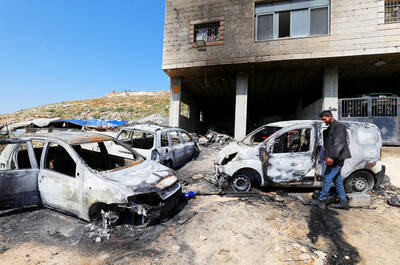
RAMPAGE: A Palestinian man was left dead after dozens of Israeli settlers searching for a missing 14-year-old boy stormed a village in the Israeli-occupied West Bank US President Joe Biden on Friday said he expected Iran to attack Israel “sooner, rather than later” and warned Tehran not to proceed. Asked by reporters about his message to Iran, Biden simply said: “Don’t,” underscoring Washington’s commitment to defend Israel. “We are devoted to the defense of Israel. We will support Israel. We will help defend Israel and Iran will not succeed,” he said. Biden said he would not divulge secure information, but said his expectation was that an attack could come “sooner, rather than later.” Israel braced on Friday for an attack by Iran or its proxies as warnings grew of

A prominent Christian leader has allegedly been stabbed at the altar during a Mass yesterday in southwest Sydney. Bishop Mar Mari Emmanuel was saying Mass at Christ The Good Shepherd Church in Wakeley just after 7pm when a man approached him at the altar and allegedly stabbed toward his head multiple times. A live stream of the Mass shows the congregation swarm forward toward Emmanuel before it was cut off. The church leader gained prominence during the COVID-19 pandemic, amassing a large online following, Officers attached to Fairfield City police area command attended a location on Welcome Street, Wakeley following reports a number


 RSS
RSS