


A Columbia University history professor hired by The New York Times to assess the coverage of one of its correspondents in the Soviet Union during the 1930s said on Wednesday that the Pulitzer Prize the reporter received should be rescinded because of his "lack of balance" in covering Stalin's government.
The paper had asked the professor, Mark von Hagen, to examine the coverage of the correspondent, Walter Duranty, after receiving a letter in early July from the Pulitzer Board seeking its comment. In its letter to The Times, the board said it was responding to "a new round of demands" that the prize awarded Duranty in 1932 be revoked. The most vocal demands came from Ukrainian-Americans who contended that Duranty should be punished for failing to report on a famine that killed millions of Ukrainians in 1932 and 1933.
In his report to The Times, von Hagen described the coverage for which Duranty won the Pulitzer -- his writing in 1931, a year prior to the onset of the famine -- as a "dull and largely uncritical recitation of Soviet sources."
"That lack of balance and uncritical acceptance of the Soviet self-justification for its cruel and wasteful regime," the professor wrote, "was a disservice to the American readers of The New York Times>> and the liberal values they subscribe to and to the historical experience of the peoples of the Russian and Soviet empires and their struggle for a better life."
In his nine-page report, von Hagen, an expert on early 20th-century Russian history, did not address whether the Pulitzer Board should revoke the award it gave to Duranty. Duranty died in 1957.
But in comments first published on Wednesday in The New York Sun, von Hagen said he believed the board should indeed take such action. He echoed those remarks in an interview on Wednesday evening with The Times.
"They should take it away for the greater honor and glory of The New York Times," he said. "He really was kind of a disgrace in the history of The New York Times."
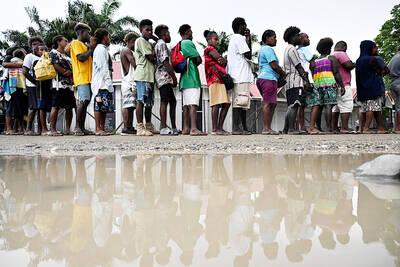
SEEKING CHANGE: A hospital worker said she did not vote in previous elections, but ‘now I can see that maybe my vote can change the system and the country’ Voting closed yesterday across the Solomon Islands in the south Pacific nation’s first general election since the government switched diplomatic allegiance from Taiwan to Beijing and struck a secret security pact that has raised fears of the Chinese navy gaining a foothold in the region. The Solomon Islands’ closer relationship with China and a troubled domestic economy weighed on voters’ minds as they cast their ballots. As many as 420,000 registered voters had their say across 50 national seats. For the first time, the national vote also coincided with elections for eight of the 10 local governments. Esther Maeluma cast her vote in the
Nearly half of China’s major cities are suffering “moderate to severe” levels of subsidence, putting millions of people at risk of flooding, especially as sea levels rise, according to a study of nationwide satellite data released yesterday. The authors of the paper, published by the journal Science, found that 45 percent of China’s urban land was sinking faster than 3mm per year, with 16 percent at more than 10mm per year, driven not only by declining water tables, but also the sheer weight of the built environment. With China’s urban population already in excess of 900 million people, “even a small portion

UNSETTLING IMAGES: The scene took place in front of TV crews covering the Trump trial, with a CNN anchor calling it an ‘emotional and unbelievably disturbing moment’ A man who doused himself in an accelerant and set himself on fire outside the courthouse where former US president Donald Trump is on trial has died, police said yesterday. The New York City Police Department (NYPD) said the man was declared dead by staff at an area hospital. The man was in Collect Pond Park at about 1:30pm on Friday when he took out pamphlets espousing conspiracy theories, tossed them around, then doused himself in an accelerant and set himself on fire, officials and witnesses said. A large number of police officers were nearby when it happened. Some officers and bystanders rushed

HYPOCRISY? The Chinese Ministry of Foreign Affairs yesterday asked whether Biden was talking about China or the US when he used the word ‘xenophobic’ US President Joe Biden on Wednesday called for a hike in steel tariffs on China, accusing Beijing of cheating as he spoke at a campaign event in Pennsylvania. Biden accused China of xenophobia, too, in a speech to union members in Pittsburgh. “They’re not competing, they’re cheating. They’re cheating and we’ve seen the damage here in America,” Biden said. Chinese steel companies “don’t need to worry about making a profit because the Chinese government is subsidizing them so heavily,” he said. Biden said he had called for the US Trade Representative to triple the tariff rates for Chinese steel and aluminum if Beijing was


 RSS
RSS