


Frustrated by three years of violence and failed peace initiatives, former government officials, civic leaders and even Hollywood stars such as Danny DeVito have jumped into Israeli-Palestinian peacemaking, hoping to succeed where their leaders have failed.
While leaders on both sides can't even get a limited agreement off the ground, freelance peacemakers are offering sweeping visions of a final peace deal between Israelis and Palestinians.
"It's very essential that people stop feeling desperate and stop being represented by extremists on both sides," said Saman Khoury, a Palestinian negotiator.

PHOTO: REUTERS
The latest proposal, dubbed the Geneva agreement, was negotiated by former officials with Swiss government backing. It would require Israel to hand over almost all its war-won land, but not to accept returning refugees -- parameters that many on both sides are coming to view as inevitable.
Still, Palestinian leader Yasser Arafat, while saying he welcomed the deal, did not commit himself to it. And Israeli Prime Minister Ariel Sharon attacked the Israeli negotiators, most of them opposition members, for going behind his back.
"This agreement promises only false hope. By what right are left-wingers proposing moves that Israel can never make nor will ever make?" he said.
Three years of Israeli-Palestinian violence have destroyed trust on both sides. Israel blames Arafat for the suicide bombings and other attacks that have killed more than 400 Israelis. Palestinians blame Sharon for the military actions that have made their lives a misery.
Even if agreement were reached on the toughest issues -- the borders of a Palestinian state, the fate of Israeli settlements and Palestinian refugees and the possible division of Jerusalem -- it would be hard to make the concessions stick. Many Israelis refuse to consider dividing Jerusalem and abandoning settlements, and Islamic militants are sworn to destroy the Jewish state.
The 1993 Oslo Accords that were greeted with great hopes were narrow and never stopped the violence. Broader-reaching negotiations in 2000 did not meet with success. Even this year's US-backed "road map" peace plan stalled amid violence and internal Palestinian wrangling.
The road map envisaged creating a Palestinian state by 2005 and called for a series of short-term steps -- a Palestinian crack down on militant groups, an end to Israeli settlement building and the lifting of Israeli restrictions on Palestinians. However, it left all the details of borders, refugees and the fate of Jerusalem for a future international conference to decide.
In that respect, it resembled all past initiatives, leaving a huge gap between what the Palestinians and the Israelis expected from a final peace plan.
"This vacuum has been filled right now," said Orni Petruschka, who helped negotiate a peace proposal called the "destination map."
That plan, published earlier this year and posted at www.hashd.org, was championed by Ami Ayalon, the popular former head of Israel's Shin Bet security service, and Sari Nusseibeh, the president of Al-Quds University and a leading Palestinian intellectual.
The somewhat vague agreement would establish a Palestinian state in the West Bank and Gaza Strip generally along the borders that existed before the 1967 Mideast War. Jerusalem would be a shared capital and each side would administer its own holy sites.
Palestinian refugees would give up their claim to homes in Israel they left during the 1948 Mideast War. That "right of return" has been a red flag for Israelis, who fear the influx of Palestinians would dilute Israel's Jewish majority.
More than 50,000 Palestinians and 80,000 Israelis have signed their names to the plan, Petruschka said.
The Geneva plan, negotiated by former Cabinet ministers Yossi Beilin and Yasser Abed Rabbo, has not been published in full but seems to follow the same lines as the "destination map."
Nearly half of China’s major cities are suffering “moderate to severe” levels of subsidence, putting millions of people at risk of flooding, especially as sea levels rise, according to a study of nationwide satellite data released yesterday. The authors of the paper, published by the journal Science, found that 45 percent of China’s urban land was sinking faster than 3mm per year, with 16 percent at more than 10mm per year, driven not only by declining water tables, but also the sheer weight of the built environment. With China’s urban population already in excess of 900 million people, “even a small portion

UNSETTLING IMAGES: The scene took place in front of TV crews covering the Trump trial, with a CNN anchor calling it an ‘emotional and unbelievably disturbing moment’ A man who doused himself in an accelerant and set himself on fire outside the courthouse where former US president Donald Trump is on trial has died, police said yesterday. The New York City Police Department (NYPD) said the man was declared dead by staff at an area hospital. The man was in Collect Pond Park at about 1:30pm on Friday when he took out pamphlets espousing conspiracy theories, tossed them around, then doused himself in an accelerant and set himself on fire, officials and witnesses said. A large number of police officers were nearby when it happened. Some officers and bystanders rushed
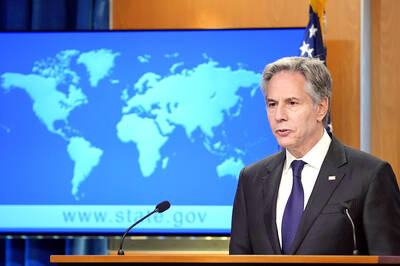
Beijing is continuing to commit genocide and crimes against humanity against Uyghurs and other Muslim minorities in its western Xinjiang province, U.S. Secretary of State Antony Blinken said in a report published on Monday, ahead of his planned visit to China this week. The State Department’s annual human rights report, which documents abuses recorded all over the world during the previous calendar year, repeated language from previous years on the treatment of Muslims in Xinjiang, but the publication raises the issue ahead of delicate talks, including on the war in Ukraine and global trade, between the top U.S. diplomat and Chinese
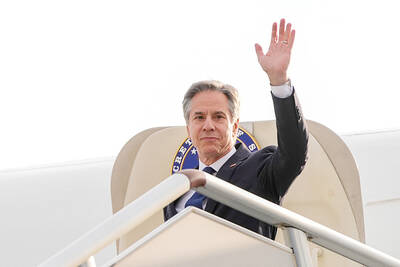
‘IN A DIFFERENT PLACE’: The envoy first visited Shanghai, where he attended a Chinese basketball playoff match, and is to meet top officials in Beijing tomorrow US Secretary of State Antony Blinken yesterday arrived in China on his second visit in a year as the US ramps up pressure on its rival over its support for Russia while also seeking to manage tensions with Beijing. The US diplomat tomorrow is to meet China’s top brass in Beijing, where he is also expected to plead for restraint as Taiwan inaugurates president-elect William Lai (賴清德), and to raise US concerns on Chinese trade practices. However, Blinken is also seeking to stabilize ties, with tensions between the world’s two largest economies easing since his previous visit in June last year. At the


 RSS
RSS