


Buoyed by a diplomatic coup on Iraq at the UN, US President George W. Bush arrived in Tokyo yesterday to start a six-day sweep through Asia that will be dominated by issues of security, counter-terrorism and trade.
Bush will hold talks and dine with one of his closest allies, Japanese Prime Minister Junichiro Koizumi, in the only official function in a visit to Japan that will last less than 24 hours.
Troops and money for Iraq, a crisis over North Korea's nuclear program and the touchy topic of Tokyo's efforts to stem the yen's surge against the dollar are likely to be on the menu, along with a meal expected to feature Japanese beef.
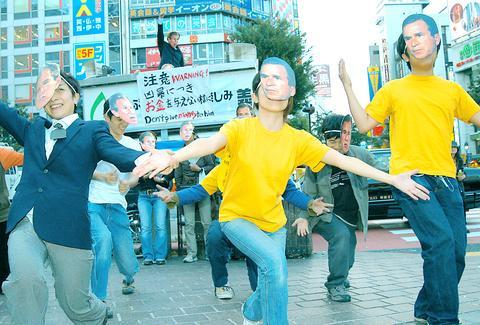
PHOTO: AP
Washington is taking care not to give the impression that the brief visit suggests a slight to Japan.
"When you go to Japan, it's never a lay-over. This is one of our best friends, one of our best allies," a senior US official said en route to Japan.
In a development likely to have cheered Bush, the UN Security Council unanimously adopted on Thursday a resolution aimed at getting troops and cash for Iraq.
The US official said Bush had been personally pressing world leaders to contribute to the rebuilding of Iraq.
"He's been making a number of phone calls and obviously these meetings [in Asia] allow him to make the case, although the Japanese, of course, are already there," the official said.
Japan welcomed the resolution, which officials said would help clear the way for Tokyo to dispatch troops to Iraq.
Bush has already received a present from Koizumi in the form of a pledge to provide US$1.5 billion in grant aid to rebuild Iraq next year and Tokyo is likely to offer more at a donors' conference in Madrid next week.
About 50 protesters shouting "Bush, Go Home!" gathered outside the US embassy in Tokyo to lambast Koizumi and Bush.
"The money Koizumi has pro-mised is from our tax money and we haven't approved that," said Motoharu Inahara, a middle-aged activist.
"We have no idea how it will be used. Koizumi is just like a dog wagging his tail," he said.
About 9,000 police have been mobilized to provide tight security during Bush's 17-hour visit.
Koizumi has been determined to keep his promise to Bush to "get boots on the ground" in Iraq. But he is reluctant to stir up voters -- most of whom opposed the US-led war on Iraq and are wary of putting their military in harm's way -- before a Nov. 9 election.
The daily Yomiuri Shimbun said yesterday that Koizumi would inform Bush of a plan to send about 150 army personnel to southern Iraq in December and around 550 more in the new year.
Despite reluctance to be seen as what critics have dubbed America's "ATM" (automatic teller machine), Japan is expected to provide a total of about $5 billion for Iraq's reconstruction -- about 10 percent of the total funds thought to be needed.
While Bush is likely to praise Koizumi's efforts on Iraq, he also looks set to broach a less palatable topic -- currencies.
Under pressure from US firms to act on what they see as unfair currency policies, Bush has already taken aim at Tokyo's policy of intervening to try to restrain a surge in the yen.
Many US lawmakers are also angry with China for pegging the yuan to the dollar at a rate they consider to be artificially weak.
"We need a level playing field when it comes [to] trade and a level playing field will help us create jobs here in America," Bush said in California before leaving for Japan.

Republican US lawmakers on Friday criticized US President Joe Biden’s administration after sanctioned Chinese telecoms equipment giant Huawei unveiled a laptop this week powered by an Intel artificial intelligence (AI) chip. The US placed Huawei on a trade restriction list in 2019 for contravening Iran sanctions, part of a broader effort to hobble Beijing’s technological advances. Placement on the list means the company’s suppliers have to seek a special, difficult-to-obtain license before shipping to it. One such license, issued by then-US president Donald Trump’s administration, has allowed Intel to ship central processors to Huawei for use in laptops since 2020. China hardliners

DISADVANTAGE: Erin O’Toole, who led the Conservatives during the election campaign in 2021, estimated that the interference cost his party as many as nine legislative seats Canada’s domestic spy agency on Monday concluded that China interfered in the past two elections, an official probe heard, the firmest evidence so far of suspected Chinese meddling in Canadian politics. Canadian Prime Minister Justin Trudeau’s Liberal Party won both the elections, held in 2019 and 2021. Under pressure from opposition lawmakers unhappy about media reports on China’s possible role, Trudeau set up a commission into foreign interference. The commission was shown a slide on Monday containing an extract of a briefing in February last year from the Canadian Security Intelligence Service (CSIS). “We know that the PRC [People’s Republic of China] clandestinely
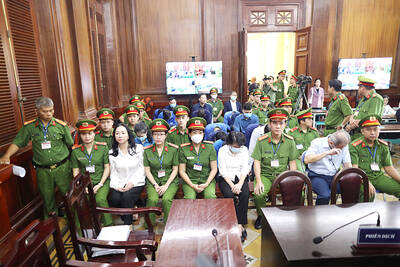
A top Vietnamese property tycoon was on Thursday sentenced to death in one of the biggest corruption cases in history, with an estimated US$27 billion in damages. A panel of three hand-picked jurors and two judges rejected all defense arguments by Truong My Lan, chair of major developer Van Thinh Phat, who was found guilty of swindling cash from Saigon Commercial Bank (SCB) over a decade. “The defendant’s actions ... eroded people’s trust in the leadership of the [Communist] Party and state,” read the verdict at the trial in Ho Chi Minh City. After the five-week trial, 85 others were also sentenced on

‘DELUSIONAL’: Targeting the families of Hamas’ leaders would not push the group to change its position or to give up its demands for Palestinians, Ismail Haniyeh said Israeli aircraft on Wednesday killed three sons of Hamas’ top political leader in the Gaza Strip, striking high-stakes targets at a time when Israel is holding delicate ceasefire negotiations with the militant group. Hamas said four of the leader’s grandchildren were also killed. Ismail Haniyeh’s sons are among the highest-profile figures to be killed in the war so far. Israel said they were Hamas operatives, and Haniyeh accused Israel of acting in “the spirit of revenge and murder.” The deaths threatened to strain the internationally mediated ceasefire talks, which appeared to gain steam in recent days even as the sides remain far


 RSS
RSS