


North Korea's threat to display a "nuclear deterrent" at an appropriate time was dismissed in South Korea yesterday as bluff, and US officials said they saw nothing new in the latest escalatory rhetoric from Pyongyang.
In comments published late on Thursday by the North's official KCNA news agency, a North Korean Foreign Ministry spokesman said the country would move to end debate over its nuclear status if the US delayed a solution to a year-old nuclear impasse.
"When an appropriate time comes, the DPRK [Democratic People's Republic of Korea] will take a measure to open its nuclear deterrent to the public as a physical force and then there will be no need to have any more argument," the spokesman said, noting that some people doubted that the North had nuclear capability.
Thursday's statement did not spell out how Pyongyang might display its "deterrent." It did not use the word "test".
In Washington on Thursday, US Secretary of State Colin Powell told reporters: "They've said things like that before, and I don't know what they mean."
Earlier this month, North Korea said it had redirected plutonium extracted from thousands of spent nuclear fuel rods to help enhance its deterrent force. In 1994, US intelligence officials estimated the North had processed enough plutonium for two bombs. The New York Times reported this week there could be more.
South Korean officials said they saw another attempt by Pyongyang to grab US attention.
"This looks like bluffing," said Rhee Bong-jo, policy chief of the National Security Council, telling reporters that South Korea should avoid overreacting to the statement.
But in a fresh reminder of the intractibility of the year-old dispute, four days of Cabinet-level talks between the two Koreas ended in deadlock yesterday, with Pyong-yang rejecting Seoul's call to agree to an early resumption of multilateral talks.
President Roh Moo-hyun's national security adviser said the North was trying to raise the stakes in future negotiations.
"This looks like another negotiating card it is playing," Ra Jong-yil told reporters, referring to the North's threat. "They are trying to gain the upper hand in the next round of six-party talks."
China, Russia, the two Koreas, Japan and the US held an inconclusive first round of talks in Beijing in August. All sides pledged to avoid steps that would aggravate the dispute and all the parties except North Korea said they sought another round of talks.
The North's statement said a fresh round of six-way talks would be meaningless unless the US dropped its hostility toward North Korea. But it did not rule out further talks as it has previously done.
US State Department spokesman Adam Ereli told reporters in Washington that the US was working to open another round of six-way talks next month.
"What it does underscore is the concern that we all have about North Korea's nuclear program, and the need to work together in a multilateral way, through the six-party talks, to bring about the complete, irreversible and verifiable end to that program," he said.

Republican US lawmakers on Friday criticized US President Joe Biden’s administration after sanctioned Chinese telecoms equipment giant Huawei unveiled a laptop this week powered by an Intel artificial intelligence (AI) chip. The US placed Huawei on a trade restriction list in 2019 for contravening Iran sanctions, part of a broader effort to hobble Beijing’s technological advances. Placement on the list means the company’s suppliers have to seek a special, difficult-to-obtain license before shipping to it. One such license, issued by then-US president Donald Trump’s administration, has allowed Intel to ship central processors to Huawei for use in laptops since 2020. China hardliners
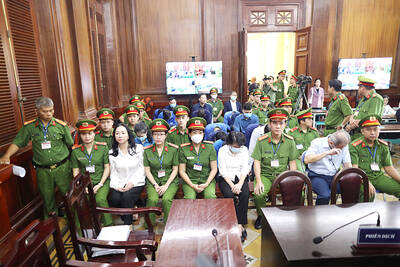
A top Vietnamese property tycoon was on Thursday sentenced to death in one of the biggest corruption cases in history, with an estimated US$27 billion in damages. A panel of three hand-picked jurors and two judges rejected all defense arguments by Truong My Lan, chair of major developer Van Thinh Phat, who was found guilty of swindling cash from Saigon Commercial Bank (SCB) over a decade. “The defendant’s actions ... eroded people’s trust in the leadership of the [Communist] Party and state,” read the verdict at the trial in Ho Chi Minh City. After the five-week trial, 85 others were also sentenced on

‘DELUSIONAL’: Targeting the families of Hamas’ leaders would not push the group to change its position or to give up its demands for Palestinians, Ismail Haniyeh said Israeli aircraft on Wednesday killed three sons of Hamas’ top political leader in the Gaza Strip, striking high-stakes targets at a time when Israel is holding delicate ceasefire negotiations with the militant group. Hamas said four of the leader’s grandchildren were also killed. Ismail Haniyeh’s sons are among the highest-profile figures to be killed in the war so far. Israel said they were Hamas operatives, and Haniyeh accused Israel of acting in “the spirit of revenge and murder.” The deaths threatened to strain the internationally mediated ceasefire talks, which appeared to gain steam in recent days even as the sides remain far

RAMPAGE: A Palestinian man was left dead after dozens of Israeli settlers searching for a missing 14-year-old boy stormed a village in the Israeli-occupied West Bank US President Joe Biden on Friday said he expected Iran to attack Israel “sooner, rather than later” and warned Tehran not to proceed. Asked by reporters about his message to Iran, Biden simply said: “Don’t,” underscoring Washington’s commitment to defend Israel. “We are devoted to the defense of Israel. We will support Israel. We will help defend Israel and Iran will not succeed,” he said. Biden said he would not divulge secure information, but said his expectation was that an attack could come “sooner, rather than later.” Israel braced on Friday for an attack by Iran or its proxies as warnings grew of


 RSS
RSS