


Looking slightly dazed at all the fuss, China's first man in orbit returned to a hero's welcome yesterday, completing an historic odyssey and fuelling the country's more ambitious dreams of a space station or space walk.
Yang Liwei (
Suspended from a giant parachute, the bronze-colored capsule carrying the taikonaut, coined from the Chinese word for space, touched down at around 6.23am after a 21-hour journey that took him around the world 14 times.
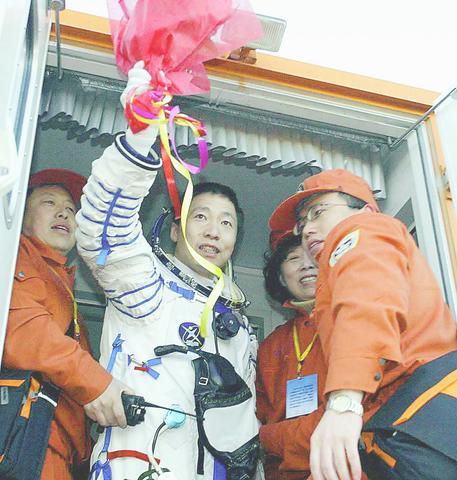
PHOTO: AFP
Premier Wen Jiabao (
The 38-year-old former fighter pilot, raised in China's decaying northeast "rust belt," received flowers and ribbons from well-wishers and was then carried in a chair to waiting doctors for a checkup.
"The spacecraft operated smoothly. I'm feeling good. I'm proud of my motherland," Yang said before being whisked off for a flight to Beijing.
His return brought a triumphant climax to China's maiden space voyage, four decades after Russian cosmonaut Yuri Gagarin and American astronaut Alan Shepard pioneered manned flight in 1961.
The mission marked the crowning moment for a program launched by Mao Zedong (毛澤東) in 1958 but quickly left far behind in the Cold War "space race" rivalry that saw the US put a man on the moon in 1969.
A year later, in the throes of the Cultural Revolution, China launched its first satellite which orbited the Earth beaming out the propaganda anthem "The East is Red."
Yang's feat highlighted the emerging power of China, a permanent UN Security Council member now pursuing more active diplomacy, one of the world's fastest growing economies and chosen host of the 2008 Olympics.
"Our space hero Yang Liwei walked out of the capsule himself," mission commander Li Jinai said.
"Our country's first manned space flight achieved complete success," Li added, according to the Xinhua news agency.
Space officials, this mission under their belt, outlined future space ambitions yesterday and held out the prospect of cooperating with foreign partners.
Shenzhou VI would take to the heavens in the next one or two years, and future forays would include sending an astronaut on a space walk, docking two spacecraft and developing a "space lab," Xie Mingbao, director of the China Manned Space Engineering Office, told a news conference.
In a mission that appeared to run like clockwork, a Long March 2F China lifted off into a clear blue sky over the Gobi desert at 9am on Wednesday and entered its predetermined orbit 10 minutes later.
Yang punctuated his journey with updates on his condition -- variations of "I feel good" -- the last of the voyage coming as the capsule floated to the ground after re-entry.
He spoke to his wife as the Shenzhou, or "Divine Ship," started its eighth circuit around the Earth, assuring her from space: "I feel very good, don't worry."
His son, who also talked to his father in space, had become the "instant envy" of his classmates, giving him bragging rights as the only student in China to be able to claim: "My dad is an astronaut."
Yang, a lieutenant colonel in the People's Liberation Army, was chosen from a pool of 14 contenders. He is the son of a teacher and an agricultural firm official and was raised in the northeast "rust belt" province of Liaoning.
State media said Yang's capsule was supplied with a tent, a knife and a gun in case he landed in the wrong place.
Accolades poured in after China successfully put Yang into orbit. In the US, NASA Administrator Sean O'Keefe described the launch as an important achievement.
UN Secretary General Kofi Annan added his congratulations, noting that, "as the exploration of space knows no national borders, the mission of the Shenzhou V is a step forward for all humankind."
In the middle of the more than 600,000km journey, state television broadcast footage of Yang waving small Chinese and UN flags inside his capsule.
Crew members set to blast off to the International Space Station (ISS) called China a serious contender in the race for supremacy in space.
"Do I see China as a potential rival? Yes, not only in space, but already commercially, economically. I think militarily it's also a possibility," said US astronaut Michael Foale, commander of Expedition 8 to the ISS.
A tight veil of secrecy has blanketed China's space program. State-controlled television delayed broadcasts of both launch and re-entry, airing footage only after the manoeuvres had been declared successful.
On the Internet, anonymous commentators gave full vent to their emotions.
"Today is your holiday, my motherland. Today is your holiday, my Divine Ship. Today is your holiday, my countrymen. Today is your holiday, our Liwei," wrote one person in a dedication to Yang on the portal Sina.com.
"When will we launch a shuttle?" asked another.
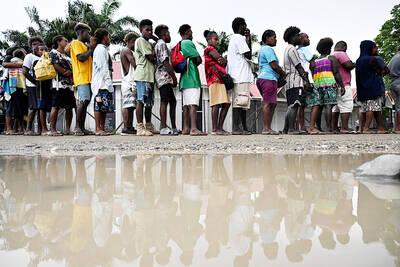
SEEKING CHANGE: A hospital worker said she did not vote in previous elections, but ‘now I can see that maybe my vote can change the system and the country’ Voting closed yesterday across the Solomon Islands in the south Pacific nation’s first general election since the government switched diplomatic allegiance from Taiwan to Beijing and struck a secret security pact that has raised fears of the Chinese navy gaining a foothold in the region. The Solomon Islands’ closer relationship with China and a troubled domestic economy weighed on voters’ minds as they cast their ballots. As many as 420,000 registered voters had their say across 50 national seats. For the first time, the national vote also coincided with elections for eight of the 10 local governments. Esther Maeluma cast her vote in the
Nearly half of China’s major cities are suffering “moderate to severe” levels of subsidence, putting millions of people at risk of flooding, especially as sea levels rise, according to a study of nationwide satellite data released yesterday. The authors of the paper, published by the journal Science, found that 45 percent of China’s urban land was sinking faster than 3mm per year, with 16 percent at more than 10mm per year, driven not only by declining water tables, but also the sheer weight of the built environment. With China’s urban population already in excess of 900 million people, “even a small portion

UNSETTLING IMAGES: The scene took place in front of TV crews covering the Trump trial, with a CNN anchor calling it an ‘emotional and unbelievably disturbing moment’ A man who doused himself in an accelerant and set himself on fire outside the courthouse where former US president Donald Trump is on trial has died, police said yesterday. The New York City Police Department (NYPD) said the man was declared dead by staff at an area hospital. The man was in Collect Pond Park at about 1:30pm on Friday when he took out pamphlets espousing conspiracy theories, tossed them around, then doused himself in an accelerant and set himself on fire, officials and witnesses said. A large number of police officers were nearby when it happened. Some officers and bystanders rushed

HYPOCRISY? The Chinese Ministry of Foreign Affairs yesterday asked whether Biden was talking about China or the US when he used the word ‘xenophobic’ US President Joe Biden on Wednesday called for a hike in steel tariffs on China, accusing Beijing of cheating as he spoke at a campaign event in Pennsylvania. Biden accused China of xenophobia, too, in a speech to union members in Pittsburgh. “They’re not competing, they’re cheating. They’re cheating and we’ve seen the damage here in America,” Biden said. Chinese steel companies “don’t need to worry about making a profit because the Chinese government is subsidizing them so heavily,” he said. Biden said he had called for the US Trade Representative to triple the tariff rates for Chinese steel and aluminum if Beijing was


 RSS
RSS