


"Where is my leg?" moaned a disembodied head in a temple courtyard a few miles from the site of last year's terrorist bombings in Bali. "Where is my arm?"
This past August, the memory of the carnage was still vivid to the audience, but the actor playing a victim of the bombings turned the mood of hushed dread into one of comedy, evoking sudden peals of laughter by quoting the tagline of a popular Indonesian television show about the undead: "Don't watch me! I'm not here!"
"The audience laughed out of relief," said Gusti Ngurah Windia, a well-known Balinese actor, as he recalled his performance a few days later. He was sitting on the porch of his home in the village of Carang Sari, several miles from the southern town of Kuta, where the bombings took place. "For a moment, the horror of their memories was transformed into fiction, a dream from a television melodrama, as if it never really happened."

PHOTO: AFP
A year ago today, more than 200 people were killed in the terrorist attack by Islamic radicals. In other parts of the globe a similar assault might have led to ethnic retaliation, but the Balinese, living on the only Hindu island in Indonesia, the world's most populous Muslim nation, answered with art.
During the last 12 months, performers in temple courtyards, village halls and on television frequently have used traditional Balinese theater forms -- masked comedies, shadow plays and folk operas -- to refer to the attack and its aftermath, which has shattered the island's tourist-driven economy.
Another response took place on Nov. 15 last year, when purification ceremonies, accompanied by theater, music and dance performances, were staged in every village across the island.
This grassroots event stretched as far as New York, where, on the same day, Balinese musicians in sarongs and flowered head-dresses led a ceremonial procession from the World Trade Center site to the Battery Park Esplanade. Among the hundreds of Americans and Indonesians who participated were family members of the American victims of the Bali bombing. They joined a masked Balinese performer in throwing flowers into the Hudson River, a Hindu ritual symbolizing the release of the soul to heaven.
Wearing the sacred mask of Sidha Karya, a mythological Balinese figure representing death and renewal, Nyoman Catra, the performer, surveyed the scarred skyline of Manhattan and said, "People are trying to destroy our world, our country, our village." In keeping with Balinese tradition, he was playing a character in a 15th-century story, but he was also speaking of contemporary events as he connected the terror victims of the two islands -- Bali and Manhattan -- by turning them into inhabitants of one town.
"Maybe the bombers wanted to create chaos and fighting between Hindus and Muslims," said Made Sumadi, an official in Bali's ministry of religion, during an interview in August near the island's capital, Denpasar. "But we did not respond the way the bombers expected. In Bali we responded to violence with peace. The bomb had a great impact on everyone, but it could not stop our performances."
The anthropologist Clifford Geertz called 19th-century Bali a theater-state, where performances were inextricably linked to politics, religion and the problems of everyday life. Similar theatrical impulses exist in 21st-century Balinese society, where almost every village temple ceremony includes some form of theatrical event, with clown narrators serving as mediators between the invisible world of gods and ancestors and the tangible one of current events. In improvised dialogues, the clowns grapple with issues like globalization and overdevelopment that endanger the island's Hindu-animist traditions.
In traditional Balinese mythology, an era marked by death and violence is referred to as "Kali Yuga" or "the time of Kali," a reference to the Hindu deity of destruction. Many Balinese performers have invoked Kali Yuga as a metaphor for the chaos brought on by the bombings. This context has encouraged the Balinese to forgo violent acts of revenge and respond instead with religious offerings designed to restore spiritual harmony to the universe.
In August, shortly after the trial that condemned a mechanic, Amrozi bin Nurhasyim, known as Amrozi, to death for his role in the Bali bombings, a troupe of actors assembled in the village of Kerobokan, a few miles north of Kuta, to put on a play in a temple courtyard. The plot was based on an ancient legend, but the clown narrators made numerous references to Amrozi, including a slapstick gag in which one character jumped in fright at the sound of a slamming door because he thought it was a terrorist attack. Anxiety of this type is a recurring source of comedy in Bali. "Every time somebody burps, I think it's a bomb," joked another clown.
Later, an actor in a buck-toothed mask ran aggressively into the audience. "Don't worry!" he shouted. "I'm not Amrozi." He then told a story about a black-magic curse that had left shops without customers. As the characters in the play overcame the curse by performing ritual offerings, spectators staged similar ceremonies of renewal to exorcise evil and invoke prosperity. A procession of elderly women in sarongs snaked through the courtyard between the actors and the audience, while a white-bearded priest chanted mantras on a flower-covered shrine. The boundaries between the play and the audience dissolved further when a woman in the crowd began sobbing and flailing her arms.
"She's in a trance," someone shouted, as a priest sprinkled holy water on her head to revive her. Within a few minutes other spectators began weeping, as if the temple were plagued by a contagion of communal sadness. All this occurred during the appearance of an actor portraying Sidha Karya, who wore the same mask of death and renewal that had evoked tears from onlookers at the Balinese ceremony in Lower Manhattan.

Republican US lawmakers on Friday criticized US President Joe Biden’s administration after sanctioned Chinese telecoms equipment giant Huawei unveiled a laptop this week powered by an Intel artificial intelligence (AI) chip. The US placed Huawei on a trade restriction list in 2019 for contravening Iran sanctions, part of a broader effort to hobble Beijing’s technological advances. Placement on the list means the company’s suppliers have to seek a special, difficult-to-obtain license before shipping to it. One such license, issued by then-US president Donald Trump’s administration, has allowed Intel to ship central processors to Huawei for use in laptops since 2020. China hardliners
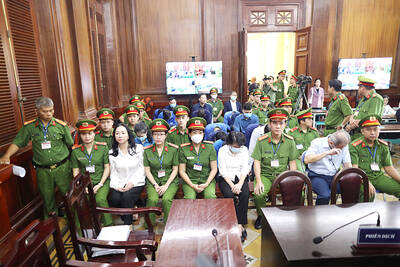
A top Vietnamese property tycoon was on Thursday sentenced to death in one of the biggest corruption cases in history, with an estimated US$27 billion in damages. A panel of three hand-picked jurors and two judges rejected all defense arguments by Truong My Lan, chair of major developer Van Thinh Phat, who was found guilty of swindling cash from Saigon Commercial Bank (SCB) over a decade. “The defendant’s actions ... eroded people’s trust in the leadership of the [Communist] Party and state,” read the verdict at the trial in Ho Chi Minh City. After the five-week trial, 85 others were also sentenced on

‘DELUSIONAL’: Targeting the families of Hamas’ leaders would not push the group to change its position or to give up its demands for Palestinians, Ismail Haniyeh said Israeli aircraft on Wednesday killed three sons of Hamas’ top political leader in the Gaza Strip, striking high-stakes targets at a time when Israel is holding delicate ceasefire negotiations with the militant group. Hamas said four of the leader’s grandchildren were also killed. Ismail Haniyeh’s sons are among the highest-profile figures to be killed in the war so far. Israel said they were Hamas operatives, and Haniyeh accused Israel of acting in “the spirit of revenge and murder.” The deaths threatened to strain the internationally mediated ceasefire talks, which appeared to gain steam in recent days even as the sides remain far
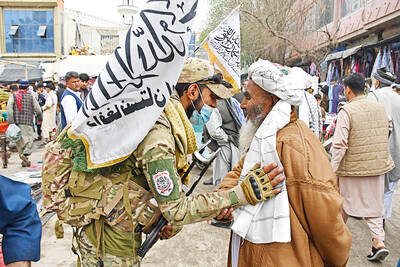
The Taliban’s reclusive supreme leader made a rare public appearance yesterday, an Afghan government spokesman said, leading thousands of worshipers in prayers marking Eid al-Fitr. Hibatullah Akhundzada has made only a handful of public appearances since inheriting the leadership of the Taliban in 2016 and leading the movement back to power with the withdrawal of US forces in 2021. Taliban government spokesman Zabihullah Mujahid said prayer in the largest mosque in Kandahar was “performed under the leadership of the supreme leader.” In a statement on X, he said the early-morning service “was attended by thousands of compatriots” in the southern province considered the


 RSS
RSS