


The test tube of botulinum presented by Washington and London as evidence that Saddam Hussein had been developing and concealing weapons of mass destruction, was found in an Iraqi scientist's home refrigerator, where it had been sitting for 10 years, it emerged Monday.
David Kay, the expert appointed by the CIA to lead the hunt for weapons, told a congressional committee last week that the vial of botulinum had been "hidden" at the scientist's home, and could be used to "covertly surge production of deadly weapons."
Since then, the discovery of the vial has been at the heart of the debate over prewar claims that Iraq had an arsenal of banned weapons.
It has been cited in justifications of the invasion by US President George W. Bush and by British Foreign SecretaryJack Straw, who described botulinum toxin as "15,000 times more toxic than the nerve agent VX."
The US state department even argued that the discovery of the test tube meant that Kay's Iraq Survey Group (ISG), contrary to its own claim, had found a weapon of mass destruction.
However, newly disclosed details about the circumstances in which the botulinum vial was found, have raised fresh questions about its significance.
While presenting his progress report to Congress, Kay did not say when and where the botulinum had been hidden but he told a television interviewer on Sunday that the scientist involved said he was asked to hide the botulinum in his refrigerator at home in 1993.
Iraq admitted pursuing a biological weapons program to UN inspectors two years later. It is unclear whether the Iraqi scientist had received any orders from the regime after that date.
It is also unclear whether the vial contained the bacteria botulinum, from which the toxin is drawn, or the toxin itself, as Kay claimed in interviews over the weekend.
Furthermore, the most lethal form of the germ is the A strain, while the form found by the ISG was the B strain.
Kay admitted that "we have not yet found shiny, pointy things that I would call a weapon," but he insisted there was plenty of evidence of Saddam's intentions to reconstitute weapons programs once free of international scrutiny.
He said the scientist who had the botulinum toxin in his refrigerator had also been entrusted with many more strains of biological weapons, including anthrax, but had given them back "because he said they were too dangerous; he had small children in the house."
More evidence of such programs was included in a 200-page classified version of the 13-page report made public, but experts in the ISG, including former UN inspectors, have so far not been allowed to read the classified version, according to one of their former colleagues.
The refusal to allow the ISG experts to read a report on their own work adds weight to suspicions that the report has been manipulated. "They're under huge pressure to come up with whatever," the former colleague said.
Kay has said privately that he had finished the report in mid-September. But its publication was held up for about two weeks, while more work was done on it at CIA headquarters in Langley, Virginia.
He has said that the ISG will need six to nine more months to complete its search, which has so far cost dollars 300m. The Bush administration has asked Congress for another $US6 million.
He said that the 1,200-strong ISG team -- drawn from the US, Britain and Australia -- were following up an abundance of leads, including the claim by the Iraqi scientist that he had been asked in 1993 to look after anthrax and other biological agents.
Kay also said that the ISG had found some evidence to support the prewar claims that Iraq was trying to buy uranium in Africa.
That claim had been undermined by the discovery that a letter purporting to be an offer by the Niger government to sell uranium to Baghdad turned out to be a fake.
But Kay said: "We have found a document that is an unsolicited -- as far as we can tell -- proposal to sell uranium to them from another African country, not Niger. And we're continuing-that's an active area of a current investigation."

Republican US lawmakers on Friday criticized US President Joe Biden’s administration after sanctioned Chinese telecoms equipment giant Huawei unveiled a laptop this week powered by an Intel artificial intelligence (AI) chip. The US placed Huawei on a trade restriction list in 2019 for contravening Iran sanctions, part of a broader effort to hobble Beijing’s technological advances. Placement on the list means the company’s suppliers have to seek a special, difficult-to-obtain license before shipping to it. One such license, issued by then-US president Donald Trump’s administration, has allowed Intel to ship central processors to Huawei for use in laptops since 2020. China hardliners
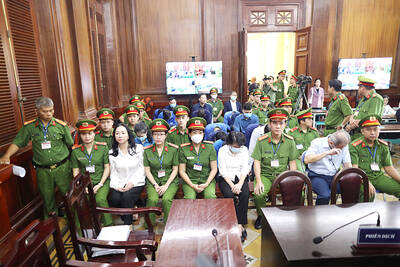
A top Vietnamese property tycoon was on Thursday sentenced to death in one of the biggest corruption cases in history, with an estimated US$27 billion in damages. A panel of three hand-picked jurors and two judges rejected all defense arguments by Truong My Lan, chair of major developer Van Thinh Phat, who was found guilty of swindling cash from Saigon Commercial Bank (SCB) over a decade. “The defendant’s actions ... eroded people’s trust in the leadership of the [Communist] Party and state,” read the verdict at the trial in Ho Chi Minh City. After the five-week trial, 85 others were also sentenced on

‘DELUSIONAL’: Targeting the families of Hamas’ leaders would not push the group to change its position or to give up its demands for Palestinians, Ismail Haniyeh said Israeli aircraft on Wednesday killed three sons of Hamas’ top political leader in the Gaza Strip, striking high-stakes targets at a time when Israel is holding delicate ceasefire negotiations with the militant group. Hamas said four of the leader’s grandchildren were also killed. Ismail Haniyeh’s sons are among the highest-profile figures to be killed in the war so far. Israel said they were Hamas operatives, and Haniyeh accused Israel of acting in “the spirit of revenge and murder.” The deaths threatened to strain the internationally mediated ceasefire talks, which appeared to gain steam in recent days even as the sides remain far
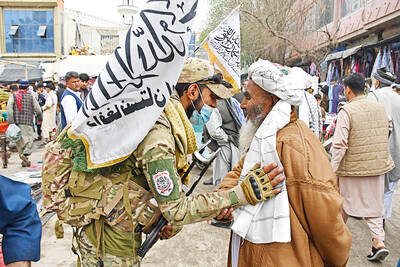
The Taliban’s reclusive supreme leader made a rare public appearance yesterday, an Afghan government spokesman said, leading thousands of worshipers in prayers marking Eid al-Fitr. Hibatullah Akhundzada has made only a handful of public appearances since inheriting the leadership of the Taliban in 2016 and leading the movement back to power with the withdrawal of US forces in 2021. Taliban government spokesman Zabihullah Mujahid said prayer in the largest mosque in Kandahar was “performed under the leadership of the supreme leader.” In a statement on X, he said the early-morning service “was attended by thousands of compatriots” in the southern province considered the


 RSS
RSS