


President Hu Jintao's (胡錦濤) call for a more democratic China sounded a lot like pluralism. But it doesn't mean the one-party communist system will allow opposition politics, foreign analysts say.
Instead, they say, Hu's vague call for "democratic election" and other reforms in a speech this week heralds the start of long-planned changes aimed at strengthening the party's grip on power by making it better attuned to public needs in a fast-changing, increasingly capitalist society.
"In fact, this is aimed at preventing the development of a multiparty system by making the Communist Party more responsive and attractive," said Kenneth Lieberthal, a scholar of Chinese politics at the University of Michigan Business School.
Hu, speaking Tuesday to fellow Communist Party leaders, called for a bigger public role in government, more "socialist democracy" and a fairer legal system, according to state media. Hu called for "efforts to expand citizens' orderly participation in political affairs and guarantee the people's rights to carry out democratic election," the official Xinhua News Agency said.
The remarks were the most emphatic statement yet of political goals by Hu, a little-known figure who succeeded Jiang Zemin (江澤民) as party leader last year and as president in March.
But such reforms are in line with proposals debated for years by the communists and appear to reflect a carefully planned, party-wide effort rather than Hu's personal desires.
China has experimented for a decade with nonpartisan voting for low-level village offices. The party is rumored to be considering competitive internal elections to its posts. But the communists, who celebrated their 54th anniversary in power Wednesday, have crushed attempts to set up opposition parties, jailing their leaders on subversion charges.
"They might want a bit more involvement by the people, but still under the control of the Communist Party," said Steve Tsang, director of the Asian Studies Center at Oxford University's St. Antony's College.
"We see nothing in Hu's history to suggest he is any different from good members of the Communist Party, and none of them really believes in democracy," Tsang said.
Pressure has been building for years for change in the communist system.
The economy has been transformed by reforms launched in 1979 under the late supreme leader Deng Xiaoping (鄧小平), gradually creating a new elite of entrepreneurs and professionals. Government controls over where Chinese could live or work and even whom they could marry have been eliminated or relaxed.
Shanghai and other major city governments have appointed advisory panels of leading capitalists. The central government's main advisory body, the Chinese People's Political Consultative Conference, has grown from a purely ceremonial group of businesspeople, academics and other noncommunist figures into an important resource for Chinese leaders to stay in touch with public opinion in an increasingly diverse -- and politically vocal -- society.
Yet the ruling party still operates almost exactly as it did when it took power in 1949.
Decisions are made in secret by a tiny clique of leaders who are struggling to keep up with economic and social change. Local party bosses -- unelected and unaccountable to the public -- are often accused of corruption or incompetence.
Hu has tried to build an image for himself as a champion of ordinary Chinese, having himself photographed visiting laborers and migrant herders. He has called for government officials to be more professional and accountable.
Lieberthal said that as changes accelerate, China could see direct elections within a year at the county level and to city-level offices by 2010. That could put popularly elected figures into positions with responsibility over millions of people.
Ultimately, he said, the ruling party could be aiming at a system like that of the Institutional Revolutionary Party of Mexico or the Liberal Democratic Party of Japan. Both stayed in power for decades by uniting a wide array of competing factions -- then keeping them together by not demanding ideological unity.
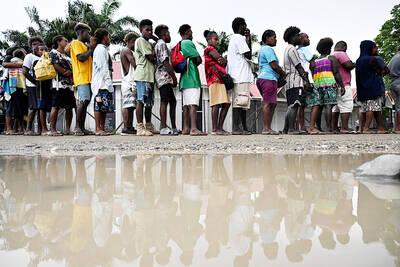
SEEKING CHANGE: A hospital worker said she did not vote in previous elections, but ‘now I can see that maybe my vote can change the system and the country’ Voting closed yesterday across the Solomon Islands in the south Pacific nation’s first general election since the government switched diplomatic allegiance from Taiwan to Beijing and struck a secret security pact that has raised fears of the Chinese navy gaining a foothold in the region. The Solomon Islands’ closer relationship with China and a troubled domestic economy weighed on voters’ minds as they cast their ballots. As many as 420,000 registered voters had their say across 50 national seats. For the first time, the national vote also coincided with elections for eight of the 10 local governments. Esther Maeluma cast her vote in the
Nearly half of China’s major cities are suffering “moderate to severe” levels of subsidence, putting millions of people at risk of flooding, especially as sea levels rise, according to a study of nationwide satellite data released yesterday. The authors of the paper, published by the journal Science, found that 45 percent of China’s urban land was sinking faster than 3mm per year, with 16 percent at more than 10mm per year, driven not only by declining water tables, but also the sheer weight of the built environment. With China’s urban population already in excess of 900 million people, “even a small portion
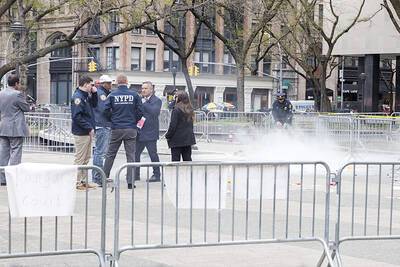
UNSETTLING IMAGES: The scene took place in front of TV crews covering the Trump trial, with a CNN anchor calling it an ‘emotional and unbelievably disturbing moment’ A man who doused himself in an accelerant and set himself on fire outside the courthouse where former US president Donald Trump is on trial has died, police said yesterday. The New York City Police Department (NYPD) said the man was declared dead by staff at an area hospital. The man was in Collect Pond Park at about 1:30pm on Friday when he took out pamphlets espousing conspiracy theories, tossed them around, then doused himself in an accelerant and set himself on fire, officials and witnesses said. A large number of police officers were nearby when it happened. Some officers and bystanders rushed

HYPOCRISY? The Chinese Ministry of Foreign Affairs yesterday asked whether Biden was talking about China or the US when he used the word ‘xenophobic’ US President Joe Biden on Wednesday called for a hike in steel tariffs on China, accusing Beijing of cheating as he spoke at a campaign event in Pennsylvania. Biden accused China of xenophobia, too, in a speech to union members in Pittsburgh. “They’re not competing, they’re cheating. They’re cheating and we’ve seen the damage here in America,” Biden said. Chinese steel companies “don’t need to worry about making a profit because the Chinese government is subsidizing them so heavily,” he said. Biden said he had called for the US Trade Representative to triple the tariff rates for Chinese steel and aluminum if Beijing was


 RSS
RSS