


For the last 10 years, the Hans and the Lins have lived together under the same roof as distant relatives and dear friends. They raised their two rambunctious sons together. They bought their small brick house together. But now the house is divided in more ways than one between Hans on the left side and Lins on the right.
It is hard to see the families sharing anything other than dagger glances ever again, because of a summertime tragedy reminiscent of Lord of the Flies.
In June the Hans' only son, nine-year old Han Zhixiang, drowned in a swirling, but far from turbulent, river near this town, as the Lins' only son, Lin Qiang, 12, and several other boys watched, without helping.
That much is agreed, but the rest is not clear-cut. According to the Han family, Lin Qiang ordered the others to hide Han Zhixiang's clothes and keep their mouths shut. They say he even contemplated burning the body.
So a few weeks ago, the Hans did something that has become more natural in China: They sued their friends for damages.
The story of the Hans and the Lins is emblematic of how ordinary citizens are developing a litigious itch to resolve the kind of disputes that used to be handled informally in places like Xianyang, a town of 10,000 in Fujian Province.
While people once dismissed the courts as corrupt and biased, many Chinese now believe that the brand of justice being meted out can be fair and reliable.
They hope the courts may also be able to resolve social rifts that otherwise could lead to a generation or more of mistrust.
"I saw on television that lawyers can help you get justice and make people take individual responsibility for their actions," said Deng Yundong, an uncle of Han Zhixiang's, whose family had never before met a lawyer, let alone stepped into a courtroom, before this summer.
"I've heard that the legal system has improved a lot, so we have a lot of faith in it," he said.
So, too, does Ma Meiju, Lin Qiang's mother. But she feels cautiously confident that her son's defense -- that the death was purely an accident -- will prevail.
"I don't know what's in their hearts, but I think they just want the money," Ma said.
The case pitting the Han family against the parents of Lin Qiang and another boy, nine-year old Nie Dao Erhuang, began last month. It comes at a time when more Chinese, rural and urban, have become accustomed to the nuances of civil cases through news reports, Web sites and pop culture.
The number of "personal rights" cases, of which civil cases are one important component, more than tripled from 1992, to 11,763 cases in 2000, said Minxin Pei, senior associate and co-director of the China program at the Carnegie Endowment for International Peace in Washington.
In the 1992 movie The Story of Qiuju, a peasant woman sues a local official for kicking her husband. A few years ago, Chinese television began broadcasting Legal Report, a 20-minute daily program that often focuses on workers suing employers or government agencies.
"Before, a lot of people didn't know anything about the law," said Lu Jun, general manager of Shanghai Fashang Information Science and Technology, which produces a Web site that provides legal services and information.
"But now, they have a lot more confidence in the legal system as a way to protect the people, and strengthen social order. It's a very good thing for China," Lu said.
Han Bangsun, the father of Han Zhixiang, has become a quick study. During a break in the trial, Han approached a reporter and pulled out a copy of an Aug. 13 article in the official People's Daily.
It was about a boy in Henan Province who drowned last summer in the company of older boys. The boy's parents sued the other families for failing to protect the boy. This summer, the court awarded the plaintiffs roughly US$730 -- a princely sum here.
"It's the same case as ours, so I'm confident we can win," said Han, a 38-year-old construction worker.
In an interview, the Hans suggested that their son, who they said could not even swim, was lured to the river by Lin Qiang, the leader of the pack. Had the boys at the scene simply cried for help, the Hans' lawyers argued in court, Han Zhixiang might have been rescued. But because the boys did not tell anyone what had happened, his body was not found until four hours after he disappeared, about a half-mile downriver.
A few days after the drowning on June 15, the Lins and the Nies, despondent, scraped together US$365 from friends and relatives -- the equivalent of what the Lins make annually from selling produce on the street. They delivered it to the Hans for the funeral expenses. The Hans accepted the money, and even signed some papers acknowledging the gift.
But a few hours later, the Hans returned most of the money and the next month, they filed a lawsuit demanding more than US$3,100 in compensation.
"We're not doing this for the money," Han said. "We're doing this to get justice."
After a three-and-a-half-hour hearing, the three-judge panel announced that it needed more time to weigh the evidence. It still has not ruled.
The families no longer talk to each other. They barely look at each other. If one family's door is open, the other keeps its door shut.
Perhaps it was not surprising, then, that after a reporter met for an hour with the Hans, Huang Juju, Nie Dao Erhuang's mother, called and tried to get the last dig in.
"Are you done with them yet?" she asked. "All you'll hear from them are lies."
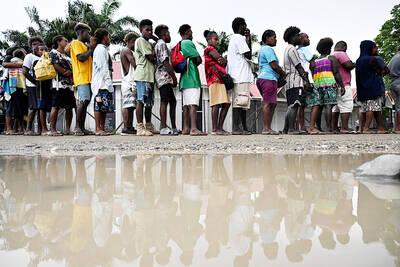
SEEKING CHANGE: A hospital worker said she did not vote in previous elections, but ‘now I can see that maybe my vote can change the system and the country’ Voting closed yesterday across the Solomon Islands in the south Pacific nation’s first general election since the government switched diplomatic allegiance from Taiwan to Beijing and struck a secret security pact that has raised fears of the Chinese navy gaining a foothold in the region. The Solomon Islands’ closer relationship with China and a troubled domestic economy weighed on voters’ minds as they cast their ballots. As many as 420,000 registered voters had their say across 50 national seats. For the first time, the national vote also coincided with elections for eight of the 10 local governments. Esther Maeluma cast her vote in the
Nearly half of China’s major cities are suffering “moderate to severe” levels of subsidence, putting millions of people at risk of flooding, especially as sea levels rise, according to a study of nationwide satellite data released yesterday. The authors of the paper, published by the journal Science, found that 45 percent of China’s urban land was sinking faster than 3mm per year, with 16 percent at more than 10mm per year, driven not only by declining water tables, but also the sheer weight of the built environment. With China’s urban population already in excess of 900 million people, “even a small portion

UNSETTLING IMAGES: The scene took place in front of TV crews covering the Trump trial, with a CNN anchor calling it an ‘emotional and unbelievably disturbing moment’ A man who doused himself in an accelerant and set himself on fire outside the courthouse where former US president Donald Trump is on trial has died, police said yesterday. The New York City Police Department (NYPD) said the man was declared dead by staff at an area hospital. The man was in Collect Pond Park at about 1:30pm on Friday when he took out pamphlets espousing conspiracy theories, tossed them around, then doused himself in an accelerant and set himself on fire, officials and witnesses said. A large number of police officers were nearby when it happened. Some officers and bystanders rushed

HYPOCRISY? The Chinese Ministry of Foreign Affairs yesterday asked whether Biden was talking about China or the US when he used the word ‘xenophobic’ US President Joe Biden on Wednesday called for a hike in steel tariffs on China, accusing Beijing of cheating as he spoke at a campaign event in Pennsylvania. Biden accused China of xenophobia, too, in a speech to union members in Pittsburgh. “They’re not competing, they’re cheating. They’re cheating and we’ve seen the damage here in America,” Biden said. Chinese steel companies “don’t need to worry about making a profit because the Chinese government is subsidizing them so heavily,” he said. Biden said he had called for the US Trade Representative to triple the tariff rates for Chinese steel and aluminum if Beijing was


 RSS
RSS