


General Wesley Clark on Monday called for "a new American patriotism" that would encourage broader public service, respect domestic dissent even in times of war, and embrace international organizations like the UN.
Clark, a former NATO military commander and retired Army officer who last week announced his candidacy for the Democratic presidential nomination, accused the George W. Bush administration of neglecting the nation's economic problems and of pursuing a dangerous go-it-alone foreign policy.
But he also used the setting of the Citadel, a military college here, to appeal to the 150 cadets and civilians assembled on the parade grounds to help restore something loftier: a sense of national spirit that he suggested the administration's campaign against terror had corroded.
"We've got to have a new kind of patriotism that recognizes that in times of war or peace, democracy requires dialogue, disagreement and the courage to speak out," Clark said. "And those who do it should not be condemned but be praised."
Clark made it clear that he believed the administration had unfairly singled out whole classes of immigrants for fear of a minority within them.
"Three million Muslims have come to this country from Asia and the Middle East. They didn't come because they were afraid of our values. They came because they wanted to live under them."
Monday was Day 6 of the Clark campaign, and his 20-minute stump speech still had a few rough patches.
"Patriotism doesn't consist of following the orders, not, not not when you're not in the chain of command," he said, stumbling over his words and catching himself before he inadvertently encouraged insubordination in the ranks.
Despite the stumbles, Clark heard good news in a CNN-USA Today-Gallup poll that showed he had jumped ahead of the other Democrats. The poll, conducted over the weekend, showed him tying with Bush head to head. Clark, a West Point graduate, was invited to speak here by Philip Lader, a visiting political science professor who is a close friend of former president Bill Clinton. Many former top Clinton aides are playing roles in the Clark campaign.
Clark aimed his rhetorical attacks against the administration, never mentioning any of the other nine Democratic candidates. He criticized the Bush team for doing little to stem the job losses and mounting deficits that have weighed down the economy since he retired from the Army in 2000 and entered the private sector.
"I'm running for president because I could not stand by and watch everything that we fought for, everything our nation had accomplished and become, unravel before our eyes," Clark said.
He assailed the administration for failing to shore up the nation's heath care and education systems, but he offered no detailed plans of his own.
He fired the other barrel of his attack at the administration's handling of Iraq, and at its overall foreign policy, especially given that Bush is now requesting US$87 billion from Congress to finance the military and reconstruction operations in Iraq and Afghanistan.
"What was the strategy?" he asked about Iraq. "What was the purpose? What is the success strategy? How are we going to finish the mission there?"
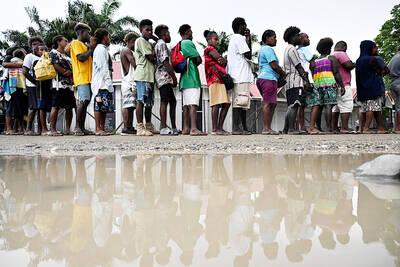
SEEKING CHANGE: A hospital worker said she did not vote in previous elections, but ‘now I can see that maybe my vote can change the system and the country’ Voting closed yesterday across the Solomon Islands in the south Pacific nation’s first general election since the government switched diplomatic allegiance from Taiwan to Beijing and struck a secret security pact that has raised fears of the Chinese navy gaining a foothold in the region. The Solomon Islands’ closer relationship with China and a troubled domestic economy weighed on voters’ minds as they cast their ballots. As many as 420,000 registered voters had their say across 50 national seats. For the first time, the national vote also coincided with elections for eight of the 10 local governments. Esther Maeluma cast her vote in the
Nearly half of China’s major cities are suffering “moderate to severe” levels of subsidence, putting millions of people at risk of flooding, especially as sea levels rise, according to a study of nationwide satellite data released yesterday. The authors of the paper, published by the journal Science, found that 45 percent of China’s urban land was sinking faster than 3mm per year, with 16 percent at more than 10mm per year, driven not only by declining water tables, but also the sheer weight of the built environment. With China’s urban population already in excess of 900 million people, “even a small portion

UNSETTLING IMAGES: The scene took place in front of TV crews covering the Trump trial, with a CNN anchor calling it an ‘emotional and unbelievably disturbing moment’ A man who doused himself in an accelerant and set himself on fire outside the courthouse where former US president Donald Trump is on trial has died, police said yesterday. The New York City Police Department (NYPD) said the man was declared dead by staff at an area hospital. The man was in Collect Pond Park at about 1:30pm on Friday when he took out pamphlets espousing conspiracy theories, tossed them around, then doused himself in an accelerant and set himself on fire, officials and witnesses said. A large number of police officers were nearby when it happened. Some officers and bystanders rushed

HYPOCRISY? The Chinese Ministry of Foreign Affairs yesterday asked whether Biden was talking about China or the US when he used the word ‘xenophobic’ US President Joe Biden on Wednesday called for a hike in steel tariffs on China, accusing Beijing of cheating as he spoke at a campaign event in Pennsylvania. Biden accused China of xenophobia, too, in a speech to union members in Pittsburgh. “They’re not competing, they’re cheating. They’re cheating and we’ve seen the damage here in America,” Biden said. Chinese steel companies “don’t need to worry about making a profit because the Chinese government is subsidizing them so heavily,” he said. Biden said he had called for the US Trade Representative to triple the tariff rates for Chinese steel and aluminum if Beijing was


 RSS
RSS