


Twenty-five years after Egypt and Israel signed the historic Camp David peace accords, their strained marriage seems colder than ever.
In addition, the broader regional peace that was to have been built on the keystone of Camp David appears more elusive than ever.
"Egypt no longer has an ambassador in Tel Aviv, political ties are bad, economic exchanges are frozen and the Egyptian people are increasingly hostile toward Israel," Egyptian researcher Emad Gad said.
Gad, who specializes in Israeli-Egyptian relations for the Al Ahram Center for Political and Strategic Studies, said Cairo newspapers have recently stepped up their attacks on Israel.
The government newspaper Al-Ahram on Sunday called for the Israeli ambassadors in Egypt and Jordan to be expelled if Israel follows through on threats to exile Palestinian leader Yasser Arafat.
Gad said that though the Camp David Accords allowed Egypt to recover the Sinai desert from Israel, they have failed to end Egyptian hostility toward Israel.
"Most of today's students were born after the return of Egyptian territory [in 1982], and that has not stopped them from listing Israel as the number one enemy," he said.
The Camp David Accords, signed on Sept. 17, 1978 at the White House, comprise two parts.
The first was a bilateral arrangement which paved the way six months later for the first peace treaty between Israel and an Arab country; the second was a framework agreement for self-rule in the West Bank and Gaza.
The second part was never implemented, though the Palestinians and Israelis struck a secret deal at Oslo more than 14 years later that paved the way for a measure of Palestinian autonomy similar to that outlined at Camp David.
Relations improved in the years after Oslo under Israeli prime minister Yitzhak Rabin, but took a turn for the worse after Rabin was assassinated in 1995 and right-winger Benjamin Netanyahu was elected prime minister in 1996.
Since hardliner Ariel Sharon became premier in March 2001, ties have hit rock bottom.
Israel's ambassador to Egypt, Gideon Ben-Ami, said the peace treaty that emerged from Camp David is durable, even though it has failed to produce the desired benefits.
"The treaty managed to survive the ups and downs of the volatile Middle East peace process, and to prove its irreversibility," Ben-Ami told reporters in a written response to a query by e-mail.
But he added that "Egyptian-Israeli current relations are by far unsatisfactory, primarily due to the consequences and shock-waves of the second intifada and Egypt's obvious solidarity with the Palestinian side."
"Naturally, one feels disappointed and frustrated with the linkage made by the Egyptians between the tiresome progress on the Palestinian track, and normalization, as we Israelis conceive it," Ben-Ami said.
Sharon said last month that Egypt could not be involved in the Middle East peace process if it did not release Israeli national Azzam Azzam, jailed in Egypt for spying -- a way to deny Egypt the key mediating role it cherishes.

‘IN A DIFFERENT PLACE’: The envoy first visited Shanghai, where he attended a Chinese basketball playoff match, and is to meet top officials in Beijing tomorrow US Secretary of State Antony Blinken yesterday arrived in China on his second visit in a year as the US ramps up pressure on its rival over its support for Russia while also seeking to manage tensions with Beijing. The US diplomat tomorrow is to meet China’s top brass in Beijing, where he is also expected to plead for restraint as Taiwan inaugurates president-elect William Lai (賴清德), and to raise US concerns on Chinese trade practices. However, Blinken is also seeking to stabilize ties, with tensions between the world’s two largest economies easing since his previous visit in June last year. At the
Nearly half of China’s major cities are suffering “moderate to severe” levels of subsidence, putting millions of people at risk of flooding, especially as sea levels rise, according to a study of nationwide satellite data released yesterday. The authors of the paper, published by the journal Science, found that 45 percent of China’s urban land was sinking faster than 3mm per year, with 16 percent at more than 10mm per year, driven not only by declining water tables, but also the sheer weight of the built environment. With China’s urban population already in excess of 900 million people, “even a small portion

UNSETTLING IMAGES: The scene took place in front of TV crews covering the Trump trial, with a CNN anchor calling it an ‘emotional and unbelievably disturbing moment’ A man who doused himself in an accelerant and set himself on fire outside the courthouse where former US president Donald Trump is on trial has died, police said yesterday. The New York City Police Department (NYPD) said the man was declared dead by staff at an area hospital. The man was in Collect Pond Park at about 1:30pm on Friday when he took out pamphlets espousing conspiracy theories, tossed them around, then doused himself in an accelerant and set himself on fire, officials and witnesses said. A large number of police officers were nearby when it happened. Some officers and bystanders rushed
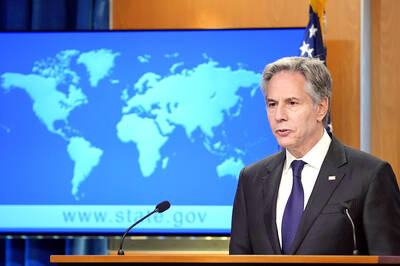
Beijing is continuing to commit genocide and crimes against humanity against Uyghurs and other Muslim minorities in its western Xinjiang province, U.S. Secretary of State Antony Blinken said in a report published on Monday, ahead of his planned visit to China this week. The State Department’s annual human rights report, which documents abuses recorded all over the world during the previous calendar year, repeated language from previous years on the treatment of Muslims in Xinjiang, but the publication raises the issue ahead of delicate talks, including on the war in Ukraine and global trade, between the top U.S. diplomat and Chinese


 RSS
RSS