


US Secretary of State Colin Powell visited a mass grave Monday to highlight perhaps the single biggest human-rights abuse of former Iraqi president Saddam Hussein's brutal regime -- the chemical weapons murder of some 5,000 people in March 1988.
Powell flew here from Baghdad to take part in the formal dedication of a memorial and museum to commemorate those who lost their lives here 15 years ago.
Powell traveled in a military C-130 transport aircraft to Kirkuk, then transferred to a helicopter, flying over dusty plains and barren hills to get to this Kurdish-dominated town.
The Halabja massacre has been cited repeatedly by US President George W. Bush as an example of Saddam's brutality.
Halabja lies on the southern fringe of Iraqi Kurdistan, near the Iranian border. Some 5,000 Kurds died there when they were attacked with bombs carrying mustard gas and other poisonous gases on March 16, 1988, part of a scorched-earth campaign to wipe out a Kurdish rebellion in northern Iraq.
Many of those attending the ceremony lost seven to 10 family members in the slaughter.
Powell stood before long rows of simple headstones where the remains of more than 1,000 victims of the conquered regime lie.
He told the gathering of several hundred: "I can't tell you that Saddam Hussein was a murderous tyrant -- you know that. What I can tell you is that what happened here in 1988 is never going to happen again."
His remarks drew enthusiastic cheers and applause.
Powell added that Saddam is "running and hiding. He's going to be running until we catch him or he dies."
Many who attended the ceremony under a hot midday sun carried signs praising the US for ousting Saddam. "Thank you President Bush for liberating Iraq," said one. "Halabja is proud to host Secretary Powell," read another.
Also addressing the gathering was Jalal Talabani, leader of the Patriotic Union of Kurdistan. He said the mass graves in Halabja "validate the morality of your intervention. ... Like [Adolf] Hitler, the Butcher of Baghdad miscalculated."
Many in attendance were women, clad in black and carrying pictures of family members killed in the attack. When Powell mixed with the crowd after his brief remarks, many broke into tears as he approached and thrust bouquets of flowers at him.
Later, Powell and his party drove to the museum for the dedication ceremony. Surrounded by black marble circular walls bearing the names in Kurdish of those who perished, Powell lit candles in their memory.
According to a State Department account of the attack on Halabja, Saddam's air force dropped sarin gas and other deadly chemicals on the city, immediately killing 5,000 people and injuring 10,000 others. Choking victims were unable to escape the gas and many bodies were found alongside the local water source, a reflection of a vain effort to quench their thirst, the account said.
"Entire families of victims were found dead in their homes and in the streets curled up together, and many homes were destroyed in the bombardment," the summary said.
On Sunday in Baghdad, Powell spent 12 hours in talks with the team of American officials guiding Iraq in the postwar period and with the US-appointed Iraqi Governing Council. He also attended a Baghdad City Council meeting, met with Foreign Minister Hoshyar Zebari and joined the US administrator for Iraq, Paul Bremer, at a joint news conference.
Powell described impressive moves toward self-government and seemed invigorated by what he heard as he made his rounds.

Republican US lawmakers on Friday criticized US President Joe Biden’s administration after sanctioned Chinese telecoms equipment giant Huawei unveiled a laptop this week powered by an Intel artificial intelligence (AI) chip. The US placed Huawei on a trade restriction list in 2019 for contravening Iran sanctions, part of a broader effort to hobble Beijing’s technological advances. Placement on the list means the company’s suppliers have to seek a special, difficult-to-obtain license before shipping to it. One such license, issued by then-US president Donald Trump’s administration, has allowed Intel to ship central processors to Huawei for use in laptops since 2020. China hardliners

Conjoined twins Lori and George Schappell, who pursued separate careers, interests and relationships during lives that defied medical expectations, died this month in Pennsylvania, funeral home officials said. They were 62. The twins, listed by Guinness World Records as the oldest living conjoined twins, died on April 7 at the Hospital of the University of Pennsylvania, obituaries posted by Leibensperger Funeral Homes of Hamburg said. The cause of death was not detailed. “When we were born, the doctors didn’t think we’d make 30, but we proved them wrong,” Lori said in an interview when they turned 50, the Philadelphia Inquirer reported. The
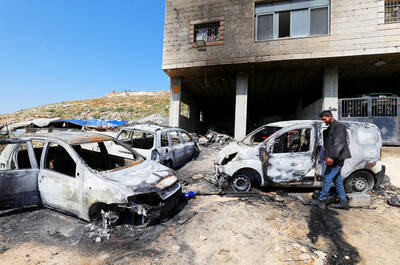
RAMPAGE: A Palestinian man was left dead after dozens of Israeli settlers searching for a missing 14-year-old boy stormed a village in the Israeli-occupied West Bank US President Joe Biden on Friday said he expected Iran to attack Israel “sooner, rather than later” and warned Tehran not to proceed. Asked by reporters about his message to Iran, Biden simply said: “Don’t,” underscoring Washington’s commitment to defend Israel. “We are devoted to the defense of Israel. We will support Israel. We will help defend Israel and Iran will not succeed,” he said. Biden said he would not divulge secure information, but said his expectation was that an attack could come “sooner, rather than later.” Israel braced on Friday for an attack by Iran or its proxies as warnings grew of
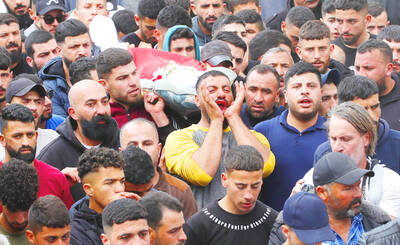
IN PURSUIT: Israel’s defense minister said the revenge attacks by Israeli settlers would make it difficult for security forces to find those responsible for the 14-year-old’s death Israeli Prime Minister Benjamin Netanyahu on Saturday condemned the “heinous murder” of an Israeli teenager in the occupied West Bank as attacks on Palestinian villages intensified following news of his death. After Benjamin Achimeir, 14, was reported missing near Ramallah on Friday, hundreds of Jewish settlers backed by Israeli forces raided nearby Palestinian villages, torching vehicles and homes, leaving at least one villager dead and dozens wounded. The attacks escalated in several villages on Saturday after Achimeir’s body was found near the Malachi Hashalom outpost. Agence France-Presse correspondents saw smoke rising from burned houses and fields. Mayor Amin Abu Alyah, of the


 RSS
RSS