


Prime Minister Junichiro Koizumi on Sunday entered the final week of campaigning for the presidency of the governing Liberal Democratic Party with an overwhelming lead in polls, almost assured of a second term, in which he pledges to continue efforts to revitalize the nation's economy.
All media surveys indicate that Koizumi seemed likely to win a majority over his three rivals and avoid a runoff after Saturday's election, in which the party's lawmakers and local members cast votes. With the Liberal Democratic Party controlling the Legislature, its president will in effect become Japan's head of government for a three-year term ending September 2006.
The four candidates appeared together on Sunday here in western Japan, standing on top of a bus in a public square. In a separate debate on Sunday, Koizumi pledged to pursue economic policies including privatizing public institutions and modernizing banking systems, while his challengers criticized him for failing to revitalize the economy first.
Buoyed by the surveys and signs of an economic recovery that include new growth figures, Koizumi was already looking beyond the party election, according to news accounts, considering dissolving the powerful lower house of Parliament next month and calling an election in November. He has been a staunch ally of US President George W. Bush, and many investors here and abroad prefer him to his challengers.
The Japanese public, according to polls, continues to support Koizumi, 61, partly because of an absence of an attractive challenger. That represents a big change since a wave of populism propelled him to power in April 2001 and earned him rock-star popularity among voters weary of bland politicians. Expectations that he would transform Japan's economy and political culture have largely declined, polls show.
"I don't think much will change, regardless of who wins, though out of the four, I guess Koizumi is the most able," said Shinji Wada, 52, a ship worker who was listening to the candidates speak here.
Recalling a time when Koizumi's popularity was such that calendars and other goods featuring his portrait were hot-selling items, Wada added: "Two-and-a-half years ago, I had high expectations that he would carry out real reforms, in the economy and politics. I don't have such expectations anymore."
Still, on top of the bus on Sunday, while his rivals stood stiffly next to him, Koizumi showed the common touch that won him record-high ratings when his term began.
Party members are rallying behind Koizumi, who remains more popular than the Liberal Democratic Party. For instance, the leader of the party's upper house members, Mikio Aoki, threw his support behind Koizumi despite being one of his harshest critics.
While Aoki has attacked the prime minister's policies, saying for example that it would be wrong to privatize the postal service, he seemed to attach greater importance to the help Koizumi's standing would give his party in elections. In exchange for Aoki's support, some experts have predicted that Koizumi will appoint a conservative to a key cabinet position.
One challenger, Masahiko Komura, 61, a former foreign minister, said, "I am frightened to hear the prime minister say that the idea of supporting someone irrespectively of policy agreement is a progressive idea." The support, he said, "is clearly created in back-room wheeling and dealing."
The other rivals are Shizuka Kamei, 66, a former party policy chief, and Takao Fujii, 60, a former transportation minister.
Koizumi's challengers said that while structural reforms were necessary, they favored more spending to boost the economy.
When campaigning began last week, Koizumi reiterated his pledges to overhaul the government sector. He focused on privatizing the postal services by 2007 and the country's four public road corporations by 2005, both of which have provided support bases for party members.
Other traditional backers of the Liberal Democrats, including the health and construction industries, are lukewarm about him, but are expected to show support to help his party over the opposition Democratic Party. "The Democratic Party's policy would be even more severe to them than Koizumi's," said Jun Iio, a professor of politics at the National Graduate Institute for Policy Studies.
The trade organizations make up a large chunk of the Liberal Democratic Party's 1.4 million members. Those members will hold 300 votes in Saturday's election, while the party's 357 lawmakers each have one vote. If no one wins a majority, or 329 votes, in the first round, the 357 lawmakers alone will choose from the top two candidates.
Many have criticized Koizumi for buckling to those conservative voices during his first term.
"Structural reforms, structural reforms -- that's what he always says," Mitsuko Tanaka, a 60-year-old housewife, said after listening to the prime minister speak on Sunday. "But it's been two and a half years, and I don't feel that the economy's improving. Stores are closing. Crime's going up because people don't have jobs."
Others, however, said that Koizumi was on the right track, and that resistance inside the party and the long economic slump made rapid change impossible.
"I think he's fulfilled half of his promises," said Takahiro Miyai, 26, a social services worker.
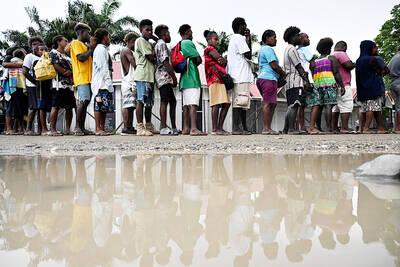
SEEKING CHANGE: A hospital worker said she did not vote in previous elections, but ‘now I can see that maybe my vote can change the system and the country’ Voting closed yesterday across the Solomon Islands in the south Pacific nation’s first general election since the government switched diplomatic allegiance from Taiwan to Beijing and struck a secret security pact that has raised fears of the Chinese navy gaining a foothold in the region. The Solomon Islands’ closer relationship with China and a troubled domestic economy weighed on voters’ minds as they cast their ballots. As many as 420,000 registered voters had their say across 50 national seats. For the first time, the national vote also coincided with elections for eight of the 10 local governments. Esther Maeluma cast her vote in the
Nearly half of China’s major cities are suffering “moderate to severe” levels of subsidence, putting millions of people at risk of flooding, especially as sea levels rise, according to a study of nationwide satellite data released yesterday. The authors of the paper, published by the journal Science, found that 45 percent of China’s urban land was sinking faster than 3mm per year, with 16 percent at more than 10mm per year, driven not only by declining water tables, but also the sheer weight of the built environment. With China’s urban population already in excess of 900 million people, “even a small portion

UNSETTLING IMAGES: The scene took place in front of TV crews covering the Trump trial, with a CNN anchor calling it an ‘emotional and unbelievably disturbing moment’ A man who doused himself in an accelerant and set himself on fire outside the courthouse where former US president Donald Trump is on trial has died, police said yesterday. The New York City Police Department (NYPD) said the man was declared dead by staff at an area hospital. The man was in Collect Pond Park at about 1:30pm on Friday when he took out pamphlets espousing conspiracy theories, tossed them around, then doused himself in an accelerant and set himself on fire, officials and witnesses said. A large number of police officers were nearby when it happened. Some officers and bystanders rushed

HYPOCRISY? The Chinese Ministry of Foreign Affairs yesterday asked whether Biden was talking about China or the US when he used the word ‘xenophobic’ US President Joe Biden on Wednesday called for a hike in steel tariffs on China, accusing Beijing of cheating as he spoke at a campaign event in Pennsylvania. Biden accused China of xenophobia, too, in a speech to union members in Pittsburgh. “They’re not competing, they’re cheating. They’re cheating and we’ve seen the damage here in America,” Biden said. Chinese steel companies “don’t need to worry about making a profit because the Chinese government is subsidizing them so heavily,” he said. Biden said he had called for the US Trade Representative to triple the tariff rates for Chinese steel and aluminum if Beijing was


 RSS
RSS