


Dramatic new evidence from the British intelligence services casts fresh doubts over British Prime Minister Tony Blair's central claim that Iraq continued to produce chemical and biological weapons up until the outbreak of war.
Newly disclosed Cabinet Office documents show that Blair's categorical assertion was only based on a single source and was described as "too strong" by senior intelligence figures.
The claim, which remained in the dossier despite warnings from experts, was repeated in Blair's foreword to the dossier and, more crucially, in the key Commons debate on Sept. 24 last year in which he attempted to persuade members of parliament to back the war.
He told parliament: "[The dossier] concludes that Iraq has chemical and biological weapons [and] that [then Iraqi president] Saddam [Hussein] has continued to produce them.'
The revelation that this key claim claim was based on a single source echoes concerns expressed by David Kelly before his death about the claim that weapons of mass destruction (WMDs) could be deployed within 45 minutes.
Uncorroborated information from a single source is not usually considered reliable by the intelligence services.
Opposition Liberal Democrats Foreign Affairs and Defence spokesman Menzies Campbell said: "This is a further and serious undermining of the prime minister's case for war. After the exposure of the 45-minute claim, no one can continue to have any confidence in assertions based on a single source."
The contents of the new documents, which were sent to the inquiry late last week, will be a blow to the government and cast further doubts over the factual accuracy of the Sept. 24 dossier.
Commenting on a key paragraph in the dossier, stating that Iraq had a "useable chemical and biological weapons capability" including "recent production of chemical agents," the Defence Intelligence Staff (DIS) official complains that this "is too strong" and adds: "This is based on a single source."
The official also warns that a box in the dossier designed to give the public a graphic warning of the effects of VX and mustard gas was "grossly misleading."
A second new document gives further evidence of disquiet about the dossier, in particularly the Blair's foreword.
The internal memo from an expert on the DIS dated Sept. 20 last year states that the dossier "still includes a number of statements not supported by the evidence available to me."
The memo continues that it had not been established "beyond doubt that Saddam has continued to produce chemical and biological weapons."
Two senior intelligence chiefs appearing before the Hutton inquiry are likely to be questioned about the new documents today.
Air Marshall Sir Joe French, former head of Defence Intelligence, will be asked why he dismissed complaints as "splitting hairs," and his deputy, Tony Cragg, who was on the circulation list of the Sept. 20 letter, will be asked about his response to the concerns of the DIS experts working below him.
There is strong speculation that Sir Richard Dearlove, head of M16, will appear as a surprise witness.
The memos confirm doubts raised by the Intelligence and Security Committee, which last week clear that Saddam "continued to produce chemical and biological weapons."
In fact, the Joint Intelligence Committee "did not know what had been produced and in what quantities," the committee went on, adding that "this uncertainty should have been highlighted to give a balanced view of Saddam's chemical and biological capacity."
The section on chemical and biological weapons had also been hardened up in early September, and though this reflected new intelligence coming to light, 'much of it was still explicitly based on judgment and assessment' rather than hard facts. The most recent JIC assessment, an analysis of all the intelligence data coming in, should have done more to point out "the uncertainties and gaps in the UK's knowledge."
On the face of it, the ISC's criticisms appear to bear out the worries of the intelligence officials whose memos have now come to light. It did added that there was "technically credible" evidence of five tons of VX being produced in 1998, but admitted that this was "uncorroborated" -- in other words, came from a single source.
Downing Street refused Saturday night to comment on the disclosures, saying that all evidence to the Hutton inquiry was a matter for Lord Hutton himself.
Meanwhile, BBC Director-General Greg Dyke will also appear before the inquiry again today, reports David Smith. It is thought he will employ attack as the best form of defence when he faces tough questions about why the corporation refused to back down in the row with Downing Street that led to Kelly's death.
With the help of a team of researchers, Dyke has personally been studying every scrap of evidence and is said by colleagues to be in "robust" form. He said recently: "Six weeks ago I'd never heard of WMD. Now I'm a WMD nerd. I could write a PhD thesis on Hutton; I have read everything."
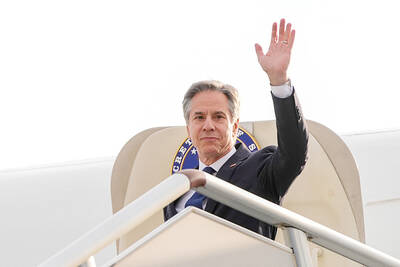
‘IN A DIFFERENT PLACE’: The envoy first visited Shanghai, where he attended a Chinese basketball playoff match, and is to meet top officials in Beijing tomorrow US Secretary of State Antony Blinken yesterday arrived in China on his second visit in a year as the US ramps up pressure on its rival over its support for Russia while also seeking to manage tensions with Beijing. The US diplomat tomorrow is to meet China’s top brass in Beijing, where he is also expected to plead for restraint as Taiwan inaugurates president-elect William Lai (賴清德), and to raise US concerns on Chinese trade practices. However, Blinken is also seeking to stabilize ties, with tensions between the world’s two largest economies easing since his previous visit in June last year. At the
Nearly half of China’s major cities are suffering “moderate to severe” levels of subsidence, putting millions of people at risk of flooding, especially as sea levels rise, according to a study of nationwide satellite data released yesterday. The authors of the paper, published by the journal Science, found that 45 percent of China’s urban land was sinking faster than 3mm per year, with 16 percent at more than 10mm per year, driven not only by declining water tables, but also the sheer weight of the built environment. With China’s urban population already in excess of 900 million people, “even a small portion

UNSETTLING IMAGES: The scene took place in front of TV crews covering the Trump trial, with a CNN anchor calling it an ‘emotional and unbelievably disturbing moment’ A man who doused himself in an accelerant and set himself on fire outside the courthouse where former US president Donald Trump is on trial has died, police said yesterday. The New York City Police Department (NYPD) said the man was declared dead by staff at an area hospital. The man was in Collect Pond Park at about 1:30pm on Friday when he took out pamphlets espousing conspiracy theories, tossed them around, then doused himself in an accelerant and set himself on fire, officials and witnesses said. A large number of police officers were nearby when it happened. Some officers and bystanders rushed
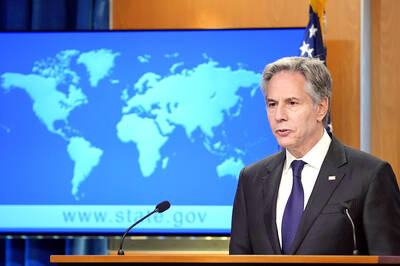
Beijing is continuing to commit genocide and crimes against humanity against Uyghurs and other Muslim minorities in its western Xinjiang province, U.S. Secretary of State Antony Blinken said in a report published on Monday, ahead of his planned visit to China this week. The State Department’s annual human rights report, which documents abuses recorded all over the world during the previous calendar year, repeated language from previous years on the treatment of Muslims in Xinjiang, but the publication raises the issue ahead of delicate talks, including on the war in Ukraine and global trade, between the top U.S. diplomat and Chinese


 RSS
RSS