


US Secretary of State Colin Powell, in a delicate meeting in Geneva today, will push for a reinforced UN role in Iraq while maintaining firm US control over reconstruction of the war-torn country.
Powell will be meeting with his counterparts of the other four permanent members of the UN Security Council -- Britain, China, France and Russia -- and UN Secretary General Kofi Annan.
He can count on the support of Britain, Washington's closest ally in the war.
But he will be facing stiff opposition from France and Russia, which, backed by China, have tabled amendments to a US resolution that would water down US prerogatives and shift much of the US say in Iraq to the UN.
The French counter-proposals were drawn up jointly with Germany, a non-permanent member of the security council which, along with Paris and Moscow and, to a lesser degree Beijing, had fervently opposed the war.
US officials have been downplaying the stakes of today's meeting to avoid the impression it will signal a return to the boisterous debates that preceded the war.
The White House claimed the French and Germans were not opposed to the idea of a new resolution, and the State Department said Powell and Russian counterpart Igor Ivanov had had a "constructive discussion" on the matter.
"We would expect the discussion [today] to be about the concepts of how we go forward in the resolution and generally with the UN on Iraq, not a negotiation on the text itself," spokesman Richard Boucher said earlier this week.
US diplomats also have been stressing the Geneva meeting would constitute an "informal discussion," and not negotiations on precise measures to be taken in Iraq.
A US plan presented last week includes the creation of a multinational force under UN mandate but US command, aimed at encouraging more countries to send troops to Iraq.
But Washington's capacity to ease its load by sharing political power in Iraq and gaining a greater international contribution, both in troops and cash, remained uncertain.
Even the fact of its again going before the UN, which it ignored when it invaded Iraq, has been seen as an about-face by US President George W. Bush's administration, under pressure of the nagging resistance to US troops in Iraq and the skyrocketing cost of keeping them there.
A leading US "hawk," Deputy Defense Secretary Paul Wolfowitz, assured a Senate committee the US was ready to share political authority in Iraq with its allies in reconstruction operations.
Washington wants "more international troops to share the burden of providing stability forces," he said.
"We're prepared to do what's needed to make it work."
The State Department indicated that Washington had no intention of being shunted aside after having borne the brunt of the military, political and economic effort in Iraq.
"Proposals have to be grounded in the reality of the current situation," said Boucher.
"You can't pretend the war never happened, you can't pretend the coalition never happened, you can't pretend that the Iraqis have not already made considerable progress under the governing council."
The US resolution to be discussed in Geneva "takes as a point of departure the reality of the situation, that the coalition is already working with the governing council, the Iraqis, to move forward toward constitutional elections and also to move forward on the exercise of sovereignty."
"We think that all council members do share essentially the same objective, that's to help Iraq and the Iraqi people exercise their full sovereignty as quickly as possible," he said.
The differences, he said, rest in the steps to be taken to get there.
Nearly half of China’s major cities are suffering “moderate to severe” levels of subsidence, putting millions of people at risk of flooding, especially as sea levels rise, according to a study of nationwide satellite data released yesterday. The authors of the paper, published by the journal Science, found that 45 percent of China’s urban land was sinking faster than 3mm per year, with 16 percent at more than 10mm per year, driven not only by declining water tables, but also the sheer weight of the built environment. With China’s urban population already in excess of 900 million people, “even a small portion
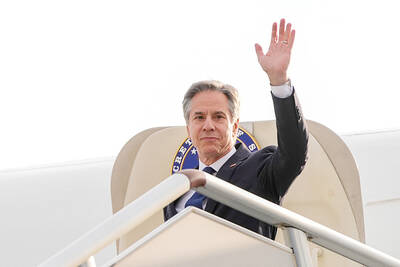
‘IN A DIFFERENT PLACE’: The envoy first visited Shanghai, where he attended a Chinese basketball playoff match, and is to meet top officials in Beijing tomorrow US Secretary of State Antony Blinken yesterday arrived in China on his second visit in a year as the US ramps up pressure on its rival over its support for Russia while also seeking to manage tensions with Beijing. The US diplomat tomorrow is to meet China’s top brass in Beijing, where he is also expected to plead for restraint as Taiwan inaugurates president-elect William Lai (賴清德), and to raise US concerns on Chinese trade practices. However, Blinken is also seeking to stabilize ties, with tensions between the world’s two largest economies easing since his previous visit in June last year. At the

UNSETTLING IMAGES: The scene took place in front of TV crews covering the Trump trial, with a CNN anchor calling it an ‘emotional and unbelievably disturbing moment’ A man who doused himself in an accelerant and set himself on fire outside the courthouse where former US president Donald Trump is on trial has died, police said yesterday. The New York City Police Department (NYPD) said the man was declared dead by staff at an area hospital. The man was in Collect Pond Park at about 1:30pm on Friday when he took out pamphlets espousing conspiracy theories, tossed them around, then doused himself in an accelerant and set himself on fire, officials and witnesses said. A large number of police officers were nearby when it happened. Some officers and bystanders rushed
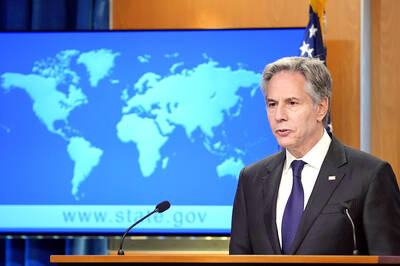
Beijing is continuing to commit genocide and crimes against humanity against Uyghurs and other Muslim minorities in its western Xinjiang province, U.S. Secretary of State Antony Blinken said in a report published on Monday, ahead of his planned visit to China this week. The State Department’s annual human rights report, which documents abuses recorded all over the world during the previous calendar year, repeated language from previous years on the treatment of Muslims in Xinjiang, but the publication raises the issue ahead of delicate talks, including on the war in Ukraine and global trade, between the top U.S. diplomat and Chinese


 RSS
RSS