


US President George W. Bush on Wednesday urged Congress to "untie the hands" of law enforcement by passing new anti-terrorism measures to deny bail to terror suspects, expand the death penalty and let investigators bypass grand juries to obtain subpoenas.
The initiative is a follow-up to hotly debated "USA Patriot Act" anti-terror legislation passed after the Sept. 11 attacks, and drew fresh criticism that the administration was infringing civil liberties.
"The House and the Senate have a responsibility to act quickly on these matters. Untie the hands of our law enforcement officials so they can fight and win the war against terror," Bush said in a speech at the FBI academy in Quantico, Virginia, outside Washington.
Bush spoke on the eve of the second anniversary of the Sept. 11 attacks. He said the Patriot Act had helped fight terrorism but remaining "unreasonable obstacles to investigating and prosecuting terrorism" should be urgently addressed.
The president was taking a piecemeal approach of endorsing individual measures rather than submitting a "Patriot II" package that the Justice Department had contemplated earlier.
Civil-liberties advocates in Congress, both conservative and liberal, had said such a package was a threat to constitutional protections. They said the original Patriot Act opened the door to government abuse of authority in surveillance and searches.
The American Civil Liberties Union attacked Bush's new proposals as "further erosions" of protections against "political abuses of power."
Senator Joseph Lieberman, a Democratic presidential candidate from Connecticut, said Americans should be "leery" of new legislation while concerns remain about the original act. Massachusetts Democratic Senator Edward Kennedy said Bush should prove the new steps are needed.
Bush defended his proposals. "These and other measures have long been on the books for other crimes. They have been tested by time, affirmed by the court, and what we are proposing, they are fully consistent with the United States Constitution."
A Senate Democratic source said that because the Patriot II package had sparked widespread criticism, Republicans had sought new ways to package the anti-terror measures.
Bush urged Congress to:
-- Let law enforcement authorities bypass a judge or grand jury to issue "administrative subpoenas" in time-sensitive terrorism investigations. Such authority is available in some other types of investigations.
"If we can use these subpoenas to catch crooked doctors, the Congress should allow law enforcement officials to use them in catching terrorists," Bush said.
-- Allow courts to deny bail for terrorism suspects. Bush said it makes no sense that "terror suspects" could be released to possibly escape when courts can deny bail to drug dealers.
-- Impose the federal death penalty for terror-related crimes, such as sabotage of a military facility that "takes innocent life."
Pennsylvania Republican Senator Arlen Specter said he had introduced death penalty legislation encompassing Bush's aims. The legislation also would apply the death penalty for financial support of terror, conspiracy or attempt to commit terrorism.

Republican US lawmakers on Friday criticized US President Joe Biden’s administration after sanctioned Chinese telecoms equipment giant Huawei unveiled a laptop this week powered by an Intel artificial intelligence (AI) chip. The US placed Huawei on a trade restriction list in 2019 for contravening Iran sanctions, part of a broader effort to hobble Beijing’s technological advances. Placement on the list means the company’s suppliers have to seek a special, difficult-to-obtain license before shipping to it. One such license, issued by then-US president Donald Trump’s administration, has allowed Intel to ship central processors to Huawei for use in laptops since 2020. China hardliners

DISADVANTAGE: Erin O’Toole, who led the Conservatives during the election campaign in 2021, estimated that the interference cost his party as many as nine legislative seats Canada’s domestic spy agency on Monday concluded that China interfered in the past two elections, an official probe heard, the firmest evidence so far of suspected Chinese meddling in Canadian politics. Canadian Prime Minister Justin Trudeau’s Liberal Party won both the elections, held in 2019 and 2021. Under pressure from opposition lawmakers unhappy about media reports on China’s possible role, Trudeau set up a commission into foreign interference. The commission was shown a slide on Monday containing an extract of a briefing in February last year from the Canadian Security Intelligence Service (CSIS). “We know that the PRC [People’s Republic of China] clandestinely
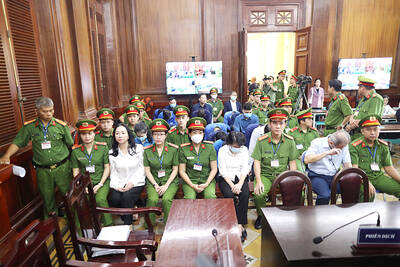
A top Vietnamese property tycoon was on Thursday sentenced to death in one of the biggest corruption cases in history, with an estimated US$27 billion in damages. A panel of three hand-picked jurors and two judges rejected all defense arguments by Truong My Lan, chair of major developer Van Thinh Phat, who was found guilty of swindling cash from Saigon Commercial Bank (SCB) over a decade. “The defendant’s actions ... eroded people’s trust in the leadership of the [Communist] Party and state,” read the verdict at the trial in Ho Chi Minh City. After the five-week trial, 85 others were also sentenced on

‘DELUSIONAL’: Targeting the families of Hamas’ leaders would not push the group to change its position or to give up its demands for Palestinians, Ismail Haniyeh said Israeli aircraft on Wednesday killed three sons of Hamas’ top political leader in the Gaza Strip, striking high-stakes targets at a time when Israel is holding delicate ceasefire negotiations with the militant group. Hamas said four of the leader’s grandchildren were also killed. Ismail Haniyeh’s sons are among the highest-profile figures to be killed in the war so far. Israel said they were Hamas operatives, and Haniyeh accused Israel of acting in “the spirit of revenge and murder.” The deaths threatened to strain the internationally mediated ceasefire talks, which appeared to gain steam in recent days even as the sides remain far


 RSS
RSS