


Residents of Sydney, Australia's biggest city, were ordered to stop watering their lawns or hosing clean their cars yesterday under strict water curbs local officials blamed on global warming.
The premier of New South Wales state imposed the mandatory water restrictions on the city and its surrounding areas for the first time in nine years because of the country's worst drought on record and stubbornly rising domestic water use.
Premier Bob Carr said the indefinite curbs, to take effect Oct. 1, would ban the use of sprinklers and watering systems and the hosing of all "hard surfaces," including vehicles, in the city of 4 million.
Violators will be fined A$220 dollars (US$145) per incident, he said, announcing the crackdown at a Sydney area reservoir.
"The reason we're doing this is that the dam levels behind me are way lower than they should be at this time of year," Carr said.
The step came despite recent rains across much of eastern Australia that raised hopes that the country's worst dry spell was ending.
But Carr said the problem was more long-term and described his government's decision as a wake-up call to the real-life dangers of global climate change.
"This is the ninth consecutive year, speaking nationally, when rainfalls have been lower than average and average temperatures are climbing," he said.
"Those people who are skeptical about global warming ought to think again because this is the first very practical intimation of global warming being upon us," he said.
"Years from now, you might recall this announcement as the first time global warming affected our way of life," he said.
Dam levels within the Sydney Catchment Authority are currently at 60.5 percent of capacity, still above the 55-percent level when mandatory restrictions are normally applied.
But Carr said that with the southern summer approaching, it was necessary to act now on water curbs, which will effect metropolitan Sydney, the Blue Mountains to the west and the Illawarra Valley to the south.

Republican US lawmakers on Friday criticized US President Joe Biden’s administration after sanctioned Chinese telecoms equipment giant Huawei unveiled a laptop this week powered by an Intel artificial intelligence (AI) chip. The US placed Huawei on a trade restriction list in 2019 for contravening Iran sanctions, part of a broader effort to hobble Beijing’s technological advances. Placement on the list means the company’s suppliers have to seek a special, difficult-to-obtain license before shipping to it. One such license, issued by then-US president Donald Trump’s administration, has allowed Intel to ship central processors to Huawei for use in laptops since 2020. China hardliners
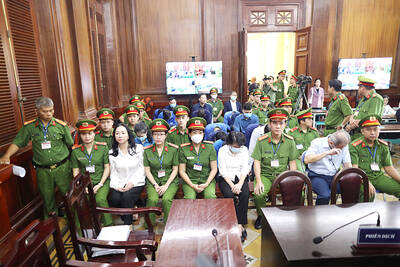
A top Vietnamese property tycoon was on Thursday sentenced to death in one of the biggest corruption cases in history, with an estimated US$27 billion in damages. A panel of three hand-picked jurors and two judges rejected all defense arguments by Truong My Lan, chair of major developer Van Thinh Phat, who was found guilty of swindling cash from Saigon Commercial Bank (SCB) over a decade. “The defendant’s actions ... eroded people’s trust in the leadership of the [Communist] Party and state,” read the verdict at the trial in Ho Chi Minh City. After the five-week trial, 85 others were also sentenced on

Conjoined twins Lori and George Schappell, who pursued separate careers, interests and relationships during lives that defied medical expectations, died this month in Pennsylvania, funeral home officials said. They were 62. The twins, listed by Guinness World Records as the oldest living conjoined twins, died on April 7 at the Hospital of the University of Pennsylvania, obituaries posted by Leibensperger Funeral Homes of Hamburg said. The cause of death was not detailed. “When we were born, the doctors didn’t think we’d make 30, but we proved them wrong,” Lori said in an interview when they turned 50, the Philadelphia Inquirer reported. The
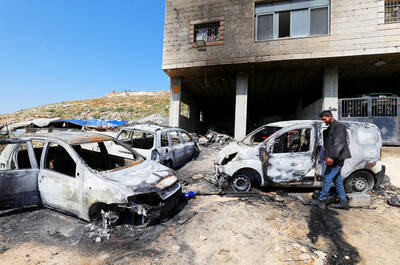
RAMPAGE: A Palestinian man was left dead after dozens of Israeli settlers searching for a missing 14-year-old boy stormed a village in the Israeli-occupied West Bank US President Joe Biden on Friday said he expected Iran to attack Israel “sooner, rather than later” and warned Tehran not to proceed. Asked by reporters about his message to Iran, Biden simply said: “Don’t,” underscoring Washington’s commitment to defend Israel. “We are devoted to the defense of Israel. We will support Israel. We will help defend Israel and Iran will not succeed,” he said. Biden said he would not divulge secure information, but said his expectation was that an attack could come “sooner, rather than later.” Israel braced on Friday for an attack by Iran or its proxies as warnings grew of


 RSS
RSS