


China, widely accused of covering up the initial outbreak of SARS earlier this year, says it is pulling out all the stops to prevent a resurgence.
"China has more to lose than anybody else if SARS returns and it's not contained," World Health Organization spokeswoman Maria Cheng said in Beijing after a scientist in Singapore tested positive for SARS, the world's first infection for three months.

PHOTO: AP
"It's extremely hard to hide this disease and if China is caught covering up again they'll be ruined."
After failing to admit the seriousness of the outbreak which critics blame for the worldwide spread of the virus, China tallied about 5,300 cases and more than 340 deaths. Nearly 8,500 people were infected globally and more than 800 died.
"Our internal work to prevent a resurgence of SARS has not slackened for a moment," the Health Ministry said on its Web site at www.moh.gov.cn. It advised people not to mistake the government's steps to block SARS for an actual outbreak.
Beijing airport was keeping planes from Singapore away from the main terminal and passengers from the city-state would undergo separate health checks, state media said. Shanghai adopted similar measures.
The 1,000-bed Xiaotangshan Hospital, built in a week north of Beijing to handle a glut of SARS patients, could be operational within a couple of days, officials said.
The outbreak ravaged sectors of the Chinese economy, like travel and tourism, and Beijing sacked the health minister and capital's mayor for mishandling the outbreak.
Since the last two SARS patients in China left hospital on Aug. 16, the Health Ministry has continued to demand that hospitals report daily even if there are no cases.
The WHO and the ministry would also test a new monitoring system to identify and track clusters of cases, Cheng said.
Anti-SARS vigilance was on display at central Beijing's Chaoyang Hospital, accused by the WHO of failing to report some milder cases as the epidemic tailed off in late May.
In the hospital's dank corridors, masked men pointed temperature guns at the hands and necks of a constant stream of people passing from ward to ward.
One attendant told a reporter that fever patients now went directly to the hospital emergency room, rather than its special fever ward. But another corrected him and led the way to the hospital backyard, where the makeshift ward was still operating at full strength and a guard outside handed the visitor two masks.
He had not heard of the new SARS case in Singapore. "New case in Singapore, huh? Well, we never let up here. They keep saying that with the weather changing, SARS could always come back."

Republican US lawmakers on Friday criticized US President Joe Biden’s administration after sanctioned Chinese telecoms equipment giant Huawei unveiled a laptop this week powered by an Intel artificial intelligence (AI) chip. The US placed Huawei on a trade restriction list in 2019 for contravening Iran sanctions, part of a broader effort to hobble Beijing’s technological advances. Placement on the list means the company’s suppliers have to seek a special, difficult-to-obtain license before shipping to it. One such license, issued by then-US president Donald Trump’s administration, has allowed Intel to ship central processors to Huawei for use in laptops since 2020. China hardliners
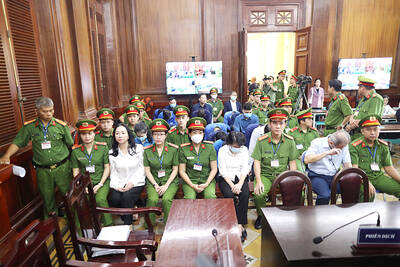
A top Vietnamese property tycoon was on Thursday sentenced to death in one of the biggest corruption cases in history, with an estimated US$27 billion in damages. A panel of three hand-picked jurors and two judges rejected all defense arguments by Truong My Lan, chair of major developer Van Thinh Phat, who was found guilty of swindling cash from Saigon Commercial Bank (SCB) over a decade. “The defendant’s actions ... eroded people’s trust in the leadership of the [Communist] Party and state,” read the verdict at the trial in Ho Chi Minh City. After the five-week trial, 85 others were also sentenced on

Conjoined twins Lori and George Schappell, who pursued separate careers, interests and relationships during lives that defied medical expectations, died this month in Pennsylvania, funeral home officials said. They were 62. The twins, listed by Guinness World Records as the oldest living conjoined twins, died on April 7 at the Hospital of the University of Pennsylvania, obituaries posted by Leibensperger Funeral Homes of Hamburg said. The cause of death was not detailed. “When we were born, the doctors didn’t think we’d make 30, but we proved them wrong,” Lori said in an interview when they turned 50, the Philadelphia Inquirer reported. The
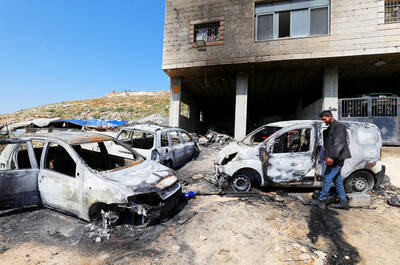
RAMPAGE: A Palestinian man was left dead after dozens of Israeli settlers searching for a missing 14-year-old boy stormed a village in the Israeli-occupied West Bank US President Joe Biden on Friday said he expected Iran to attack Israel “sooner, rather than later” and warned Tehran not to proceed. Asked by reporters about his message to Iran, Biden simply said: “Don’t,” underscoring Washington’s commitment to defend Israel. “We are devoted to the defense of Israel. We will support Israel. We will help defend Israel and Iran will not succeed,” he said. Biden said he would not divulge secure information, but said his expectation was that an attack could come “sooner, rather than later.” Israel braced on Friday for an attack by Iran or its proxies as warnings grew of


 RSS
RSS