


The face of Antarctica will change in the next 100 years, as ice melts, glaciers retreat, penguins move south and green plants begin to colonize bare rocks of the Antarctic peninsula, according to researchers.
"We know parts of Antarctica are warming, and they are warming very rapidly," Andrew Clarke of the British Antarctic Survey told the British Association science festival this week.
"The Antarctic Peninsula is one of three points on the globe that is warming particularly quickly at the moment." Climate has always changed, but the change now was particularly rapid and could trigger unexpected events, he warned.
"It looks as though we have set upon something which could change the face of the globe, and in this context, change the face of Antarctica quite rapidly."
In 100 years the Southern ocean atmosphere would be warmer, with much less ice and snow on the peninsula. More ice shelves would collapse. Green plants were already five or ten times more common than when explorers built the first bases.
Seals and whales would move their feeding grounds. The breeding grounds for all the continent's penguin species were shifting south, perhaps because, paradoxically, warmer air meant more snow, and therefore greater difficulty in maintaining nests.
"The pattern of snowfall is important to a penguin's breeding. It doesn't want to sit on a nest and have a metre of snow above it. So the breeding sites are very carefully tuned."
It looked as though the change in the pattern of population could be explained by a change in the pattern of snowfall. To get the right conditions, various penguin species had all begun to move south. But the pattern of ice was also important, because the birds had to trek to the edge of the ice shelf to feed.
"Many Antarctic organisms are susceptible to very small changes in temperature," Clarke said. "So if some of the more extreme projections of temperature change in the sea eventuate, it is likely that we will have some extinctions."
Antarctica is the world's last remaining wilderness region. It is larger than the US and drier than the Sahara.
Parts of it are covered by up to 3km of compacted ice and snow, and the continent is the repository of nine-tenths of the world's fresh water.

Republican US lawmakers on Friday criticized US President Joe Biden’s administration after sanctioned Chinese telecoms equipment giant Huawei unveiled a laptop this week powered by an Intel artificial intelligence (AI) chip. The US placed Huawei on a trade restriction list in 2019 for contravening Iran sanctions, part of a broader effort to hobble Beijing’s technological advances. Placement on the list means the company’s suppliers have to seek a special, difficult-to-obtain license before shipping to it. One such license, issued by then-US president Donald Trump’s administration, has allowed Intel to ship central processors to Huawei for use in laptops since 2020. China hardliners
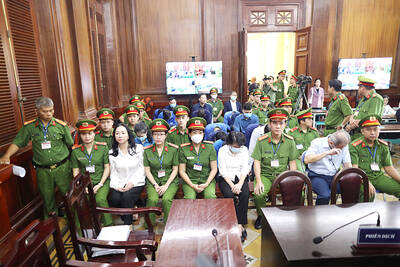
A top Vietnamese property tycoon was on Thursday sentenced to death in one of the biggest corruption cases in history, with an estimated US$27 billion in damages. A panel of three hand-picked jurors and two judges rejected all defense arguments by Truong My Lan, chair of major developer Van Thinh Phat, who was found guilty of swindling cash from Saigon Commercial Bank (SCB) over a decade. “The defendant’s actions ... eroded people’s trust in the leadership of the [Communist] Party and state,” read the verdict at the trial in Ho Chi Minh City. After the five-week trial, 85 others were also sentenced on

Conjoined twins Lori and George Schappell, who pursued separate careers, interests and relationships during lives that defied medical expectations, died this month in Pennsylvania, funeral home officials said. They were 62. The twins, listed by Guinness World Records as the oldest living conjoined twins, died on April 7 at the Hospital of the University of Pennsylvania, obituaries posted by Leibensperger Funeral Homes of Hamburg said. The cause of death was not detailed. “When we were born, the doctors didn’t think we’d make 30, but we proved them wrong,” Lori said in an interview when they turned 50, the Philadelphia Inquirer reported. The
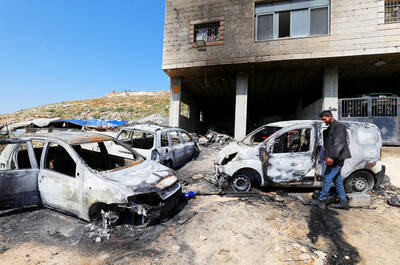
RAMPAGE: A Palestinian man was left dead after dozens of Israeli settlers searching for a missing 14-year-old boy stormed a village in the Israeli-occupied West Bank US President Joe Biden on Friday said he expected Iran to attack Israel “sooner, rather than later” and warned Tehran not to proceed. Asked by reporters about his message to Iran, Biden simply said: “Don’t,” underscoring Washington’s commitment to defend Israel. “We are devoted to the defense of Israel. We will support Israel. We will help defend Israel and Iran will not succeed,” he said. Biden said he would not divulge secure information, but said his expectation was that an attack could come “sooner, rather than later.” Israel braced on Friday for an attack by Iran or its proxies as warnings grew of


 RSS
RSS