


West African peacekeepers hoped to make their first major push into Liberia's unsecured interior yesterday, planning to at last deploy troops delayed for days into a region where fighting scares have sent thousands of civilians fleeing.
Unrest and large-scale refugee flows have persisted in Liberia's countryside despite an Aug. 18 peace deal and weeks of calm in the capital, Monrovia.
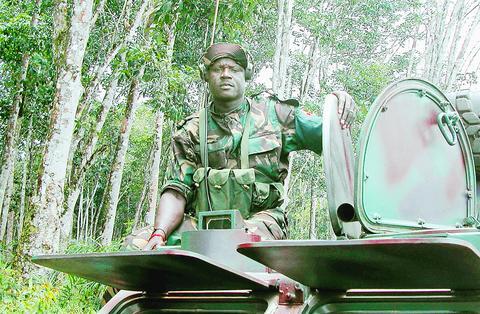
PHOTO: AP
An initial deployment of about 600 West African peacekeepers faltered on Saturday over objections by Liberia's government over the withdrawal of its fighters, as peace troops replaced them on a main road leading to front lines northeast of Monrovia.
Officials rescheduled the peace deployment for Monday, but postponed again as investigators traveled to the region to look into reports of fighting between government and rebel forces.
Colonel Theophilus Tawiah of Ghana said he hoped for a deployment yesterday.
At the north-central town of Kakata late Monday, thousands of families were bundling goods together and getting ready to run after hearing reports of nearby strife, poised to join thousands of civilians already on the road from nearby hamlets.
"I saw the people [fighters] with my own eye ... they were firing in the town," said Miatta Boima, 29, on the run from the nearby community of Todee. "I ran in the bush with my baby."
"We ran from the town, because the shooting was too much," said farmer Peter D. Willey, 42, also from Todee.
State radio reported fighting at Todee on Sunday, saying rebels had injured a number of government fighters and captured one. Rebels denied the claim.
Todee's fleeing people on Monday gave different accounts of whether the gunmen there were rebels, government soldiers, or both -- and it was unclear whether any actual fighting occurred.
Both sides in Liberia have been repeatedly accused of staging attacks, or launching rumors of fighting, to scare residents from towns so that fighters could loot and steal food without interference.
"It fits a pattern," said the top UN humanitarian official in Liberia, Ross Mountain, of the reported fighting. "Fighters that in most cases don't have access to food themselves ... find more enterprising ways of finding it."
The month-old West African peace mission in Liberia has largely kept to bases in and around Monrovia, sending only small teams on brief missions to the countryside. Liberia's government initially objected to the Kakata deployment, but Defense Minister Daniel Chea promised Sunday to pull forces from the region so the 600 Guinea-Bissau troops could deploy there afterward.
The West African soldiers landed in Monrovia in early August, bringing calm to the capital after well over 1,000 civilians were killed in more than two months of fighting.
The African peace force is expected to reach its intended force strength of 3,250 soldiers today, after which officials have said they will turn attention to Liberia's interior.
On Monday, about 30 female peace protesters delivered a petition to the US embassy asking for more American troops in Monrovia to free up African troops to spread into the interior.
The US has roughly 30 Marines on the ground in Liberia, a nation founded by freed American slaves in the 19th century. The Marines are acting as liaisons with the peace force. Protesters asked that the American forces' numbers be beefed up to 500.
Dozens more are guarding the US embassy, and a 150-Marine rapid-reaction force has been stationed aboard warships off Liberia.
Over the weekend, the US military flew 32 sick Marines -- most from the quick-reaction force -- and one sailor from the USS Iwo Jima warship to medical centers in Germany and the US, the US European Command said in a statement.
Doctors confirmed at least 12 of the Marines contracted malaria, while test results were pending on the 21 remaining patients.
The quick reaction force was briefly deployed at a main airport outside Monrovia in August.
US officials said that as a precaution, movements of Marines ashore in Liberia from the Iwo Jima and two other US Navy ships off the coast were being limited.
Malaria, a mosquito-borne disease, infects 300 million people a year in Africa.
On Aug. 18, Liberia's government and rebels signed a peace deal arranging a power-sharing government to be installed on Oct. 14, leading to democratic elections in 2005.
Nearly half of China’s major cities are suffering “moderate to severe” levels of subsidence, putting millions of people at risk of flooding, especially as sea levels rise, according to a study of nationwide satellite data released yesterday. The authors of the paper, published by the journal Science, found that 45 percent of China’s urban land was sinking faster than 3mm per year, with 16 percent at more than 10mm per year, driven not only by declining water tables, but also the sheer weight of the built environment. With China’s urban population already in excess of 900 million people, “even a small portion

UNSETTLING IMAGES: The scene took place in front of TV crews covering the Trump trial, with a CNN anchor calling it an ‘emotional and unbelievably disturbing moment’ A man who doused himself in an accelerant and set himself on fire outside the courthouse where former US president Donald Trump is on trial has died, police said yesterday. The New York City Police Department (NYPD) said the man was declared dead by staff at an area hospital. The man was in Collect Pond Park at about 1:30pm on Friday when he took out pamphlets espousing conspiracy theories, tossed them around, then doused himself in an accelerant and set himself on fire, officials and witnesses said. A large number of police officers were nearby when it happened. Some officers and bystanders rushed
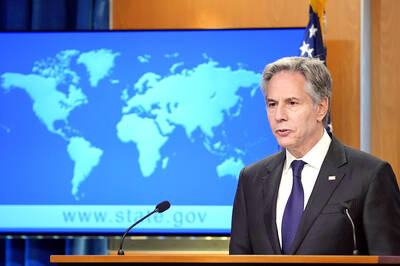
Beijing is continuing to commit genocide and crimes against humanity against Uyghurs and other Muslim minorities in its western Xinjiang province, U.S. Secretary of State Antony Blinken said in a report published on Monday, ahead of his planned visit to China this week. The State Department’s annual human rights report, which documents abuses recorded all over the world during the previous calendar year, repeated language from previous years on the treatment of Muslims in Xinjiang, but the publication raises the issue ahead of delicate talks, including on the war in Ukraine and global trade, between the top U.S. diplomat and Chinese

HYPOCRISY? The Chinese Ministry of Foreign Affairs yesterday asked whether Biden was talking about China or the US when he used the word ‘xenophobic’ US President Joe Biden on Wednesday called for a hike in steel tariffs on China, accusing Beijing of cheating as he spoke at a campaign event in Pennsylvania. Biden accused China of xenophobia, too, in a speech to union members in Pittsburgh. “They’re not competing, they’re cheating. They’re cheating and we’ve seen the damage here in America,” Biden said. Chinese steel companies “don’t need to worry about making a profit because the Chinese government is subsidizing them so heavily,” he said. Biden said he had called for the US Trade Representative to triple the tariff rates for Chinese steel and aluminum if Beijing was


 RSS
RSS