


Iran is warning the US and other nations against pushing for too much too soon at a meeting of the UN atomic agency, warning that nuclear tensions could grow if Tehran is handed an ultimatum on opening its programs to full outside examination.
Opening yesterday, the meeting likely will urge Iran to make its nuclear program accessible by agreeing to a protocol allowing tougher International Atomic Energy Agency inspections without notice.
Under strong international pressure, Iran last month offered to negotiate the IAEA protocol. The IAEA will also ask Tehran to explain agency findings that the Americans and others say point to the existence of a covert nuclear weapons program.
Iran's delegate, Ali Akbar Salehi, said ahead of the meeting that Iran still was open to negotiating the inspection issue with the International Atomic Energy Agency, but indicated the offer could be withdrawn if IAEA board meeting "disrupted the whole process."
"We are sitting on a very thin edge," Salehi said. "It could tilt one way or the other very easily."
The US accuses Iran of working on a secret nuclear weapons program, and a recent confidential IAEA report, obtained by The Associated Press, said traces of highly enriched, weapons-grade uranium were found at an Iranian nuclear facility.
The report also said Iran was conducting tests that experts say make little sense unless the country was pursuing nuclear weapons.
Tehran insists its nuclear programs are for generating electricity and says its equipment was "contaminated" with enriched uranium by a previous owner.
Salehi, while not going into specifics, warned of "unexpected or surprising consequences" should the Iranian leadership decide the IAEA board was making harsh demands -- in effect suggesting that such a move might escalate nuclear tensions.
Kenneth Brill, the chief US IAEA delegate, declined to comment on what the Americans were seeking. But he said the US and other board members believe Iran is trying "to evade international obligations and to seek the capacity to build nuclear weapons."
"It's fair to say that the majority of board members will want to see Iran ... enhance its cooperation" and "provide the answers to all the questions that are outstanding," he said.
An Iranian Foreign Ministry spokesman said Sunday the IAEA did not share the view of the US, "which pursues an extremist position and its behavior is politically motivated."
"We hope Monday's meeting in Vienna will carry out its professional job away from political considerations," Hamid Reza Asefi said in Tehran before yesterday's summit.
In an apparent victory for Iran, the Bush administration last week decided not to ask the Vienna meeting to endorse a resolution finding Iran in noncompliance of IAEA obligations. That could bring the matter before the UN Security Council, which can take steps ranging from criticism to sanctions.
Instead, the resolution being drafted likely will call on Iran to answer questions raised in the report and provide full disclosure of its program. It also could set a deadline for Tehran to comply and warn that Iran will be declared in noncompliance if it misses that deadline, diplomats said on condition of anonymity.
Iran has said it would agree to unfettered inspections if it is granted access to advanced nuclear technology as provided for under the Nuclear Nonproliferation Treaty. Tehran says Washington's influence is blocking that technology.
Suspicions about Iran's nuclear activities prompted Mohamed ElBaradei, the IAEA director-general, in February to tour Iran's nuclear facilities, including the incomplete plant in Natanz, about 480km south of Tehran. Diplomats said he was taken aback by the advanced stage of a project using hundreds of centrifuges to enrich uranium.

Republican US lawmakers on Friday criticized US President Joe Biden’s administration after sanctioned Chinese telecoms equipment giant Huawei unveiled a laptop this week powered by an Intel artificial intelligence (AI) chip. The US placed Huawei on a trade restriction list in 2019 for contravening Iran sanctions, part of a broader effort to hobble Beijing’s technological advances. Placement on the list means the company’s suppliers have to seek a special, difficult-to-obtain license before shipping to it. One such license, issued by then-US president Donald Trump’s administration, has allowed Intel to ship central processors to Huawei for use in laptops since 2020. China hardliners

Conjoined twins Lori and George Schappell, who pursued separate careers, interests and relationships during lives that defied medical expectations, died this month in Pennsylvania, funeral home officials said. They were 62. The twins, listed by Guinness World Records as the oldest living conjoined twins, died on April 7 at the Hospital of the University of Pennsylvania, obituaries posted by Leibensperger Funeral Homes of Hamburg said. The cause of death was not detailed. “When we were born, the doctors didn’t think we’d make 30, but we proved them wrong,” Lori said in an interview when they turned 50, the Philadelphia Inquirer reported. The
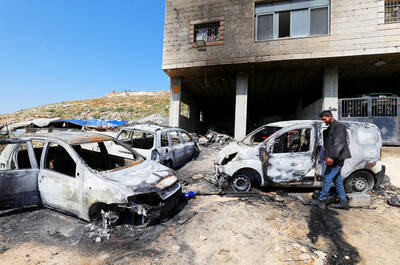
RAMPAGE: A Palestinian man was left dead after dozens of Israeli settlers searching for a missing 14-year-old boy stormed a village in the Israeli-occupied West Bank US President Joe Biden on Friday said he expected Iran to attack Israel “sooner, rather than later” and warned Tehran not to proceed. Asked by reporters about his message to Iran, Biden simply said: “Don’t,” underscoring Washington’s commitment to defend Israel. “We are devoted to the defense of Israel. We will support Israel. We will help defend Israel and Iran will not succeed,” he said. Biden said he would not divulge secure information, but said his expectation was that an attack could come “sooner, rather than later.” Israel braced on Friday for an attack by Iran or its proxies as warnings grew of

IN PURSUIT: Israel’s defense minister said the revenge attacks by Israeli settlers would make it difficult for security forces to find those responsible for the 14-year-old’s death Israeli Prime Minister Benjamin Netanyahu on Saturday condemned the “heinous murder” of an Israeli teenager in the occupied West Bank as attacks on Palestinian villages intensified following news of his death. After Benjamin Achimeir, 14, was reported missing near Ramallah on Friday, hundreds of Jewish settlers backed by Israeli forces raided nearby Palestinian villages, torching vehicles and homes, leaving at least one villager dead and dozens wounded. The attacks escalated in several villages on Saturday after Achimeir’s body was found near the Malachi Hashalom outpost. Agence France-Presse correspondents saw smoke rising from burned houses and fields. Mayor Amin Abu Alyah, of the


 RSS
RSS