


Ariel Sharon flew to New Delhi yesterday for the first-ever visit to India by an Israeli prime minister, cementing defense and trade ties that have blossomed over the past decade and led to talk of a three-way strategic alliance with the US.
Analysts expect Sharon's meetings with Indian Prime Minister Atal Bihari Vajpayee, President A.P.J. Abdul Kalam and other Indian officials to put the seal of approval on the sale of an advanced Israeli airborne radar package.
The deal has sparked angry protests from India's nuclear rival Pakistan.
The Israeli and Indian leaders are also expected to discuss the possible sale to India of the Arrow missile defense system, developed by Israel and the US; Iran's reported attempts to acquire nuclear weapons; the Israeli-Palestinian conflict; and the role of radical Islamic groups in Pakistan.
Israeli and Indian officials would only say that a number of bilateral agreements were to be signed during Sharon's three-day trip to New Delhi and Bombay.
Palestinian Foreign Minister Nabil Shaath ended a three-day India visit a week ago, but officials said the proximity of the two visits was a coincidence.
Indian and US defense officials met last month in Washington where they declared a "new strategic partnership."
Israel has its own deep friendship with the Americans, prompting Israeli and American analysts to talk of a possible three-way alliance in which India's proximity to the Gulf region could serve Israeli and US efforts to pre-empt any hostile action by countries such as Iran.
"India could be an important security partner for both the United States and Israel," former Pentagon official Richard Speier wrote in a Sept. 3 analysis for the Washington Institute for Near East Policy.
"Like them, India is threatened by the proliferation of weapons of mass destruction, missiles that deliver them and radical Islamist terrorists," Speier told the US-based think tank.
After initial doubts, the US recently gave its blessing for India's purchase of four Israeli-made PHALCON airborne early-warning systems, at an estimated US$1 billion for the package. That does not sit well with India's nuclear neighbors, Pakistan and China.
Hamid Gul, a retired army general and former head of Pakistan's spy agency, said Sharon's visit and the US-approved deals were disconcerting.
"After using Pakistan as a front-line state in the war against terrorism, America has started encouraging Israel to sign new defense deals with India," he said. "America's policy will kill the conventional balance in the region."
In 2000, Washington vetoed the intended Israeli sale to China of a PHALCON-equipped plane -- with a Chinese option to buy seven more -- arguing that such aircraft would increase the threat to Taiwan and endanger US pilots in case of war with China.
Yitzhak Shichor, an Asia expert at Israel's University of Haifa, said he was unaware of a public Chinese response to India's PHALCON purchase, but that it would cause great displeasure in Beijing.
"The Chinese keep quiet because they don't want to lose face, but absolutely they are not happy about it," he said.
China and India have had border disputes and have fallen out over surveillance flights by American U2 spy planes from Indian airspace and a range of other issues, Shichor said. "There are unsettled accounts between them," he added.
While the PHALCON sale is seen in Israel as a done deal, Speier says any plan to sell India the Arrow -- a US-Israeli joint development packed with advanced missile technology -- could well run into an American veto.
India and Israel established full diplomatic relations in 1992. Since then they have developed thriving commercial and military ties. Israeli experts say India has bought Israeli missiles, radar, communications equipment and guns, though the Israeli Defense Ministry refuses to comment.

Republican US lawmakers on Friday criticized US President Joe Biden’s administration after sanctioned Chinese telecoms equipment giant Huawei unveiled a laptop this week powered by an Intel artificial intelligence (AI) chip. The US placed Huawei on a trade restriction list in 2019 for contravening Iran sanctions, part of a broader effort to hobble Beijing’s technological advances. Placement on the list means the company’s suppliers have to seek a special, difficult-to-obtain license before shipping to it. One such license, issued by then-US president Donald Trump’s administration, has allowed Intel to ship central processors to Huawei for use in laptops since 2020. China hardliners

DISADVANTAGE: Erin O’Toole, who led the Conservatives during the election campaign in 2021, estimated that the interference cost his party as many as nine legislative seats Canada’s domestic spy agency on Monday concluded that China interfered in the past two elections, an official probe heard, the firmest evidence so far of suspected Chinese meddling in Canadian politics. Canadian Prime Minister Justin Trudeau’s Liberal Party won both the elections, held in 2019 and 2021. Under pressure from opposition lawmakers unhappy about media reports on China’s possible role, Trudeau set up a commission into foreign interference. The commission was shown a slide on Monday containing an extract of a briefing in February last year from the Canadian Security Intelligence Service (CSIS). “We know that the PRC [People’s Republic of China] clandestinely
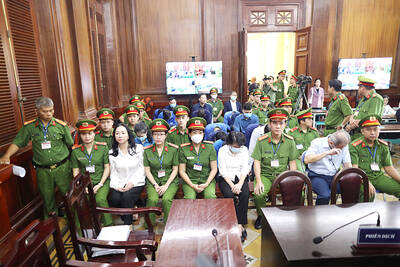
A top Vietnamese property tycoon was on Thursday sentenced to death in one of the biggest corruption cases in history, with an estimated US$27 billion in damages. A panel of three hand-picked jurors and two judges rejected all defense arguments by Truong My Lan, chair of major developer Van Thinh Phat, who was found guilty of swindling cash from Saigon Commercial Bank (SCB) over a decade. “The defendant’s actions ... eroded people’s trust in the leadership of the [Communist] Party and state,” read the verdict at the trial in Ho Chi Minh City. After the five-week trial, 85 others were also sentenced on

‘DELUSIONAL’: Targeting the families of Hamas’ leaders would not push the group to change its position or to give up its demands for Palestinians, Ismail Haniyeh said Israeli aircraft on Wednesday killed three sons of Hamas’ top political leader in the Gaza Strip, striking high-stakes targets at a time when Israel is holding delicate ceasefire negotiations with the militant group. Hamas said four of the leader’s grandchildren were also killed. Ismail Haniyeh’s sons are among the highest-profile figures to be killed in the war so far. Israel said they were Hamas operatives, and Haniyeh accused Israel of acting in “the spirit of revenge and murder.” The deaths threatened to strain the internationally mediated ceasefire talks, which appeared to gain steam in recent days even as the sides remain far


 RSS
RSS