


Near Hong Kong's main train station, Ah Chuen and several other young women from China position themselves by the entrance of a cheap hotel.
Decked out in a bare-backed top, tight jeans and stiletto heels, the prostitute throws a teasing glance at a passer-by before sashaying up to whisper in his ear.
Ah Chuen, 23, and her compatriots are among thousands of Chinese who have been quick to take advantage of an increasingly porous border and Hong Kong's closer ties with China since the former British colony returned to the Chinese fold in 1997.
Hong Kong is hoping that a flood of Chinese tourists will help revive its ailing economy, but fears are growing that they will also bring an increase in crime such as prostitution, money laundering and theft.
Instead of thronging tourist sites, restaurants and fancy boutiques, some female "tourists" offer sex while men work illegally on construction sites.
"It's my third time visiting Hong Kong in the last year," said Ah Chuen, who charges customers HK$500 (US$64).
China recently agreed to allow individual tourists from parts of neighboring Guangdong Province to visit Hong Kong and will extend the scheme to residents of Beijing and Shanghai in September. Previously, Chinese visitors could only visit Hong Kong as part of tour groups.
The moves are widely seen as intended to give an economic boost to Hong Kong, which was rocked by big demonstrations against the Beijing-backed government last month, alarming China's leaders.
Beijing believes political tension in the city will quickly evaporate once the economy improves, but a sharp increase in crime could fuel public antipathy toward the mainland and strain ties.
"With the increase in the number of mainland visitors, we don't rule out that some will take up illegal work and stay on as beggars, prostitutes and illegal workers," Security Secretary Ambrose Lee (
"We will increase raids on hot spots. Those caught will be sent back and they will be stopped from coming here for between one to five years. But the percentage of those caught breaking the law is small, 0.3 percent or three in 10,000 people."
The police have also said said they will step up efforts to quash cross-boundary crime.
The government warned property agents last month that they must report any suspicious deals to authorities.
The notice came after one real-estate agency reported a Chinese traveller had paid more than HK$2 million (US$256,400) in cash for five apartments during a brief visit to Hong Kong.
Chinese travellers are only allowed to take a maximum of 6,000 yuan (US$724) out of the country per trip.
Nearly 300 black-market laborers were arrested in the first seven months of this year, 54 percent more than the period a year ago, government figures show.
But social workers say many illegal workers are not caught.
While it is illegal for tourists to work in Hong Kong, prostitution is legal in the territory and it is relatively easy for someone from the mainland to pass themselves off as a Hong Kong person.
However, it is a crime to solicit and overstay one's visa.
A growing number of women operate on their own without using pimps from Hong Kong's crime syndicates. They earn their money quietly and leave on the day their visas expire, free to apply to visit Hong Kong again the moment they are over the border.
But elsewhere, such as the crowded Mongkok district, women from China provide a steady stream of fresh flesh for triad-controlled brothels.
These gangsters usually arrange visas for the women and pay their passage to Hong Kong. The women must service over 20 men a day to pay off the debts before they can start earning money of their own, social workers say.
"They work very long hours, from 7am to as late as 10pm," said Lam, 36, a former prostitute from Hong Kong who now gives health advice and counselling to sex workers.
"If they earn a few tens of thousands of dollars, they can build a house and start a business back home."
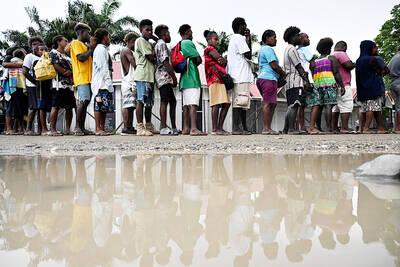
SEEKING CHANGE: A hospital worker said she did not vote in previous elections, but ‘now I can see that maybe my vote can change the system and the country’ Voting closed yesterday across the Solomon Islands in the south Pacific nation’s first general election since the government switched diplomatic allegiance from Taiwan to Beijing and struck a secret security pact that has raised fears of the Chinese navy gaining a foothold in the region. The Solomon Islands’ closer relationship with China and a troubled domestic economy weighed on voters’ minds as they cast their ballots. As many as 420,000 registered voters had their say across 50 national seats. For the first time, the national vote also coincided with elections for eight of the 10 local governments. Esther Maeluma cast her vote in the
Nearly half of China’s major cities are suffering “moderate to severe” levels of subsidence, putting millions of people at risk of flooding, especially as sea levels rise, according to a study of nationwide satellite data released yesterday. The authors of the paper, published by the journal Science, found that 45 percent of China’s urban land was sinking faster than 3mm per year, with 16 percent at more than 10mm per year, driven not only by declining water tables, but also the sheer weight of the built environment. With China’s urban population already in excess of 900 million people, “even a small portion

UNSETTLING IMAGES: The scene took place in front of TV crews covering the Trump trial, with a CNN anchor calling it an ‘emotional and unbelievably disturbing moment’ A man who doused himself in an accelerant and set himself on fire outside the courthouse where former US president Donald Trump is on trial has died, police said yesterday. The New York City Police Department (NYPD) said the man was declared dead by staff at an area hospital. The man was in Collect Pond Park at about 1:30pm on Friday when he took out pamphlets espousing conspiracy theories, tossed them around, then doused himself in an accelerant and set himself on fire, officials and witnesses said. A large number of police officers were nearby when it happened. Some officers and bystanders rushed

HYPOCRISY? The Chinese Ministry of Foreign Affairs yesterday asked whether Biden was talking about China or the US when he used the word ‘xenophobic’ US President Joe Biden on Wednesday called for a hike in steel tariffs on China, accusing Beijing of cheating as he spoke at a campaign event in Pennsylvania. Biden accused China of xenophobia, too, in a speech to union members in Pittsburgh. “They’re not competing, they’re cheating. They’re cheating and we’ve seen the damage here in America,” Biden said. Chinese steel companies “don’t need to worry about making a profit because the Chinese government is subsidizing them so heavily,” he said. Biden said he had called for the US Trade Representative to triple the tariff rates for Chinese steel and aluminum if Beijing was


 RSS
RSS