


A federal appeals court threw out more than 100 death sentences in Arizona, Montana and Idaho because the inmates were sent to death row by judges instead of juries.
The case stems from a 2002 decision by the US Supreme Court, in which the high court found that juries, not judges, must render death sentences. But the Supreme Court left unclear whether the new rules should apply retroactively to inmates awaiting execution.
In an 8-3 vote, the San Francisco-based 9th US Circuit Court of Appeals said Tuesday that all condemned inmates sentenced by a judge should have their sentences commuted to life in prison.
The ruling applies only to Arizona, Idaho and Montana, the only states in the 9th Circuit that have allowed judges to impose death sentences.
Two other states, Nebraska and Colorado, have also allowed judges to sentence inmates to death. But the federal appeals courts that oversee them have yet to rule on the issue.
The ruling affects approximately 3 percent of the 3,700 people on death row in the US.
``By deciding that judges are not constitutionally permitted to decide whether defendants are eligible for the death penalty, the Supreme Court altered the fundamental bedrock principles applicable to capital murder trials,'' Circuit Judge Sidney R. Thomas wrote for the court.
Defense attorneys hailed the verdict.
``This is fundamental justice,'' said Ken Murray, a federal public defender in Phoenix.
The decision affects 89 cases on Arizona's death row, Attorney General Terry Goddard said.
Goddard said his state will ask the US Supreme Court to review the decision. Even if the ruling is upheld, he said Arizona could conduct new ``mini-trials'' with juries deciding whether to impose life or death sentences in individual cases.
In Idaho, the ruling is expected to reduce the death sentences of at least 15 condemned inmates, while Montana Attorney General Mike McGrath said the ruling should have no effect on that state's five death-row inmates.
McGrath said the specific circumstances of those cases insulate them from the appeals court decision. But Montana would join any appeal to the Supreme Court, he said.
Scott Crichton, executive director for Montana's chapter of the American Civil Liberties Union, said the ruling ``takes us a step closer to the day when the US will join the civilized nations of the world in outlawing the cruel, inhumane and biased application of the death penalty.''
The case the appeals court used to decide the issue concerned Arizona inmate Warren Summerlin, who was found guilty of murder in the 1981 slaying of Brenna Bailey, 36.
The Tempe finance company administrator's body was found in the trunk of her car a day after she visited Summerlin to check on money he owed. Summerlin was convicted in 1982 and a judge sentenced him to death.
Prior to the US Supreme Court's ruling last year, a jury determined guilt or innocence, but one or more judges evaluated whether the particulars of the case made it worthy of the death penalty in Arizona, Idaho, Montana, Colorado and Nebraska.
The Death Penalty Information Center, which compiles statistics on capital punishment, calculated that since 1976, those five states have executed 29 people under laws allowing nonjury sentencing.
In July, meanwhile, the 11th US Circuit Court of Appeals ruled in a Florida case that the Supreme Court decision should not be applied retroactively in some death penalty cases.
In Florida, Alabama, Indiana and Delaware, juries recommend a life or death sentence but judges are allowed to give the death penalty against the jury's wishes.
Justice Department officials in Washington declined comment on the appeals court decision.
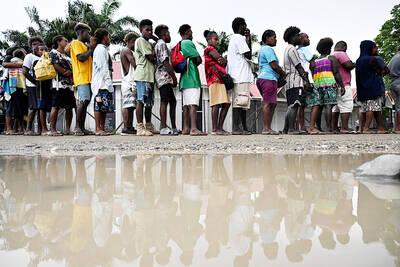
SEEKING CHANGE: A hospital worker said she did not vote in previous elections, but ‘now I can see that maybe my vote can change the system and the country’ Voting closed yesterday across the Solomon Islands in the south Pacific nation’s first general election since the government switched diplomatic allegiance from Taiwan to Beijing and struck a secret security pact that has raised fears of the Chinese navy gaining a foothold in the region. The Solomon Islands’ closer relationship with China and a troubled domestic economy weighed on voters’ minds as they cast their ballots. As many as 420,000 registered voters had their say across 50 national seats. For the first time, the national vote also coincided with elections for eight of the 10 local governments. Esther Maeluma cast her vote in the
Nearly half of China’s major cities are suffering “moderate to severe” levels of subsidence, putting millions of people at risk of flooding, especially as sea levels rise, according to a study of nationwide satellite data released yesterday. The authors of the paper, published by the journal Science, found that 45 percent of China’s urban land was sinking faster than 3mm per year, with 16 percent at more than 10mm per year, driven not only by declining water tables, but also the sheer weight of the built environment. With China’s urban population already in excess of 900 million people, “even a small portion

UNSETTLING IMAGES: The scene took place in front of TV crews covering the Trump trial, with a CNN anchor calling it an ‘emotional and unbelievably disturbing moment’ A man who doused himself in an accelerant and set himself on fire outside the courthouse where former US president Donald Trump is on trial has died, police said yesterday. The New York City Police Department (NYPD) said the man was declared dead by staff at an area hospital. The man was in Collect Pond Park at about 1:30pm on Friday when he took out pamphlets espousing conspiracy theories, tossed them around, then doused himself in an accelerant and set himself on fire, officials and witnesses said. A large number of police officers were nearby when it happened. Some officers and bystanders rushed

HYPOCRISY? The Chinese Ministry of Foreign Affairs yesterday asked whether Biden was talking about China or the US when he used the word ‘xenophobic’ US President Joe Biden on Wednesday called for a hike in steel tariffs on China, accusing Beijing of cheating as he spoke at a campaign event in Pennsylvania. Biden accused China of xenophobia, too, in a speech to union members in Pittsburgh. “They’re not competing, they’re cheating. They’re cheating and we’ve seen the damage here in America,” Biden said. Chinese steel companies “don’t need to worry about making a profit because the Chinese government is subsidizing them so heavily,” he said. Biden said he had called for the US Trade Representative to triple the tariff rates for Chinese steel and aluminum if Beijing was


 RSS
RSS