


North Korea took less than a day to break one of the modest agreements it had made with the US and four other nations during talks on its nuclear program: a promise not to say anything to aggravate the 10-month-old nuclear standoff.
"The talks only reinforced our confidence that there is no other option for us but to further increase the nuclear-deterrent force," the North's Foreign Ministry said Saturday, its first official comment on the six-nation summit that ended in Beijing a day earlier.
North Korea has made similar threats before, and its trademark bluster often fails to draw urgent reactions from the ones it wants to threaten.
Instead, the region's dialogue partners, although they consider North Korea capable of such dangerous provocations as a missile test-launch, see the isolated country's harsh rhetoric as reflecting its entrenched mistrust of Americans and fear for the survival of its own totalitarian regime.
All six nations -- including China, Russia, South Korea and Japan -- say they want the Korean Peninsula free of nuclear weapons. But the question comes down to whether the countries at the center of the dispute, the US and North Korea, can trust each other, and which should make the first move to untie the Gordian knot.
Should the US provide free oil shipments, open diplomatic ties, provide economic and humanitarian aid and sign a nonaggression pact before North Korea feels safe to abandon its nuclear facilities? Or should the North scrap its nuclear program before Washington improves relations?
"Both sides are leveling guns at each other. How can the DPRK trust the US and drop its gun?" said the North Korean spokesman, using his country's official name, Democratic People's Republic of Korea. "What we want is for both sides to drop guns at the same time and coexist peacefully."
The Americans consider North Koreans untrustworthy and want to avoid mistakes like the nuclear accord they signed with the North in 1994.
Under that agreement, the North promised to freeze its nuclear activities in return for economic aid, including US$4.6 billion for power plants still under construction. But US officials said last October that North Korea admitted running a secret nuclear weapons program -- a claim North Korea now denies.
North Korea, too, says it can't take any chances when dealing with the Americans. Kim Jong-il's regime sees its survival as depending on how profitably it plays its nuclear card.
After the crumbling of the Soviet bloc, which sustained North Korea with trade and arms deals, the country slipped into economic quagmire and now attempts to earn its way through by selling missiles and trading its "nuclear deterrent force" for economic aid and a US promise not to attempt a regime change in Pyongyang. Washington calls the tactic "nuclear blackmail."
"North Korea's statement [on Saturday] seems to be aimed at pressuring the United States, since it believes it hasn't gained anything from the six-way talks," said Koh Yoo-hwan, a North Korea expert at Seoul's Dongkuk University.
Striving to mediate a compromise, the six nations agreed this week to seek a solution with "synchronized, or parallel, stages of implementation." What comes first in these phased-in stages could take years -- and more North Korean threats and delicate diplomacy -- to sort out.
But no one believes instability on the Korean Peninsula serves anybody's interest. That raises the prospects of an eventual breakthrough.
Although North Korea often warns of an impending nuclear war, its leaders know conflict with the US would mean their end. Washington fears that in a war's initial hours, North Korea could shower artillery shells and missiles on Seoul.
If North Korea had carried out its threat to walk out of the talks, it would have been a slap in the face of China, which enjoys growing trade ties with the US but remains Pyongyang's closest ally.
Beijing arranged and hosted the multilateral talks and wants to see them succeed, an outcome that would burnish its international image. Since Chinese troops fought American forces during the Korean War, Beijing has seen North Korea as a buffer against American influence in the region.
Russia, which first set up a client communist regime in the North at the end of World War II, now wants to link its Trans-Siberian railway and shaky economy with South Korean and Japanese exports and investors -- a project put on hold because of nuclear tensions.
South Korea and Japan have joined the US in stating they have no intention of invading the North and would help its economy prosper once it gives up its nuclear program.
North Korea remains to be convinced.
When US and Soviet forces divided the small peninsula nation following its liberation from brutal Japanese colonial rule in 1945, Koreans chanted a popular limerick: "Don't trust Americans! Don't be cheated by Russians! Koreans be careful! Or the Japanese will rise again."
In today's globalizing South Korea, those terse lines have little circulation. But they pretty much sum up the mood in the North.

Republican US lawmakers on Friday criticized US President Joe Biden’s administration after sanctioned Chinese telecoms equipment giant Huawei unveiled a laptop this week powered by an Intel artificial intelligence (AI) chip. The US placed Huawei on a trade restriction list in 2019 for contravening Iran sanctions, part of a broader effort to hobble Beijing’s technological advances. Placement on the list means the company’s suppliers have to seek a special, difficult-to-obtain license before shipping to it. One such license, issued by then-US president Donald Trump’s administration, has allowed Intel to ship central processors to Huawei for use in laptops since 2020. China hardliners
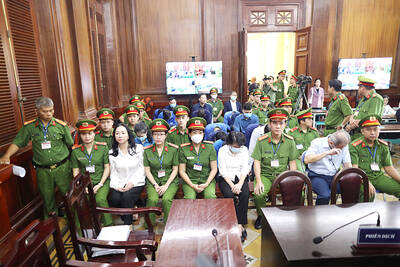
A top Vietnamese property tycoon was on Thursday sentenced to death in one of the biggest corruption cases in history, with an estimated US$27 billion in damages. A panel of three hand-picked jurors and two judges rejected all defense arguments by Truong My Lan, chair of major developer Van Thinh Phat, who was found guilty of swindling cash from Saigon Commercial Bank (SCB) over a decade. “The defendant’s actions ... eroded people’s trust in the leadership of the [Communist] Party and state,” read the verdict at the trial in Ho Chi Minh City. After the five-week trial, 85 others were also sentenced on

Conjoined twins Lori and George Schappell, who pursued separate careers, interests and relationships during lives that defied medical expectations, died this month in Pennsylvania, funeral home officials said. They were 62. The twins, listed by Guinness World Records as the oldest living conjoined twins, died on April 7 at the Hospital of the University of Pennsylvania, obituaries posted by Leibensperger Funeral Homes of Hamburg said. The cause of death was not detailed. “When we were born, the doctors didn’t think we’d make 30, but we proved them wrong,” Lori said in an interview when they turned 50, the Philadelphia Inquirer reported. The
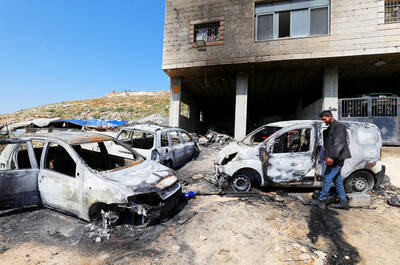
RAMPAGE: A Palestinian man was left dead after dozens of Israeli settlers searching for a missing 14-year-old boy stormed a village in the Israeli-occupied West Bank US President Joe Biden on Friday said he expected Iran to attack Israel “sooner, rather than later” and warned Tehran not to proceed. Asked by reporters about his message to Iran, Biden simply said: “Don’t,” underscoring Washington’s commitment to defend Israel. “We are devoted to the defense of Israel. We will support Israel. We will help defend Israel and Iran will not succeed,” he said. Biden said he would not divulge secure information, but said his expectation was that an attack could come “sooner, rather than later.” Israel braced on Friday for an attack by Iran or its proxies as warnings grew of


 RSS
RSS