


West African peace force leaders and American diplomats rolled into Liberia's cut-off second city under escort of roaring Harrier attack jets and clattering helicopter gunships, greeted by cheering refugees.
US Ambassador John Blaney, marking the peace force's first sizable entry to Buchanan since Liberia's war ended, presented insurgents still firmly in control of the city with a dog-eared copy of the Aug. 18 peace deal on Friday.

PHOTO: AFP
"I'm not your father, but I'm Uncle Sam -- and you need an uncle, right?" Blaney told the red-bereted rebel commander who took the copy. "The United States is here."
"I think you have a very good deal," Blaney added, speaking of the accord.
Buchanan, Liberia's second-largest city and second most vital port after the capital, remains isolated, severed behind front lines, even after a West African peace force helped bring calm to Monrovia.
Civilians ran out of hiding places, singing and dancing, to chase after the lumbering 20-25 vehicle convoy of West African armored vehicles, jeeps and civilian four-by-fours.
Waving, crowds shouted at the Nigerian soldiers, "Thank you!"
American Harrier attack jets and heavy military helicopters clattered back and forth, deafeningly, over the town, deploying from three US warships off Monrovia in a pointed show of military might during the visit.
While about 250 troops of a second African country, Mali, joined a 1,500-strong Nigerian-led peace force on Friday, there was no sign the African peace force had yet build adequate strength to deploy permanently in Buchanan.
Rebels holding the city belong to Liberia's smaller insurgent movement, Movement for Democracy in Liberia.
"We're trapped!" one civilian man shouted repeatedly, saying rebels still blocked residents from crossing the river to the rest of the country.
Those caught included 8,000 people packed into a single, cream-colored, tin-roofed Catholic school compound, their shelter since July 28, when Buchanan fell to rebels.
Telling their stories for the first time, Buchanan's people poured out tales of bodies lying unburied, of hunger, and fear.
"At night they come and pull us out, and carry away our property," David Hill, a truck driver living just outside of town, said of rebels. "If you have money, they take it."
After July 28, corpses "lay in the streets and the dogs ate them. There are bodies in the rivers, so we can't drink the water," Hill said.
Insurgents appeared firm in holding the city against government troops -- but insisted they, too, too wanted the fighting over.
"We want peace. We're ready for peace," said rebel Annie Cooper, with a cowboy hat and AK-47.
She worried for her four children, on the other side of the front line, in Monrovia.
"We're ready to cooperate with anyone. Any hour, any minute," Cooper said.
Rebels signed the peace deal after the Aug. 11 resignation and departure of President Charles Taylor, a former rebel who had plunged Liberia into 14 years of civil war.
Blaney, speaking to the rebel commanders, called the peace deal a "victory ... for all Liberians."
Standing up to make his point, West African force leader Brigadier General Festus Okonkwo drove home the message in the meeting with Buchanan's rebel overlords.
West African leaders have "declared the war is over," Okonkwo said.
"It is over," Okonkwo, tall and imposing in green uniform, said as he tossed new white T-shirts to the rebel with the slogans, "We want peace."

Republican US lawmakers on Friday criticized US President Joe Biden’s administration after sanctioned Chinese telecoms equipment giant Huawei unveiled a laptop this week powered by an Intel artificial intelligence (AI) chip. The US placed Huawei on a trade restriction list in 2019 for contravening Iran sanctions, part of a broader effort to hobble Beijing’s technological advances. Placement on the list means the company’s suppliers have to seek a special, difficult-to-obtain license before shipping to it. One such license, issued by then-US president Donald Trump’s administration, has allowed Intel to ship central processors to Huawei for use in laptops since 2020. China hardliners
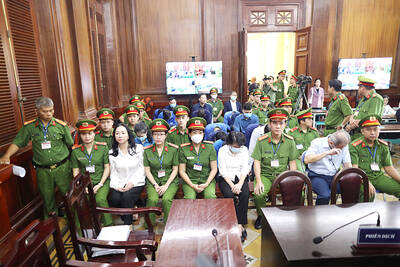
A top Vietnamese property tycoon was on Thursday sentenced to death in one of the biggest corruption cases in history, with an estimated US$27 billion in damages. A panel of three hand-picked jurors and two judges rejected all defense arguments by Truong My Lan, chair of major developer Van Thinh Phat, who was found guilty of swindling cash from Saigon Commercial Bank (SCB) over a decade. “The defendant’s actions ... eroded people’s trust in the leadership of the [Communist] Party and state,” read the verdict at the trial in Ho Chi Minh City. After the five-week trial, 85 others were also sentenced on

Conjoined twins Lori and George Schappell, who pursued separate careers, interests and relationships during lives that defied medical expectations, died this month in Pennsylvania, funeral home officials said. They were 62. The twins, listed by Guinness World Records as the oldest living conjoined twins, died on April 7 at the Hospital of the University of Pennsylvania, obituaries posted by Leibensperger Funeral Homes of Hamburg said. The cause of death was not detailed. “When we were born, the doctors didn’t think we’d make 30, but we proved them wrong,” Lori said in an interview when they turned 50, the Philadelphia Inquirer reported. The
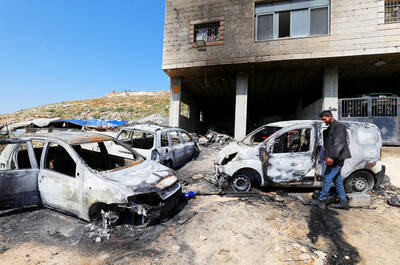
RAMPAGE: A Palestinian man was left dead after dozens of Israeli settlers searching for a missing 14-year-old boy stormed a village in the Israeli-occupied West Bank US President Joe Biden on Friday said he expected Iran to attack Israel “sooner, rather than later” and warned Tehran not to proceed. Asked by reporters about his message to Iran, Biden simply said: “Don’t,” underscoring Washington’s commitment to defend Israel. “We are devoted to the defense of Israel. We will support Israel. We will help defend Israel and Iran will not succeed,” he said. Biden said he would not divulge secure information, but said his expectation was that an attack could come “sooner, rather than later.” Israel braced on Friday for an attack by Iran or its proxies as warnings grew of


 RSS
RSS