


A court in northern Nigeria said on Wednesday it would issue a judgment next month in the appeal of a woman sentenced to death by stoning for having a child out of wedlock.
Amina Lawal, 31, was convicted in March 2002 for having had a baby 10 months after a divorce, taken by prosecutors as proof that she had had extramarital sex.
A judge ordered that Lawal's stoning should not be carried out until she had weaned her baby, which may not be until next year according to sharia law.
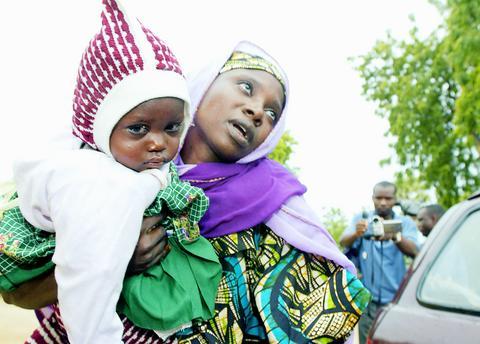
PHOTO: AFP
The case caused international outrage, including calls for a boycott of the Miss World beauty pageant, which was due to have been held in Nigeria last year.
On Wednesday, the court said it would issue a judgment on her appeal on Sept. 25.
Lawal's uncle Magaji Liman told reporters: "All of us are in great distress... She cannot eat, I have to even persuade her to eat. She is very anxious to see the end of this saga, so she can just remarry and have a good life."
Lawal's first attempt at an appeal was denied last August.
Her case is a critical test for Nigeria's system of Islamic or sharia law which sparked riots when it was extended from civil law to criminal law in 12 northern states three years ago.
Thousands died in the violence, which pitted Christians from mainly southern ethnic groups against Muslim northerners.
With Lawal sitting alone on a stone bench at the front of the court, her 20-month-old baby strapped to her back, her lawyer, Aliyu Musa Yawuri, argued her second appeal.
Yawuri said that under Islamic law there is a presumption a woman could carry a "sleeping embryo for a period of five years commencing from the date of divorce."
"Amina had been divorced for about 10 months when she delivered her child, so the courts ought to have applied that law in her favor," he said.
Wearing traditional British-style barrister's wig, Yawuri presented his case in northern Nigeria's Hausa language before five judges wearing black-and-gold robes.
Yawuri also said Lawal had withdrawn a confession of guilt made in March last year. In the first appeal, her request to withdraw the confession was rejected.
The prosecution argued the confession could only be withdrawn if an alternative explanation for her pregnancy was submitted, which it said had not been done.
Lawal's lawyers said if the appeal fails they would take the case to a federal court in Kaduna, the last stage before going to Nigeria's Supreme Court.
So far, none of the sharia criminal sentences have reached as far as the federal level.
Pierre Brun of Avocats sans Frontieres (Lawyers without Borders), who is advising the defense lawyers, said he was pleased with the procedure in the court room, adding everyone was given time to put their arguments.
"Everything was fairly done. We're positive we should have an acquittal on the 25th, but if not, we are already preparing for an appeal before the federal court of appeal," he said.
Abu Umar, a prosecution lawyer representing Katsina state, said if the appeals failed, Lawal could be executed by means other than stoning.
"It can be through any means that take her life," Umar said. "It can be an execution, which could be by hanging."
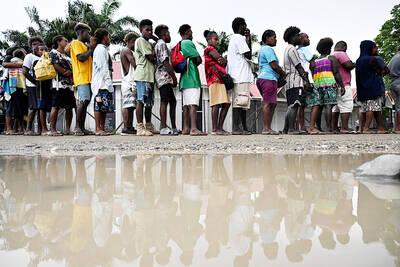
SEEKING CHANGE: A hospital worker said she did not vote in previous elections, but ‘now I can see that maybe my vote can change the system and the country’ Voting closed yesterday across the Solomon Islands in the south Pacific nation’s first general election since the government switched diplomatic allegiance from Taiwan to Beijing and struck a secret security pact that has raised fears of the Chinese navy gaining a foothold in the region. The Solomon Islands’ closer relationship with China and a troubled domestic economy weighed on voters’ minds as they cast their ballots. As many as 420,000 registered voters had their say across 50 national seats. For the first time, the national vote also coincided with elections for eight of the 10 local governments. Esther Maeluma cast her vote in the
Nearly half of China’s major cities are suffering “moderate to severe” levels of subsidence, putting millions of people at risk of flooding, especially as sea levels rise, according to a study of nationwide satellite data released yesterday. The authors of the paper, published by the journal Science, found that 45 percent of China’s urban land was sinking faster than 3mm per year, with 16 percent at more than 10mm per year, driven not only by declining water tables, but also the sheer weight of the built environment. With China’s urban population already in excess of 900 million people, “even a small portion

UNSETTLING IMAGES: The scene took place in front of TV crews covering the Trump trial, with a CNN anchor calling it an ‘emotional and unbelievably disturbing moment’ A man who doused himself in an accelerant and set himself on fire outside the courthouse where former US president Donald Trump is on trial has died, police said yesterday. The New York City Police Department (NYPD) said the man was declared dead by staff at an area hospital. The man was in Collect Pond Park at about 1:30pm on Friday when he took out pamphlets espousing conspiracy theories, tossed them around, then doused himself in an accelerant and set himself on fire, officials and witnesses said. A large number of police officers were nearby when it happened. Some officers and bystanders rushed

HYPOCRISY? The Chinese Ministry of Foreign Affairs yesterday asked whether Biden was talking about China or the US when he used the word ‘xenophobic’ US President Joe Biden on Wednesday called for a hike in steel tariffs on China, accusing Beijing of cheating as he spoke at a campaign event in Pennsylvania. Biden accused China of xenophobia, too, in a speech to union members in Pittsburgh. “They’re not competing, they’re cheating. They’re cheating and we’ve seen the damage here in America,” Biden said. Chinese steel companies “don’t need to worry about making a profit because the Chinese government is subsidizing them so heavily,” he said. Biden said he had called for the US Trade Representative to triple the tariff rates for Chinese steel and aluminum if Beijing was


 RSS
RSS