


Ancient mantras echoed at the cremations yesterday for the first of 39 Hindus killed when pilgrims in a massive crowd stampeded on the banks of a holy river.
Grieving relatives of other victims complained that police were stopping them from claiming the bodies of their loved ones who died when a crowd surged on the banks of the Godavari river near Nasik, about 175km northeast of Bombay.

PHOTO: AP
Many of the bereaved said they were turned away at morgues by officers who had demanded documented proof that they were truly family members and not tricksters seeking personal effects or wanting to fraudulently claim insurance money.
"They are insisting on paperwork. They keep sending us back when we ask for the body. We don't know where to go," Mukesh Saidas Sharma, 28, said as he wept in Nasik's government hospital seeking the body of his dead aunt.
Similar charges of bureaucratic insensitivity were made after Bombay's twin terror bombings on Monday, when at least 51 people were killed.
About 125 people were injured in Wednesday's riverside chaos where an estimated 1.6 million worshippers had gathered.
Most of the dead were women who had been trampled underfoot.
Vikram Marathe, Nasik's deputy police commissioner, defended the policy of making sure bodies were collected only by close relatives.
"We will not give the bodies to anyone else. We are willing to wait for five or six days," Marathe said.
"People might take advantage of the deaths. We know what people can do in cases like these. They can take the insurance money, or seek property, if they have the body," Marathe said.
Worshippers believe they can bathe away their sins in the Godavari River, which is considered holy to many Hindus.
Stampedes are not uncommon at major Hindu religious festivals, which can attract millions of worshippers. In 1954, about 800 pilgrims died during the Kumbh Mela in Allahabad.
Most recently, 51 pilgrims died in 1999 after a rope meant to channel worshippers snapped in a landslide at a Hindu shrine in southern India. Fifty people died in 1986 in a stampede in the town of Haridwar.
Police in Nasik estimated that nearly 1.6 million people attended the festival on Wednesday. About 60 million people are likely to participate at various times during the festival, which started on July 30 and ends on Monday.
Witnesses said the stampede happened when impatient pilgrims pushed past barricades.
Police tried to hold them back by beating some with canes, said Ram Phool Maina, a farmer from the central Indian state of Madhya Pradesh whose arm was fractured in the melee.
"They tried to stop the people. No one stopped. I fell down and people were walking over me. I lunged to save my mother. Then I heard my arm bone crack into two," Maina said. "Other people from my village dragged me to the side or I would have been dead."
"Old women were crying, `Take me out. Help me,'" said Lalji Mistry, a 35-year-old pilgrim who escaped unharmed. "People, even women, were pushing forward. People started falling down."
Witnesses said rescue workers pleaded with crowds to give way so ambulances could rush the injured to hospitals. Workers also heaved dozens of injured people into cars and police vehicles.
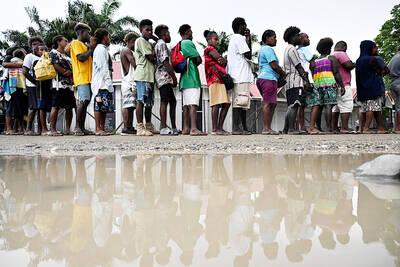
SEEKING CHANGE: A hospital worker said she did not vote in previous elections, but ‘now I can see that maybe my vote can change the system and the country’ Voting closed yesterday across the Solomon Islands in the south Pacific nation’s first general election since the government switched diplomatic allegiance from Taiwan to Beijing and struck a secret security pact that has raised fears of the Chinese navy gaining a foothold in the region. The Solomon Islands’ closer relationship with China and a troubled domestic economy weighed on voters’ minds as they cast their ballots. As many as 420,000 registered voters had their say across 50 national seats. For the first time, the national vote also coincided with elections for eight of the 10 local governments. Esther Maeluma cast her vote in the
Nearly half of China’s major cities are suffering “moderate to severe” levels of subsidence, putting millions of people at risk of flooding, especially as sea levels rise, according to a study of nationwide satellite data released yesterday. The authors of the paper, published by the journal Science, found that 45 percent of China’s urban land was sinking faster than 3mm per year, with 16 percent at more than 10mm per year, driven not only by declining water tables, but also the sheer weight of the built environment. With China’s urban population already in excess of 900 million people, “even a small portion

UNSETTLING IMAGES: The scene took place in front of TV crews covering the Trump trial, with a CNN anchor calling it an ‘emotional and unbelievably disturbing moment’ A man who doused himself in an accelerant and set himself on fire outside the courthouse where former US president Donald Trump is on trial has died, police said yesterday. The New York City Police Department (NYPD) said the man was declared dead by staff at an area hospital. The man was in Collect Pond Park at about 1:30pm on Friday when he took out pamphlets espousing conspiracy theories, tossed them around, then doused himself in an accelerant and set himself on fire, officials and witnesses said. A large number of police officers were nearby when it happened. Some officers and bystanders rushed

HYPOCRISY? The Chinese Ministry of Foreign Affairs yesterday asked whether Biden was talking about China or the US when he used the word ‘xenophobic’ US President Joe Biden on Wednesday called for a hike in steel tariffs on China, accusing Beijing of cheating as he spoke at a campaign event in Pennsylvania. Biden accused China of xenophobia, too, in a speech to union members in Pittsburgh. “They’re not competing, they’re cheating. They’re cheating and we’ve seen the damage here in America,” Biden said. Chinese steel companies “don’t need to worry about making a profit because the Chinese government is subsidizing them so heavily,” he said. Biden said he had called for the US Trade Representative to triple the tariff rates for Chinese steel and aluminum if Beijing was


 RSS
RSS