


Iran told Japan yesterday it was ready to start negotiations with the UN's atomic watchdog on snap inspections of its nuclear program, a move that could help clear the way for Tokyo to clinch a deal on a US$2 billion contract to develop a giant oil field.
Resource-poor Japan has been juggling its desire to clinch the contract to develop the Azadegan oil field with pressure from the US -- its main security ally -- to back off because of concerns that Tehran is developing nuclear weapons.
Iran says its program is for peaceful purposes only.
Iranian Foreign Minister Kamal Kharrazi gave Prime Minister Junichiro Koizumi a letter from Iranian President Mohammad Khatami stating that Tehran wanted to broaden cooperation with the UN's International Atomic Energy Agency (IAEA) and would begin talks on signing an Additional Protocol, allowing snap inspections of nuclear sites, a Japanese Foreign Ministry official said.
Iran had said on Tuesday it was ready to sign the IAEA's Additional Protocol but wanted clarification on "the preservation of its sovereignty" under the enhanced inspection program, a reservation analysts said could delay final agreement.
Iran's nuclear programme is in the limelight as the US, the two Koreas, China, Russia and Japan engage in delicate talks in Beijing on North Korea's nuclear ambitions.
Kharrazi said after meeting Japanese Trade Minister Takeo Hiranuma that talks on the deal to develop Azadegan, one of the world's largest untapped oil fields, were "moving in the right direction."
A Japanese-backed consortium missed a June 30 deadline and lost exclusive rights to the deal, but Iran has said it still hoped to conclude the contract with Japan.
After meeting Koizumi, Kharrazi told reporters through an interpreter that it would be in Japan's interest to invest in Iran, since that would help it secure stable energy supplies.
Hiranuma said earlier this week that progress had been made in the talks, but officials have offered no timetable for when a deal might be finalized.
Fears that Tehran wants nuclear weapons were stoked by a new IAEA report that showed Iran had repeatedly failed to inform the UN nuclear watchdog of its atomic activities, Western diplomats in Vienna, where the agency is based, said on Wednesday.
Japan, though, has never been comfortable with Washington's inclusion of Iran -- Tokyo's third largest oil supplier -- as part of an "axis of evil" with Iraq and communist North Korea.
Japanese Foreign Minister Yoriko Kawaguchi reiterated on Wednesday that Tokyo viewed the oil deal and the nuclear concerns as separate matters, and some diplomatic experts said that ultimately Tokyo was likely to finalize the contract.
The timing, however, could well be affected by progress toward Tehran's signing the Additional Protocol.
"There is a public presentation issue with regard to how it chimes with the nuclear problem and that obviously has a bearing on when this [the oil deal] can be done," a Western diplomat said.
"I think Japan will go ahead and take the contract, but the way it will be done is to spread it over a period of time, and fudged in various ways," he said. "It will happen and the Americans will probably accept it, at the end of the day."
The Japanese consortium includes the government-backed Japan Petroleum Exploration Co (JAPEX) and INPEX Corp as well as trading house Tomen Corp.
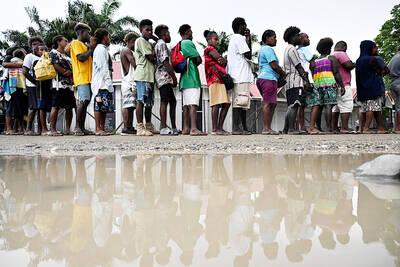
SEEKING CHANGE: A hospital worker said she did not vote in previous elections, but ‘now I can see that maybe my vote can change the system and the country’ Voting closed yesterday across the Solomon Islands in the south Pacific nation’s first general election since the government switched diplomatic allegiance from Taiwan to Beijing and struck a secret security pact that has raised fears of the Chinese navy gaining a foothold in the region. The Solomon Islands’ closer relationship with China and a troubled domestic economy weighed on voters’ minds as they cast their ballots. As many as 420,000 registered voters had their say across 50 national seats. For the first time, the national vote also coincided with elections for eight of the 10 local governments. Esther Maeluma cast her vote in the
Nearly half of China’s major cities are suffering “moderate to severe” levels of subsidence, putting millions of people at risk of flooding, especially as sea levels rise, according to a study of nationwide satellite data released yesterday. The authors of the paper, published by the journal Science, found that 45 percent of China’s urban land was sinking faster than 3mm per year, with 16 percent at more than 10mm per year, driven not only by declining water tables, but also the sheer weight of the built environment. With China’s urban population already in excess of 900 million people, “even a small portion

UNSETTLING IMAGES: The scene took place in front of TV crews covering the Trump trial, with a CNN anchor calling it an ‘emotional and unbelievably disturbing moment’ A man who doused himself in an accelerant and set himself on fire outside the courthouse where former US president Donald Trump is on trial has died, police said yesterday. The New York City Police Department (NYPD) said the man was declared dead by staff at an area hospital. The man was in Collect Pond Park at about 1:30pm on Friday when he took out pamphlets espousing conspiracy theories, tossed them around, then doused himself in an accelerant and set himself on fire, officials and witnesses said. A large number of police officers were nearby when it happened. Some officers and bystanders rushed

HYPOCRISY? The Chinese Ministry of Foreign Affairs yesterday asked whether Biden was talking about China or the US when he used the word ‘xenophobic’ US President Joe Biden on Wednesday called for a hike in steel tariffs on China, accusing Beijing of cheating as he spoke at a campaign event in Pennsylvania. Biden accused China of xenophobia, too, in a speech to union members in Pittsburgh. “They’re not competing, they’re cheating. They’re cheating and we’ve seen the damage here in America,” Biden said. Chinese steel companies “don’t need to worry about making a profit because the Chinese government is subsidizing them so heavily,” he said. Biden said he had called for the US Trade Representative to triple the tariff rates for Chinese steel and aluminum if Beijing was


 RSS
RSS