


Forty families are calling on the Russian authorities to reopen the inquiry into the loss of the submarine Kursk, sunk with the loss of 118 lives in the Barents Sea three years ago. They accuse the government of covering up key facts to avoid the embarrassing prosecution of senior officers.
Their lawyer Boris Kuznetsov said, in an interview to mark the third anniversary of the disaster, that there was a "clear contradiction between the detailed research of the experts who worked on the investigation and the conclusion of the report."
This week the families will petition the military prosecutor's office to have the investigation reopened. Despite their low pensions, Kuznetsov said, they were not primarily seeking financial compensation but "to be told the truth."
The submarine, powered by two nuclear reactors, sank to the sea bed at a depth of 100 to 150m more than 140km north of the Russian port of Murmansk, after an explosion. It was taking part in Russia's biggest naval exercises in the Arctic for years.
Russian President Vladimir Putin appeared to shun offers of international help and seemed unmoved until the navy finally admitted the sailors had died.
The military authority's report was published last July and the investigation was closed soon afterward, the Kremlin considering the matter over. Several senior officers were sacked or demoted.
The families say key facts were covered so that the 14 senior officers arrested in connection with the case need not be charged with criminal offences.
The families also say the crew was given poor training before going to sea, knowing little about the volatile liquid fuel torpedo which caused the explosion.
"The most shocking conclusion for me in the report is that the actions of the navy command `are not directly linked' to the deaths of the submarine's crew," Kuznetsov said.
"To justify this conclusion, the investigation had to prove that at the moment when the rescue alert was declared, the crew was already dead. This meant however badly or well the navy performed the rescue operation, they would not have been able to save anyone," Kuznetsov said.
The most compelling evidence that the crew were still alive after eight hours was the knocking noises registered by the navy hydro- acoustic service during "the first, second and in the morning of the third day after the catastrophe", he said.
The noises were hailed as SOS calls from survivors, but later dismissed as being from other ships.

Republican US lawmakers on Friday criticized US President Joe Biden’s administration after sanctioned Chinese telecoms equipment giant Huawei unveiled a laptop this week powered by an Intel artificial intelligence (AI) chip. The US placed Huawei on a trade restriction list in 2019 for contravening Iran sanctions, part of a broader effort to hobble Beijing’s technological advances. Placement on the list means the company’s suppliers have to seek a special, difficult-to-obtain license before shipping to it. One such license, issued by then-US president Donald Trump’s administration, has allowed Intel to ship central processors to Huawei for use in laptops since 2020. China hardliners
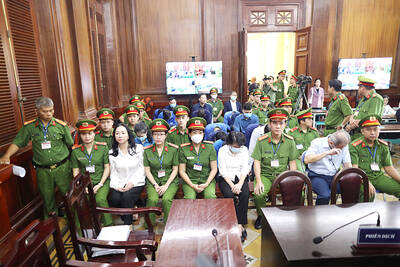
A top Vietnamese property tycoon was on Thursday sentenced to death in one of the biggest corruption cases in history, with an estimated US$27 billion in damages. A panel of three hand-picked jurors and two judges rejected all defense arguments by Truong My Lan, chair of major developer Van Thinh Phat, who was found guilty of swindling cash from Saigon Commercial Bank (SCB) over a decade. “The defendant’s actions ... eroded people’s trust in the leadership of the [Communist] Party and state,” read the verdict at the trial in Ho Chi Minh City. After the five-week trial, 85 others were also sentenced on

Conjoined twins Lori and George Schappell, who pursued separate careers, interests and relationships during lives that defied medical expectations, died this month in Pennsylvania, funeral home officials said. They were 62. The twins, listed by Guinness World Records as the oldest living conjoined twins, died on April 7 at the Hospital of the University of Pennsylvania, obituaries posted by Leibensperger Funeral Homes of Hamburg said. The cause of death was not detailed. “When we were born, the doctors didn’t think we’d make 30, but we proved them wrong,” Lori said in an interview when they turned 50, the Philadelphia Inquirer reported. The
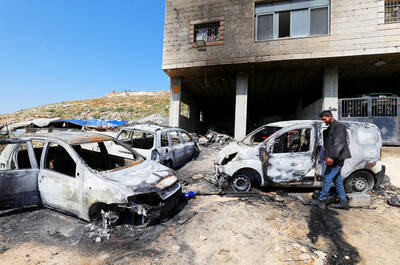
RAMPAGE: A Palestinian man was left dead after dozens of Israeli settlers searching for a missing 14-year-old boy stormed a village in the Israeli-occupied West Bank US President Joe Biden on Friday said he expected Iran to attack Israel “sooner, rather than later” and warned Tehran not to proceed. Asked by reporters about his message to Iran, Biden simply said: “Don’t,” underscoring Washington’s commitment to defend Israel. “We are devoted to the defense of Israel. We will support Israel. We will help defend Israel and Iran will not succeed,” he said. Biden said he would not divulge secure information, but said his expectation was that an attack could come “sooner, rather than later.” Israel braced on Friday for an attack by Iran or its proxies as warnings grew of


 RSS
RSS