


Squeezed behind the tiny wheel of his bright green Volkswagen Beetle, Ignacio Montealegre gazed down at his protruding belly and succumbed to a moment of nostalgia.
"I used to be slim, but then I got married and had to work so hard I stopped playing football and got fat," the 105kg taxi driver explained. "At the end of the day I go home, eat and go to sleep in front of the television."
Montealegre is a man of his time. He is also testament to a big new health challenge facing his country even as malnutrition still haunts its poverty-stricken countryside, particularly in indigenous communities.
Usually associated with the developed world, obesity is now an epidemic sweeping much of Latin America, with Mexico among the worst affected along with Chile and Peru.
A recently released national survey by the Health Ministry classified 28 percent of adult Mexican women as obese, with another 36 percent overweight. Just under 19 percent of Mexican men are obese and another 41 percent overweight. The figures confirm the shock sprung two years ago by a groundbreaking study revealing a 158 percent increase in obesity over a decade, prompting disbelief among many scientists.
Not any more. Now the consensus is that Mexico's combination of junk food, rapid urbanization and genetic traits mean obesity rates have overtaken Europe's fattest country, Britain, where around 22 percent of adults are obese. More worryingly it is catching up with the US where adult obesity tops 30 percent.
Experts say the health problems of traditional Mexican fare have been halted by the invasion of relatively inexpensive industrially produced foods. American fast food restaurants became fixtures in the 1990s, and today it is often easier to find a bag of crisps than a banana even in the remotest jungle village.
Household expenditure on fruit and vegetables fell by over a quarter between 1986 and 1998, while over a third more was spent on soft drinks.
Urbanization has only made things worse. Those who can afford cars would rather wait in valet-parking queues outside restaurants than leave their vehicle a block away and walk. The majority, obliged to take public transport, often demand that buses drop them off at their own street corner.
Meanwhile, slouching in front of the television now dominates leisure time, in part because the open spaces that once housed local football teams have disappeared under urban sprawl. Only 13 percent of Mexicans say they play sport.
Whatever the root causes, nutritionists warn that Mexico is settling into the established trend where obesity is primarily associated with the least fortunate.
"That is the tendency," says a government nutritionist, Simon Barquera. "That is where we are headed."
Nearly half of China’s major cities are suffering “moderate to severe” levels of subsidence, putting millions of people at risk of flooding, especially as sea levels rise, according to a study of nationwide satellite data released yesterday. The authors of the paper, published by the journal Science, found that 45 percent of China’s urban land was sinking faster than 3mm per year, with 16 percent at more than 10mm per year, driven not only by declining water tables, but also the sheer weight of the built environment. With China’s urban population already in excess of 900 million people, “even a small portion

UNSETTLING IMAGES: The scene took place in front of TV crews covering the Trump trial, with a CNN anchor calling it an ‘emotional and unbelievably disturbing moment’ A man who doused himself in an accelerant and set himself on fire outside the courthouse where former US president Donald Trump is on trial has died, police said yesterday. The New York City Police Department (NYPD) said the man was declared dead by staff at an area hospital. The man was in Collect Pond Park at about 1:30pm on Friday when he took out pamphlets espousing conspiracy theories, tossed them around, then doused himself in an accelerant and set himself on fire, officials and witnesses said. A large number of police officers were nearby when it happened. Some officers and bystanders rushed
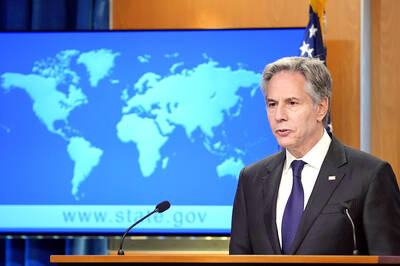
Beijing is continuing to commit genocide and crimes against humanity against Uyghurs and other Muslim minorities in its western Xinjiang province, U.S. Secretary of State Antony Blinken said in a report published on Monday, ahead of his planned visit to China this week. The State Department’s annual human rights report, which documents abuses recorded all over the world during the previous calendar year, repeated language from previous years on the treatment of Muslims in Xinjiang, but the publication raises the issue ahead of delicate talks, including on the war in Ukraine and global trade, between the top U.S. diplomat and Chinese

HYPOCRISY? The Chinese Ministry of Foreign Affairs yesterday asked whether Biden was talking about China or the US when he used the word ‘xenophobic’ US President Joe Biden on Wednesday called for a hike in steel tariffs on China, accusing Beijing of cheating as he spoke at a campaign event in Pennsylvania. Biden accused China of xenophobia, too, in a speech to union members in Pittsburgh. “They’re not competing, they’re cheating. They’re cheating and we’ve seen the damage here in America,” Biden said. Chinese steel companies “don’t need to worry about making a profit because the Chinese government is subsidizing them so heavily,” he said. Biden said he had called for the US Trade Representative to triple the tariff rates for Chinese steel and aluminum if Beijing was


 RSS
RSS