


Britain sweltered through its hottest day on record on Sunday and Alpine glaciers melted as the heat wave that has baked much of Europe for days sizzled relentlessly on.
"It is just miserable. You can't get any respite from it," says Londoner Ranald Davidson, squinting in the late afternoon sun as Britain surpassed 37.7 degrees centigrade for the first time.
The national weather service recorded -- 37.9 degrees centigrade -- at Heathrow Airport, near a parched and baking London. Later an even higher reading -- 38.1 degrees centigrade -- was taken at Gravesend in southern England.
Northern parts of the country were cooler, and torrential rain created problems in North Yorkshire.
Germans, too, have had record heat. In the Bavarian city of Roth, the temperature hit 40.4 degrees centigrade on Saturday. The previous record of 40.2 degrees centigrade was also in Bavaria, set in 1983.
More than 40 deaths -- including a 3-year-old French girl who died in a parked car on Sunday -- have been blamed on temperatures that have hovered in the mid-30s degrees centigrade for days.
Pope John Paul II, at the papal palace in lakeside Castel Gandolfo, which is generally cooler than Rome, asked for prayers for relief from drought-fed fires that have plagued Italy, the Iberian Peninsula, France and arid areas of other countries.
"I invite all to join in my prayers for the victims of this calamity, and I exhort all to raise to the Lord fervent entreaties so that He may grant the relief of rain to the thirsty Earth," John Paul told pilgrims and tourists.
In northeastern Italy, firefighters worked for a third day to put out a fire in the countryside near Udine.
Three fires blazed in Portugal. The government asked Spain for two firefighting planes to help tackle a wildfire near Portimao, in the southern region of Algarve. About 145 firefighters, 45 vehicles, two helicopters and two planes were battling the flames.
In the French Alps, a police officer warned hikers about rock avalanches along a popular route on Mont Blanc. Glacial ice is melting, loosening rocks from the mountainside. On Saturday, helicopters evacuated 44 climbers in danger, mountain police said.
Germany was expected to remain hot until midweek; France was counting on at least another week of abnormally high temperatures; and weather experts in Italy expect the country to be steamy through August.
Spain's National Meteorological Institute predicted temperatures of up to 42 degrees centigrade will continue throughout Spain for at least another week.
Authorities in the northeastern province of Barcelona have asked people not to visit national parks for picnics, to avoid any accidental fires.
In southern England, the unaccustomed stretch of very hot weather parched lawns in the capital and taxed tempers.
Two Australian women looking for an air-conditioned pub in the Holborn area of London were fed up with the search for a cool place to sit.
"London is not built for these temperatures!" said Jenny Geddes, 29 of Newcastle, Australia.
"Where do you escape in London? There's nowhere to go sit and cool off," said Heather Irvine, of Ettalong, Australia, now living in London.
In Britain, many trains have had to reduce speed because of the danger the heat will buckle the tracks.
The London Underground is so hot that signs have appeared at stations advising people to take bottled water with them and to let staff know if they are feeling unwell before they get on the train.
At Britain's beaches, where you often see people wrapped up in wool cardigans as they await the appearance of the sun, thousands of people bared nearly all on Sunday, soaking up the rays.
At the southern resort town of Bournemouth, the coastline was jammed.
"Our capacity on the seafront is about 100,000 and there is no spare sand here today," said senior seafront inspector Brian Cunnings. "Everybody has just squeezed in wherever they can."
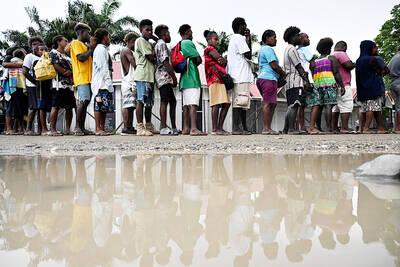
SEEKING CHANGE: A hospital worker said she did not vote in previous elections, but ‘now I can see that maybe my vote can change the system and the country’ Voting closed yesterday across the Solomon Islands in the south Pacific nation’s first general election since the government switched diplomatic allegiance from Taiwan to Beijing and struck a secret security pact that has raised fears of the Chinese navy gaining a foothold in the region. The Solomon Islands’ closer relationship with China and a troubled domestic economy weighed on voters’ minds as they cast their ballots. As many as 420,000 registered voters had their say across 50 national seats. For the first time, the national vote also coincided with elections for eight of the 10 local governments. Esther Maeluma cast her vote in the
Nearly half of China’s major cities are suffering “moderate to severe” levels of subsidence, putting millions of people at risk of flooding, especially as sea levels rise, according to a study of nationwide satellite data released yesterday. The authors of the paper, published by the journal Science, found that 45 percent of China’s urban land was sinking faster than 3mm per year, with 16 percent at more than 10mm per year, driven not only by declining water tables, but also the sheer weight of the built environment. With China’s urban population already in excess of 900 million people, “even a small portion

UNSETTLING IMAGES: The scene took place in front of TV crews covering the Trump trial, with a CNN anchor calling it an ‘emotional and unbelievably disturbing moment’ A man who doused himself in an accelerant and set himself on fire outside the courthouse where former US president Donald Trump is on trial has died, police said yesterday. The New York City Police Department (NYPD) said the man was declared dead by staff at an area hospital. The man was in Collect Pond Park at about 1:30pm on Friday when he took out pamphlets espousing conspiracy theories, tossed them around, then doused himself in an accelerant and set himself on fire, officials and witnesses said. A large number of police officers were nearby when it happened. Some officers and bystanders rushed

HYPOCRISY? The Chinese Ministry of Foreign Affairs yesterday asked whether Biden was talking about China or the US when he used the word ‘xenophobic’ US President Joe Biden on Wednesday called for a hike in steel tariffs on China, accusing Beijing of cheating as he spoke at a campaign event in Pennsylvania. Biden accused China of xenophobia, too, in a speech to union members in Pittsburgh. “They’re not competing, they’re cheating. They’re cheating and we’ve seen the damage here in America,” Biden said. Chinese steel companies “don’t need to worry about making a profit because the Chinese government is subsidizing them so heavily,” he said. Biden said he had called for the US Trade Representative to triple the tariff rates for Chinese steel and aluminum if Beijing was


 RSS
RSS