


For the dozen or so protesters at Canberra's Aboriginal "tent embassy," these freezing winter mornings still start with coffee brewed over a campfire. But after more than 30 years, it is the last days for the site: the government has vowed to close it by the end of this month.
Since its establishment in 1972, the embassy has been a constant embarrassment to Australian governments. The standard complaint is that it is an eyesore, and it is certainly not the most polished monument in the capital.
There is a broken-down old caravan, twin huddles of tents, a rusting car covered in graffiti. In the green space between the two main camps, a sacred fire, surrounded by flags from sympathetic countries, has smouldered since 1998.
But it is the symbolic value that is most troublesome. Just meters from the entrance to Australia's old parliament building, the camp is an emblem of the sovereignty that local governments have denied Aboriginal people since European invasion in 1788.
The government has been trying to close the protest down for more than a year, led by Federal Territories Minister Wilson Tuckey. Now he wants the tents packed up within a fortnight.
"It's time the matter was settled," he said. "We can't just let it drag on any longer."
Power to the site was cut off last winter after a minor electrical fire and portable lavatories were also removed to try to force the residents out. But solar panels were brought in and the campers resolved to sit out the freezing temperatures.
In June an arson attack gutted a Portakabin on the site of the original tent embassy, which was being used as an information center.
Police have still not produced descriptions of the attackers and claim that CCTV cameras have no footage of the incident.
"It was all our history, historic documents and photographs from back in 1972," said Wayne Gray-Williams, pointing out a burnt patch of ground.
Even those who might have been expected to be the embassy's most vocal supporters seem to be deserting it. The government's indigenous affairs body, ATSIC, produced a report last week recommending the embassy continue "without permanent camping," with a monument and occasional temporary camps taking its place.
The plans are similar to Tuckey's.
"My personal preference is that it should be replaced by some sort of a memorial, a small building with an information counter, some toilets and a refreshment area," he said.
The proposal receives short shrift from Michael Anderson, the only one of the three original tent embassy protesters still living.
"They're trying to sanitize it for the government," he said. "You put memorials up to the dead and we're not dead. We're a living people."
Anderson first came here at 1am on a rainy January night. The original structure was put up hastily between police patrols, and consisted of a beach umbrella, the plastic sheeting from a double bed mattress and a few old sacks. The words "Aboriginal tent embassy" were written on a manila envelope and attached to the umbrella with shoelaces.
Ironically, the land rights that were the focus of the original protests are now the government's main tool in closing the camp down.
Tuckey has left the future of the embassy up to ATSIC and to Canberra's native Ngunnawal people, a group of 11 families who happen to be among the encampment's most vociferous critics.
Last November Ngunnawal elder Matilda House was involved in scuffles with tent embassy residents when she tried to extinguish the sacred fire and remove structures from the site. Like many indigenous bureaucrats, she feels the ramshackle campsite gives a bad image of Aborigines and wants to see it replaced. The residents have vowed to fight any attempt to move them on, but Tuckey says protests will not be tolerated.
"They will continue to be shifted until they stop going back there," he said.
But Darren Bloomfield, who has maintained the sacred fire since 1998, says: "We'll just keep coming back."
Nearly half of China’s major cities are suffering “moderate to severe” levels of subsidence, putting millions of people at risk of flooding, especially as sea levels rise, according to a study of nationwide satellite data released yesterday. The authors of the paper, published by the journal Science, found that 45 percent of China’s urban land was sinking faster than 3mm per year, with 16 percent at more than 10mm per year, driven not only by declining water tables, but also the sheer weight of the built environment. With China’s urban population already in excess of 900 million people, “even a small portion

UNSETTLING IMAGES: The scene took place in front of TV crews covering the Trump trial, with a CNN anchor calling it an ‘emotional and unbelievably disturbing moment’ A man who doused himself in an accelerant and set himself on fire outside the courthouse where former US president Donald Trump is on trial has died, police said yesterday. The New York City Police Department (NYPD) said the man was declared dead by staff at an area hospital. The man was in Collect Pond Park at about 1:30pm on Friday when he took out pamphlets espousing conspiracy theories, tossed them around, then doused himself in an accelerant and set himself on fire, officials and witnesses said. A large number of police officers were nearby when it happened. Some officers and bystanders rushed

HYPOCRISY? The Chinese Ministry of Foreign Affairs yesterday asked whether Biden was talking about China or the US when he used the word ‘xenophobic’ US President Joe Biden on Wednesday called for a hike in steel tariffs on China, accusing Beijing of cheating as he spoke at a campaign event in Pennsylvania. Biden accused China of xenophobia, too, in a speech to union members in Pittsburgh. “They’re not competing, they’re cheating. They’re cheating and we’ve seen the damage here in America,” Biden said. Chinese steel companies “don’t need to worry about making a profit because the Chinese government is subsidizing them so heavily,” he said. Biden said he had called for the US Trade Representative to triple the tariff rates for Chinese steel and aluminum if Beijing was
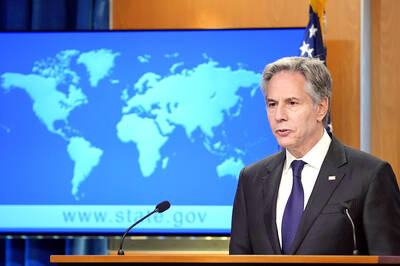
Beijing is continuing to commit genocide and crimes against humanity against Uyghurs and other Muslim minorities in its western Xinjiang province, U.S. Secretary of State Antony Blinken said in a report published on Monday, ahead of his planned visit to China this week. The State Department’s annual human rights report, which documents abuses recorded all over the world during the previous calendar year, repeated language from previous years on the treatment of Muslims in Xinjiang, but the publication raises the issue ahead of delicate talks, including on the war in Ukraine and global trade, between the top U.S. diplomat and Chinese


 RSS
RSS