


A weapons ban by international peacekeepers in war-ravaged eastern Congo has driven many militiamen out of Bunia, posing a major challenge to the authorities, and to child-care agencies.
The ban on "visible arms" was imposed on June 25 by the French-led UN-mandated peacekeeping force in Bunia, the main town in the province of Ituri where some 50,000 have died in ethnic clashes since 1999.
As a result of the ban, those militiamen, many of them mere children, who opted to hang on to their weapons have moved out of Bunia and back into the bush.
A number of them have settled in Nyakunde, some 40km west of Bunya.
Their camp is a former hospital, one of the better equipped in troubled Ituri until it was ransacked in September last year during a larger attack in which at least 1,200 civilians were massacred.
Whatever equipment was too heavy to take out was smashed to pieces. Youthful militiamen now rest their feet nonchalantly on the debris.
The camp is home to some 300 militiamen from the Lendu community, which is dominant in Ituri, and most of them are children.
They are dressed in anything from rags to camouflage T-shirts and fake Versace gear. Their weapons are similarly eclectic, ranging from arrows and machetes to old assault rifles, along with spears much taller than the junior warriors themselves, who nevertheless know how to use them to deadly effect.
Teenagers shout their welcome at a visiting photographer and the younger children -- some only nine or 10 years old -- take to dancing in the dust.
This being Africa, the child soldiers soon beg for something -- anything: money, cigarettes, food.
Some are so young that they will gladly take sweets in lieu of cigarettes. And as they stand in front of what used to be a model hospital, they complain about a lack of medicines.
According to humanitarian staff, nearly one in two militiamen fighting in Ituri is under 18.
Staff at UNICEF, the UN child care agency, recognize that as long as clashes continue outside Bunia, effective demobilization of the child soldiers will remain a major challenge.
At the same time, they add, children should not stay in demobilization centers for too long.
UNICEF is also worried that once out of rehabilitation, child soldiers may be forced back into militias, or be subject to reprisals.
"The problem is that the conflict is dragging on", lamented Trish Hiddleston, UNICEF's head of child protection in DR Congo.
"Trying to provide a safe environment to those children when they go back to their communities is quite a challenge."

Republican US lawmakers on Friday criticized US President Joe Biden’s administration after sanctioned Chinese telecoms equipment giant Huawei unveiled a laptop this week powered by an Intel artificial intelligence (AI) chip. The US placed Huawei on a trade restriction list in 2019 for contravening Iran sanctions, part of a broader effort to hobble Beijing’s technological advances. Placement on the list means the company’s suppliers have to seek a special, difficult-to-obtain license before shipping to it. One such license, issued by then-US president Donald Trump’s administration, has allowed Intel to ship central processors to Huawei for use in laptops since 2020. China hardliners

A top Vietnamese property tycoon was on Thursday sentenced to death in one of the biggest corruption cases in history, with an estimated US$27 billion in damages. A panel of three hand-picked jurors and two judges rejected all defense arguments by Truong My Lan, chair of major developer Van Thinh Phat, who was found guilty of swindling cash from Saigon Commercial Bank (SCB) over a decade. “The defendant’s actions ... eroded people’s trust in the leadership of the [Communist] Party and state,” read the verdict at the trial in Ho Chi Minh City. After the five-week trial, 85 others were also sentenced on

Conjoined twins Lori and George Schappell, who pursued separate careers, interests and relationships during lives that defied medical expectations, died this month in Pennsylvania, funeral home officials said. They were 62. The twins, listed by Guinness World Records as the oldest living conjoined twins, died on April 7 at the Hospital of the University of Pennsylvania, obituaries posted by Leibensperger Funeral Homes of Hamburg said. The cause of death was not detailed. “When we were born, the doctors didn’t think we’d make 30, but we proved them wrong,” Lori said in an interview when they turned 50, the Philadelphia Inquirer reported. The
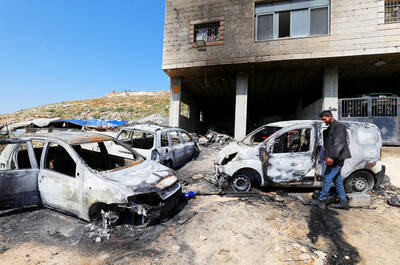
RAMPAGE: A Palestinian man was left dead after dozens of Israeli settlers searching for a missing 14-year-old boy stormed a village in the Israeli-occupied West Bank US President Joe Biden on Friday said he expected Iran to attack Israel “sooner, rather than later” and warned Tehran not to proceed. Asked by reporters about his message to Iran, Biden simply said: “Don’t,” underscoring Washington’s commitment to defend Israel. “We are devoted to the defense of Israel. We will support Israel. We will help defend Israel and Iran will not succeed,” he said. Biden said he would not divulge secure information, but said his expectation was that an attack could come “sooner, rather than later.” Israel braced on Friday for an attack by Iran or its proxies as warnings grew of


 RSS
RSS